Room 349: Who Shot Arnold Rothstein, the Gambler Who Owned New York?
On Sunday evening, 4 November 1928, Arnold Rothstein walked into a restaurant near Broadway and 50th Street, in the middle of Manhattan, New York, and sat down in his usual booth.
He was 46 years old. He lived on Fifth Avenue. He was the best-known gambler in the United States.
The restaurant was his office. He came at the same hours almost every night. Men who needed money, or a favour, or a debt settled, came there to find him. That night, several of them were already waiting.
One of them ran a large gambling club with money Rothstein had lent him. He would later tell the police what happened next.
At about 10:15 in the evening, Rothstein was called to the telephone. The call was short. He hung up and signalled to the club owner to step outside with him.
On the pavement, Rothstein said: "McManus wants to see me at the Park Central." He took a revolver from his pocket, handed it over, and said: "Keep this for me, I will be right back."
Then he walked north along Seventh Avenue, alone, towards the Park Central Hotel. It stood about 6 blocks away, between 55th and 56th Streets. A walk of a few minutes.
He did not come back.
The man who got shot
To understand why this case mattered so much, you have to know who Rothstein was.
In the 1920s, alcohol was illegal in the United States. Huge sums moved through gambling, smuggled liquor, loans and bribes. Rothstein stood in the middle of all of it. He lent money to gamblers and to gangsters. He bankrolled clubs. He was close to the politicians of the city's ruling Democratic machine. The newspapers called him "The Brain" and "The Big Bankroll".
He was widely believed to have been behind the fixing of the 1919 baseball World Series. He was never charged with it.
He was also famous for one more thing. He paid what he owed. Or at least, he always had.
In 1928 that changed.
The card game
The trouble began at a card game in the autumn of 1928, in a Manhattan apartment.
The sources do not agree on the exact date. One account puts the game from 8 to 10 September. A news magazine of the time, writing a few weeks after the murder, says late September. Both agree it was a marathon: a game of stud poker and high-card betting that ran for more than 24 hours without a break.
The host was George McManus, a well-known bookmaker. One of his brothers was a police officer, another was a priest. The players included a professional card player from the West Coast, a famous travelling gambler known as "Titanic", and several others.
Rothstein lost badly.
How badly is also disputed. One account gives a total of about 322,000 dollars, split between 3 winners. The news magazine reported an IOU for 349,000 dollars. Another source says 320,000. All the figures are in the same range: an enormous sum in 1928.
Rothstein left the table without paying.
Weeks without paying
That was not like him. Soon the rumour spread that he was holding back on purpose.
He told a friend that he had been warned the game was rigged. The friend advised him to pay anyway, so as not to advertise that he had been fooled. Rothstein still did not pay.
There was also a simpler reason. His businesses were deep in debt. He had bet very heavily on the presidential election of 6 November 1928. If his candidates won, he would collect between 550,000 and 570,000 dollars, depending on the source. Until then, he did not have the cash. He told the winners to wait until after the election.
The winners would not wait quietly. The pressure fell on McManus, because the game had been in his care and he had vouched for Rothstein: "He's good for it." According to later accounts, McManus asked a powerful politician of the city machine to lean on Rothstein. McManus also began drinking, and was heard threatening him.
That was the situation on the night of 4 November. McManus had taken room 349 at the Park Central Hotel, under a false name, "George Richards". It was from there, according to the investigation, that the phone call came.
A man on the service stairs
What happened inside the hotel between about 10:20 and 10:50 is not known. That half hour is the whole mystery.
What is known begins at the back of the building.
Near the service entrance on the 56th Street side, a night watchman and the operator of the staff elevator saw a man walking slowly down the service corridor. He was holding his stomach. He was well dressed. He asked them to call him a taxi, to take him home.
It was Rothstein. He had been shot once, low in the belly.
At 10:53 the police station on West 47th Street logged the message: "Man reported shot in Park Central Hotel, Seventh Avenue and 56th Street. Ambulance dispatched." A patrolman who had answered a street alarm box reached the service entrance within minutes.
Rothstein would not say where he had been shot, or by whom.
The gun in the street
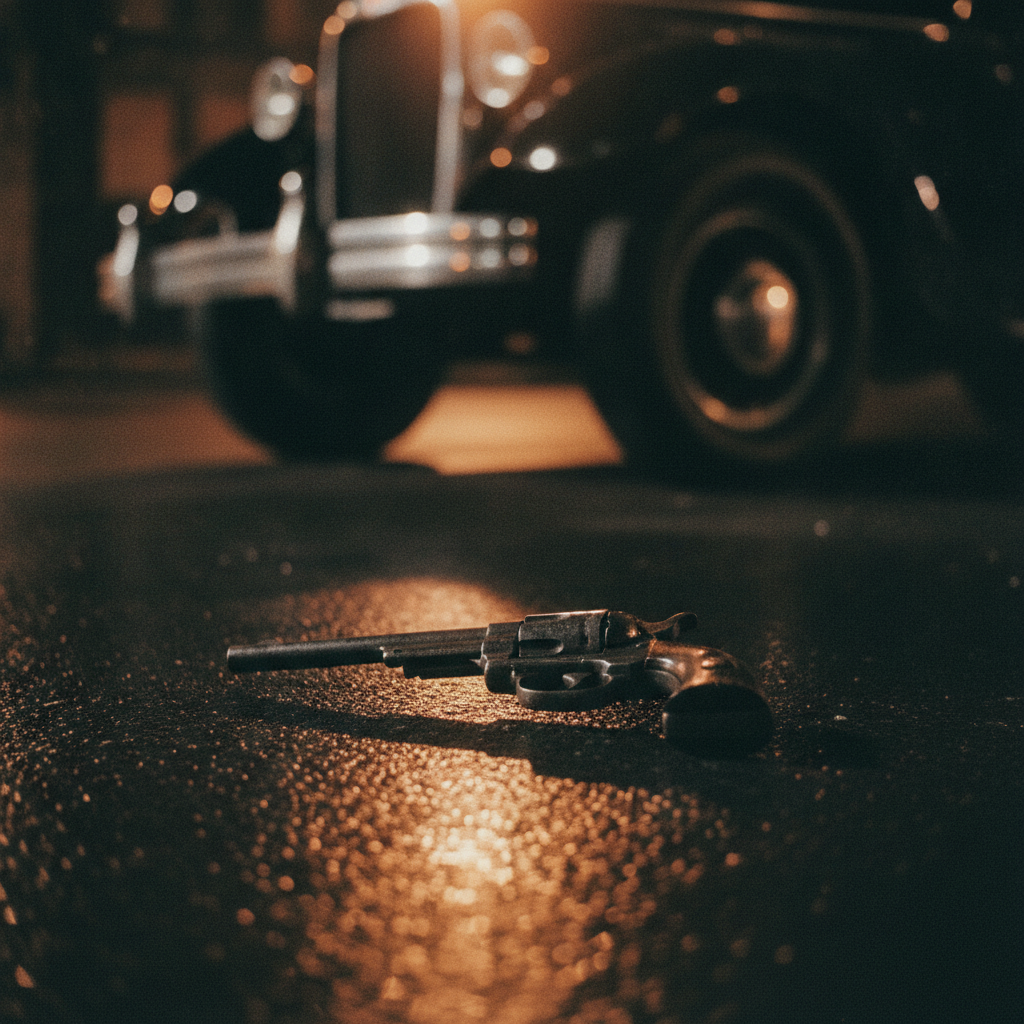
Outside, at almost the same time, a taxi driver on Seventh Avenue found a revolver lying in the road.
It was a .38 calibre revolver. It had been fired. It was dented, as if it had fallen from a height. According to later accounts it had bounced off the bonnet of a parked taxi before landing. The news magazine of the time estimated a fall of about 3 floors.
Some guests later said they thought they had heard a shot. A taxi driver thought he had heard a car backfire. Nobody saw who fired.
Two days in hospital
An ambulance took Rothstein to the Polyclinic Hospital in Manhattan.
The surgeons operated that night. The bullet had entered just above the groin and travelled downwards. It had cut an artery. He had lost a great deal of blood inside his body. The bullet was removed. When he came out of the operating room he was unconscious.
His wife and his 2 brothers were called. He was given a blood transfusion, and morphine for the pain.
On Monday morning he woke up. He told his wife he wanted to go home. During the day his lawyer brought a will, and he signed it.
The police came to his bed and asked the one question that mattered: who shot you?
He would not say. Several answers are reported. One was: "I'll take care of it myself." Another, to a detective: "You stick to your trade. I'll stick to mine."
Late on Monday afternoon he spoke to his wife again. He asked her not to leave, saying he could not stand being alone. Then he slipped into unconsciousness.
He never woke up. Arnold Rothstein died at about 10:20 in the morning on Tuesday, 6 November 1928. It was election day.
His candidate for president won. His candidate for governor of New York won. Because he was dead, the bets did not pay out.
He was buried the next day, in a Jewish cemetery in Queens.
**That is the documented core of the case. A phone call, a walk of a few minutes, a hotel room, a bullet, a gun in the street, and a victim who took the name of the shooter to his grave. Everything after this is the story of the effort to prove who fired, and how it failed.**
What the police found in room 349
The detectives went to room 349.
They found a room that had been left in a hurry. There were several empty whiskey bottles and glasses. And on a hook there was an overcoat.
It was a dark Chesterfield coat. The name "George McManus" was sewn inside it.
That coat became the centre of the case. It put McManus in the room that night. What it could not do was say when he had left, whether Rothstein had ever been in the room, or who had held the gun.
McManus himself was gone.
The city waits
Days passed without an arrest.
The pressure grew quickly. A news magazine counted 6 "big" unsolved murders in New York in the previous 18 months. This looked like the seventh. Newspapers hinted openly that the killers had political protection.
The question was dangerous for the city's ruling machine. Rothstein had been close to its politicians. A murder that stayed unsolved looked like a cover-up. A murder that was solved might expose who Rothstein had been paying.
The mayor gave his police commissioner a deadline. The commissioner, by the accounts of the time an honest man, could not meet it. About 6 weeks after the shooting he was forced to resign. The mayor replaced him with the city's official greeter of foreign dignitaries.
Three weeks in hiding
According to later accounts, on the night of the shooting McManus contacted a powerful politician of the city machine. A gangster's associate was sent to collect him and hide him.
About 3 weeks after the shooting, McManus arranged his own surrender. He was taken in at a barbershop on Broadway, by a detective who served with his brother. He pleaded not guilty. He refused to answer the district attorney's questions.
He was held without bail. The district attorney announced to the press: "We have a beautiful case of circumstantial evidence."
The card players
The police also arrested the other men from the card game. They had the best motive of anyone: they were owed hundreds of thousands of dollars.
Each one had an alibi for the night of 4 November. They were released.
A second name
In December 1928 a grand jury charged 2 men with first-degree murder.
The first was McManus.
The second was Rothstein's bagman, the man who carried payments for him. According to later accounts he had been at the hotel that night. The bagman was never arrested. He had disappeared. One later account says he fled to Cuba. He never came back to face the charge.
So only one man would stand trial.
What else the search turned up
The investigation spread into every part of Rothstein's life. What it found had nothing to do with the shooting, and everything to do with who he had been.
In his files, investigators found papers that led federal agents to a drug-smuggling network. At the Grand Central railway station in New York they seized 2 trunks of opium, cocaine, heroin and morphine, valued at the time at 2 million dollars. 2 people linked to the network were arrested in other cities.
Federal agents also announced that Rothstein had been in business with a Belgian financier who had fallen to his death from his own plane over the English Channel that summer. A later biographer of Rothstein argued that the financier's death cut off money for a drug deal, and squeezed Rothstein even further.
None of this said who fired in room 349.
The case comes apart
Then the witnesses began to change their stories.
A chambermaid at the hotel had told the police that she saw McManus in room 349 on the night of the murder. She was considered so important that she was held in jail as a material witness, to make sure she would testify.
The telephone operator at the hotel had told the police that McManus's call to the restaurant was placed at exactly 10:12 in the evening. That placed him in the room minutes before the shooting.
By the time of the trial, the operator could no longer say what time the call was made. Other witnesses no longer remembered what they had told the police. Their testimony, in the words of one account, was "hazy at best".
In March 1929, McManus was released on bail of 50,000 dollars. The chambermaid was still in jail.
The trial
The trial opened in Manhattan in late 1929, about 13 months after the shooting.
The prosecution presented its case. It had the coat with McManus's name. It had the room registered under his false name. It had the motive: the card game, the debt, the threats.
What it did not have was a single witness who could place McManus in the room at the moment of the shooting. It did not have a witness who saw Rothstein go into the room. Even the gun could not be linked to McManus.
The district attorney later admitted that he had no evidence that Rothstein had ever entered room 349 at all.
When the prosecution finished, the defence did not even need to call a witness. The judge directed the jury to acquit. In December 1929, George McManus was found not guilty.
According to one account, he walked out of the courtroom wearing the overcoat. Minutes earlier it had been tagged as a prosecution exhibit.
Under the law, McManus is innocent of the murder of Arnold Rothstein. He was tried and acquitted, and the presumption of innocence applies to him in full. He died of natural causes in 1940, in New Jersey.
Where the case stands
The murder of Arnold Rothstein was never solved. Nobody else was ever tried for it. The second man charged, the bagman, was never caught.
The reasons are plain.
The only person who certainly knew who fired was the victim, and he refused to say.
No witness saw the shot. The witnesses who had placed McManus in the room changed or lost their memory before the trial. Nobody could even prove where in the hotel Rothstein had been shot. The gun was found in the street, but no one could tie it to a person.
**From here on, nothing is proven. What follows are theories, each one attributed to whoever proposed it.**
The theories
**A quarrel in the room that ended in a shot.** The evidence: the empty bottles, the reports that McManus had been drinking and making threats, and the fact that Rothstein was shot once, in the belly, not in the head. A crime writer argued in 1999 that a planned gangland killing would not look like this. He suggested a drunken confrontation, maybe even a shot fired in a struggle. The problem: McManus was tried for exactly this and acquitted. A later biographer reported that, years afterwards, McManus told a friend while drunk that he had done it. That story is second-hand and was never tested in any court.
**The bagman fired.** The evidence: the bagman was charged together with McManus and fled before he could be arrested. The biographer of the famous gambler "Titanic", who had played in the card game, wrote that the gambler later told acquaintances that the shooter was not McManus but the bagman. At the trial, the same gambler testified that McManus was "a swell loser" who would never have shot anyone. The problem: this rests on what one man is said to have told others years later. The bagman was never questioned in a court.
**A rival gang.** The evidence: in 1971 a crime reporter, in a biography of a New York bootlegger of the era, suggested that the bootlegger had Rothstein killed in revenge for the killing of one of his own associates. The problem: no document places that man near the hotel. And as the crime writer of 1999 noted, an assassination would not normally end with one shot in the stomach and a victim still walking.
**Something bigger than a card debt.** The evidence: Rothstein's empire was large, and men around him did take it over after his death. The drug trunks showed how much money was involved. The problem: there is no direct evidence that his death was planned for this reason. The only motive documented on the night itself is the card debt.
What remains open is the half hour inside the Park Central Hotel. Who was in room 349 when Rothstein arrived. Whether he was shot there at all. And who threw a fired revolver into Seventh Avenue. Nearly a century later, the only man who could answer took the answer with him.