Seven Travellers in the Forest: The Backpacker Murders of Australia
In the late 1980s, Australia was one of the great destinations for young travellers.
They came from Britain, Germany and every corner of the world. They arrived in Sydney, slept in cheap hostels in the Kings Cross district, and then set out across the country with a backpack and very little money.
Many of them hitchhiked. It was cheap, it was common, and it felt safe. You stood by the road, held out a thumb, and a stranger drove you hundreds of kilometres.
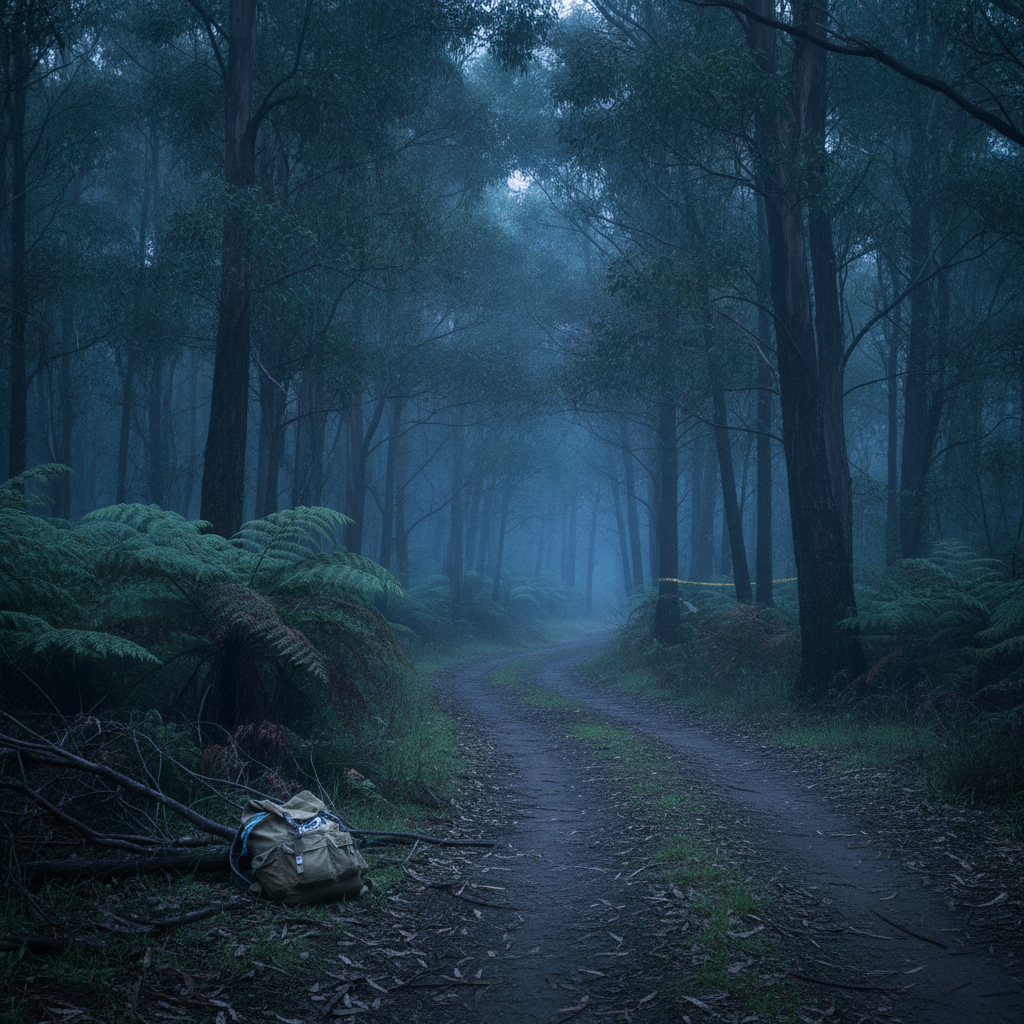
The main road south from Sydney toward Canberra and Melbourne is the Hume Highway. Just over an hour's drive south-west of the city, near the small town of Berrima, the highway passes the edge of a large forest. Its name is Belanglo State Forest.
Between the end of 1989 and the spring of 1992, 7 young people who set off on that road never arrived anywhere.
This is the story of the backpacker murders: 7 victims, 2 years of searching in the forest, and a police investigation that was finally broken open by a man who had escaped.
What the case is
In short: a man picked up young travellers on the highway south of Sydney, drove them into Belanglo State Forest, and killed them there. He hid their bodies under branches and ferns.
For years nobody even knew there was a killer. The travellers were simply listed as missing.
When the bodies were finally found, in 1992 and 1993, the police faced a forest full of graves and no name.
The man who was eventually convicted was a man from Sydney's south-west named Ivan Milat. How the police reached him is the heart of this story.
The first two bodies
On 19 September 1992, two runners were doing orienteering in Belanglo State Forest. Orienteering is a sport where you run through rough country with a map and a compass.
Off the track, they noticed a strange pile of sticks and ferns. Under it was a human body.
The police came. The next morning they searched the area and found a second body, about 30 metres away. It was hidden in the same way.
Dental records gave them names. They were 2 young British women: Caroline Clarke, aged 21, and Joanne Walters, aged 22.
The 2 friends had been travelling in Australia together. They were last seen in Kings Cross, Sydney, on 18 April 1992. That was 5 months before the runners found them.
Joanne Walters had been stabbed 15 times.
Caroline Clarke had been shot in the head 10 times. The evidence showed she was shot at the place where she was found.
Near the bodies, police found .22 calibre cartridge cases. A .22 is a small-calibre rifle, a very common type of gun.
At this point the police had 2 victims, a forest, and a very common rifle calibre. They had no suspect.
A man who kept looking
The forest is large. It covers about 3,500 to 3,800 hectares of trees, fire trails and gullies.
After the British women were found, one local man began searching the forest alone. He was a potter who lived in the area. For 9 months he walked the remote parts of Belanglo, looking for anything else.
On 5 October 1993, while collecting firewood, he found bones.
The police came back. In that remote corner they recovered 2 more bodies. They belonged to 2 young Australians, both aged 19: James Gibson and Deborah Everist. Deborah was from Frankston, near Melbourne.
The man who found them was at first treated as a suspect himself. He was cleared. Later he developed post-traumatic stress disorder from the experience.
A false trail to the north
The story of James Gibson and Deborah Everist showed how badly the early leads had pointed the wrong way.
On 30 December 1989, the 2 friends left Sydney. They were heading south, to a large alternative-lifestyle festival called ConFest, near the town of Albury on the border between New South Wales and Victoria.
They never arrived.
At the end of December 1989, James Gibson's camera was found at a place called Galston Gorge. In March 1990, his backpack was found there too.
Galston Gorge is more than 120 km north of Belanglo. It is on the other side of Sydney.
So for almost 4 years, the only physical traces of the missing couple pointed north, away from the highway they had set out on. The search for them had been looking in the wrong direction.
When their bodies were found in Belanglo, the meaning was clear. Someone had taken them south, killed them in the forest, and then dropped their belongings far to the north.
James Gibson had been stabbed. Deborah Everist had been beaten to death.
Now there were 4 bodies in one forest. Police no longer believed this was chance.
Task Force Air
On 14 October 1993, the New South Wales Police set up a special team to hunt the killer. It was called Task Force Air. It began with more than 20 detectives and analysts. It was led by a senior officer, Superintendent Clive Small.
The task force's first job was to find out whether there were more victims.
There was a list of young travellers who had vanished on the roads of New South Wales. Police organised a careful sweep of the forest, walking the fire trails in lines.
On 1 November 1993, the searchers found a skeleton in a clearing beside a fire trail.
It was Simone Schmidl, a young German woman. She was 21. On 20 January 1991 she had left Sydney to hitchhike to Melbourne. Nobody had seen her since.
She had been stabbed at least 8 times. One wound had cut through her spine.
There was something odd at the scene. Some of the clothing lying near her body was not hers. It matched clothing belonging to another missing German traveller: Anja Habschied.
3 days later the police found out why.
The last two victims
On 4 November 1993, on a nearby fire trail, searchers found 2 shallow graves about 50 metres apart.
They held Anja Habschied, aged 20, and her boyfriend, Gabor Neugebauer, aged 21. They were both from Germany.
The couple had left Kings Cross on 26 December 1991. They had planned to travel on, and they had vanished on the way.
Gabor Neugebauer had been shot 6 times.
Anja Habschied had been beheaded. Her skull was never found. To this day, it has not been found.
Seven people, one pattern
The task force now had 7 victims, found in 4 separate places in the same forest.
The forensic teams compared every scene, and a clear pattern came out.
At several scenes they found .22 calibre bullets, empty cartridge cases and cartridge boxes. When these were compared in the laboratory, they matched each other. They came from the same 2 weapons. This linked the scenes together.
Near each body there was a small campsite. The killer had not simply dumped his victims and driven away.
Most of the victims had been stabbed many times. Many showed signs of sexual assault.
Each body had been left in the bush and covered with a pile of sticks and ferns, built up like a small pyramid.
The killings had taken place over about 2 years and 4 months. The first known couple vanished at the end of 1989. The last known victims vanished in April 1992.
The investigators now knew 3 things. The killer used a .22 rifle. He knew Belanglo State Forest well, including its remote fire trails. And he picked up travellers on the road.
What they did not have was a name.
A flood of names
On 5 November 1993, the New South Wales government raised the reward for information to 500,000 Australian dollars.
Police issued public warnings against hitchhiking on the Hume Highway.
Calls came in from the public. The task force had to sort through people who owned .22 rifles, people who had been seen near the forest, people who drove the highway, and people reported by neighbours, relatives and ex-partners.
To manage this, the analysts used a method called link analysis. They took several different lists and looked for names that appeared on more than one of them.
They used road vehicle records, gym memberships, gun licences and the police's own internal records. A name on one list meant little. A name on 3 or 4 lists meant a great deal.
Step by step, this cut the list of possible suspects from 230 names down to 32.
One of the names that stayed on the short list was a man from the outer south-western suburbs of Sydney.
His name was Ivan Milat.
The call from England
Then, on 13 November 1993, a call came in from the United Kingdom.
The caller was a British man named Paul Onions. He wanted to tell the police what had happened to him almost 4 years earlier, near the same forest.
On 25 January 1990, Paul Onions was a young backpacker in Australia. He was planning to travel to Mildura, a town in Victoria, far to the south-west.
He set off from Liverpool station, in Sydney's south-west, and started hitchhiking south. Just south of a suburb called Casula, a man stopped and offered him a ride. The driver said his name was "Bill."
At first it was a normal ride. They talked.
Then, near the town of Mittagong, less than 1 km from Belanglo State Forest, the driver stopped the car. He pulled out a revolver and a set of ropes.
Paul Onions did not wait to find out what the ropes were for. He jumped out of the car and ran onto the highway.
The driver came after him and fired at him. Onions kept running and waved at the passing cars.
A woman driving past stopped for him. She let him into her car and drove him away.
The 2 of them went straight to the police station in Bowral, a town nearby. They gave a description of the attacker and of his vehicle. A police officer wrote it down.
Then the report vanished.
The report that went missing
This is the part of the story that later caused the most anger.
In January 1990, a young man had walked into a police station near Belanglo and reported that a driver had pulled a gun and ropes on him and fired at him, less than 1 km from the forest.
At that time, nobody knew there was a killer in the forest. The first 2 victims were already dead, but they were only listed as missing.
The original written report was lost. Nothing connected it to anything else.
When Paul Onions called from England in November 1993, his call was noted down. But in a flood of tips, it was not followed up straight away.
Only on 13 April 1994 did detectives find the note of his call again and see what it meant.
They then went back to look for the original 1990 report. The report itself was gone. But the details survived in a constable's notebook.
At about the same time, 2 other important people contacted the task force.
One was the woman driver who had rescued Paul Onions on the highway in 1990.
The other was the girlfriend of a man who worked alongside Ivan Milat. Her information also pointed toward him.
Now the pieces from different directions all pointed to the same man.
Watching the house
The police had in fact been watching Ivan Milat since before the call was rediscovered. Surveillance of his house on Cinnabar Street, in the suburb of Eagle Vale in Sydney's south-west, began on 26 February 1994.
The investigators checked his work records. They found that he had not been at work on the days when the victims disappeared.
They also learned something about his car. At the time of the killings, he drove a silver Nissan Patrol, a large four-wheel-drive vehicle. Soon after the first 2 bodies were found in September 1992, he sold it.
On 5 May 1994, Paul Onions flew from Britain to Australia.
The police showed him a set of photographs. He picked out Ivan Milat as the man who had called himself "Bill," pulled the gun and the ropes, and shot at him.
This was the first witness who could put Ivan Milat beside the forest with a gun, threatening a traveller.
The arrest
On 22 May 1994, about 50 police officers surrounded the house on Cinnabar Street.
They knew he had guns. Ivan Milat was arrested inside the house.
At first he was not charged with murder. He was charged with robbery and weapons offences connected with the attack on Paul Onions. This gave the police the legal power to hold him and search.
On 23 May 1994 he appeared in court. He did not enter a plea.
What the searches found
The searches that followed were among the largest in the history of the New South Wales Police.
In Ivan Milat's own house, police found a .22 calibre Anschütz rifle, a Browning pistol and a large Bowie knife.
They also found parts of a .22 calibre Ruger 10/22 rifle. Some of the parts had been hidden. According to later accounts, one part was found tucked inside a leather work boot in a bedroom wardrobe.
The Ruger was the key. Ballistics experts compared the parts with the cartridge cases and bullets from the forest. The parts matched the type of weapon used in the murders and were identified as components of the rifle used in at least 2 of the killings.
The house also held things that did not belong to Ivan Milat.
There was camping equipment. There was a tent. There was foreign currency. There were cameras. One of the cameras was identified as belonging to Caroline Clarke, the British woman found in the forest in 1992.
Further victims' belongings were found in the house, in the kitchen and in the garage.
In parallel, more than 300 police officers searched the homes of his mother and of his 5 brothers. They found 24 weapons and about 250 kg of ammunition, together with more items that belonged to the victims.
On 31 May 1994, Ivan Milat was charged with the 7 backpacker murders.
The committal hearing
In Australia, before a major trial, a magistrate holds a hearing to decide whether there is enough evidence to send the case to a jury. This is called a committal hearing.
Ivan Milat's committal hearing ran from 24 October to 12 December 1994. More than 200 witnesses were heard.
The magistrate sent the case to trial. Ivan Milat was kept in custody.
The trial
The trial opened on 26 March 1996 in the Supreme Court of New South Wales, in Sydney.
The prosecution's case did not rest on a confession. There was none. It rested on a chain of evidence, link by link.
The cartridge cases in the forest matched each other, so the killings were linked.
The rifle parts in his house matched the murder weapon.
The victims' belongings were in his house and in his family's homes.
He had not been at work on the days of the disappearances.
He had sold his car soon after the first bodies were found.
And a living witness, Paul Onions, said that this man had picked him up on the same highway, stopped near the same forest, and drawn a gun and ropes on him.
The defence argued that all of this was circumstantial. There was no witness to any of the 7 killings. No one had seen him with any of the victims who died.
The defence also suggested that other people around him could have had access to the guns and the belongings. The jury did not accept this. No one else was ever charged with the murders.
During the trial, 145 witnesses gave evidence.
On 18 June 1996, Ivan Milat went into the witness box himself and gave evidence in his own defence. He denied the murders.
The verdict
The trial lasted 18 weeks.
On 27 July 1996, the jury returned its verdict. Ivan Milat was found guilty of all 7 murders: Deborah Everist, James Gibson, Simone Schmidl, Gabor Neugebauer, Anja Habschied, Caroline Clarke and Joanne Walters.
He was also found guilty of the attempted murder, false imprisonment and robbery of Paul Onions.
He was sentenced to life in prison on each of the 7 murder counts, without the possibility of parole. For the crimes against Paul Onions, he received 6 years on each count.
The appeals
Ivan Milat appealed again and again.
In November 1997, the New South Wales Court of Criminal Appeal dismissed his first appeal.
In 2004, the High Court of Australia refused him special leave to appeal.
On 27 October 2005, the Supreme Court of New South Wales refused what was described as his final avenue of appeal. Further applications in 2006 and in November 2011 were also rejected.
The conviction stood.
His death
In May 2019, Ivan Milat was diagnosed with terminal cancer of the oesophagus.
He died at 4:07 in the morning on 27 October 2019, in the hospital wing of Long Bay Correctional Centre in Sydney. He was 74.
Afterward
The conviction itself has never been overturned, and the evidence that convicted him was tested by every court in the country.
But one question remains open for the families. Anja Habschied's skull was never found. Ivan Milat died without ever saying where it was.
For the families of the 7 young people who set off down the Hume Highway, that small missing piece is the last part of the story that the investigation could not close.