The Brighton Trunk Murders: a Woman With No Name at the Station, and a Second Body Found by Chance
On Sunday 17 June 1934, a cloakroom attendant at the railway station in Brighton noticed a smell he could not ignore.
Brighton is a seaside town on the south coast of England, about 75 km south of London. In the 1930s, trains brought crowds down from the capital every summer weekend.
The attendant worked in the left-luggage office. Travellers paid a small fee, handed over a bag or a trunk, and got a ticket back. They collected it later. Almost all of them did.
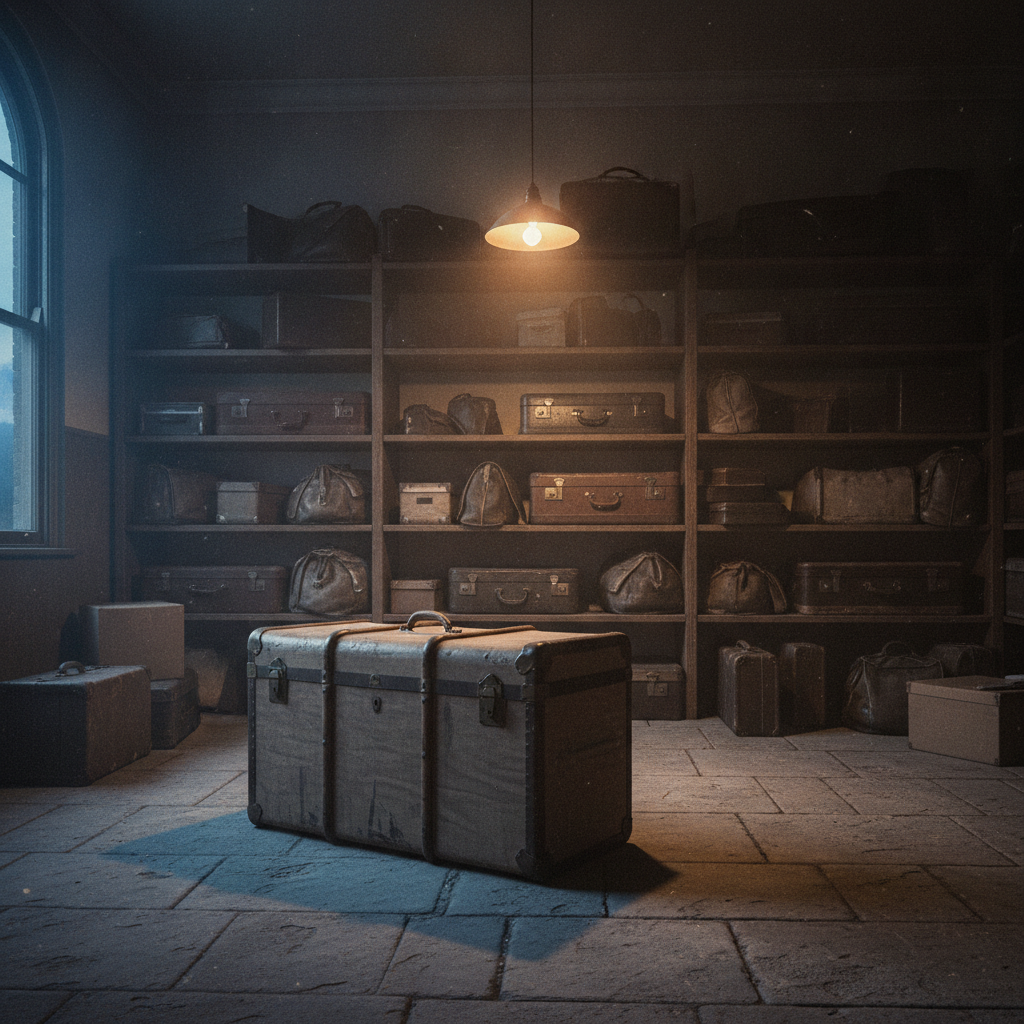
One plywood trunk had been standing there for about 11 days. Nobody had come for it. In the June heat, the smell coming from it had grown worse every day.
The attendant called the railway police. The trunk was opened.
Inside, wrapped in layers of paper and cotton wool soaked in blood and tied with sash cord, was the torso of a woman.
There was no head. There were no arms. There were no legs.
A woman with no name
She is the centre of this story, and almost nothing is known about her.
She was young, probably about 25. She was about 1.57 m tall and weighed about 54 kg. She was 5 months pregnant.
The newspapers soon gave her a nickname. Her feet, found a day later, were small and well kept, like the feet of a dancer. So the papers called her "Pretty Feet".
That nickname is all she has. In 92 years, nobody has found out her name, where she lived, who the father of her child was, or who cut her body apart and left it at a railway station.
This is the case known as the Brighton trunk murders. It is called "murders", in the plural, because the hunt for this one woman's killer led the police, by pure chance, to a second woman in a second trunk, a few minutes' walk from the station. That second case went to trial. The first one never did.
The legs in London
The Brighton police knew at once that this was more than they could handle alone. The town's chief constable asked Scotland Yard, the headquarters of the London police, for help.
Scotland Yard sent a chief inspector. The sources do not even agree on his first name: Robert in some accounts, Ronald in others. He arrived in Brighton and took charge.
The first step was obvious. If part of a body had been left in one left-luggage office, the rest might be in another. Railway stations across the country were told to check their unclaimed luggage.
The next day, 18 June 1934, staff at King's Cross, one of the main railway stations in London, found a case that had been left there. Inside were a woman's legs and feet.
The sources describe the container differently. Most say a suitcase; one says a second trunk. On what was inside, they agree: the legs belonged to the same woman.
The head and the arms were never found. Not in 1934, and not since.
What the pathologist found
On 19 June 1934, the remains were examined by the most famous pathologist in Britain at the time, a man whose evidence had helped send many killers to the gallows.
His notes gave her age as between 21 and 28, most likely about 25. He confirmed the pregnancy: about 5 months.
He found no sign that anyone had tried to end the pregnancy before she died. This point mattered, as we will see.
He also found that whoever had cut up the body had no particular skill. The cuts were not the work of a surgeon.
What he could not say, with no head and no arms, was how she had died. Most accounts state that the cause of death was never established. One later account says it was probably a blow to the head with a heavy, blunt object. The sources do not agree, and the head, which might have settled the question, was never found.
One account of the case reports a further clue from the wrapping: a scrap of paper with the letters "ford" written on it. It could have been the end of a place name, a surname or the name of a shop. It was never traced to anything.
So the police had a body without a name, a cause of death they could not prove, two pieces of luggage nobody remembered, and 4 letters on a scrap of paper.
Nobody remembered the trunk
The trunk had been left in Brighton about 11 days before it was opened. That put the day it was handed in at around 6 June.
The clerk who had taken it in was questioned. He could not remember who had handed it over.
That was not strange. Hundreds of bags passed through the office. A plain plywood trunk was nothing special.
It was the same at King's Cross. Nobody could describe the person who had left the case with the legs.
Whoever it was had used the railway as a hiding place. The body was split between 2 cities about 75 km apart, and the person who did it then simply walked away into the crowds.
The search for a missing woman
Without a face, there was only one way to identify her: find a woman who had gone missing and who matched what the pathologist had described. Young, small, about 5 months pregnant, gone since early June.
The police went through the cases of about 700 missing women. One by one, those women were found alive, or ruled out because their age, their height or their dates did not fit.
They checked hospitals, in case she had been a patient somewhere. They checked the people known to carry out illegal abortions, which in 1934 was a serious crime in England. A young pregnant woman who died in secret was, the police reasoned, quite possibly a woman who had gone to such a person for help.
According to one account of the case, it was also the first time the police turned to the public directly through the newspapers, asking anyone who knew of a missing woman to come forward.
Tips came in. Each one had to be followed up.
In July 1934, one of them took Scotland Yard detectives across the sea to Jersey, a small British island off the coast of France. A French woman who had lived there matched the description. She had been writing to a couple on the island, and her letters had stopped at about the time the trunk appeared in Brighton.
The detectives followed the trail. It led nowhere. She was not the woman in the trunk.
A doctor under watch
From early on, the chief inspector had one man in mind.
He was a local doctor who was known to carry out illegal abortions. A pregnant young woman, a death nobody could explain, a body cut up by someone without great skill: the chief inspector thought the pieces could fit together.
He put the doctor under secret watch.
Then something happened that he did not learn about until later. An officer from Hove, the town right next to Brighton, went to the doctor and confronted him directly.
According to the main account of the case, the doctor answered by reciting a list of important names - people of the kind he had helped. The officer did not report this conversation to the chief inspector.
The chief inspector only found out when a senior officer told him to back off.
A second account says the doctor wrote the list of names down, and was released without any charge.
Either way, the result was the same. That line of inquiry stopped. The famous pathologist, for his part, did not believe the doctor was the killer.
**This is where the evidence about the woman in the trunk ends. Everything after this point about who killed her is a theory, not a fact.**
The door-to-door search
While the hunt for the woman's name went on, police officers also went through the streets near the station, house by house. Someone had carried a heavy trunk to that left-luggage office. Perhaps somebody nearby had seen it, or had seen something else.
At about the same time, a newspaper reporter brought the police a name. A woman who lived in Brighton had not been seen since May. Her name was Violette Kaye.
She did not match the woman in the trunk. She was 42 years old, not 25. But she was missing, and the police went to look for her.
The second woman
Violette Kaye had been a dancer in London. By 1934 she was earning her living as a prostitute.
In September 1933 she had moved to Brighton with a man 16 years younger than her, Tony Mancini. He was 26. He used several names and had a criminal record for theft and loitering. In Brighton he worked as a waiter and a bouncer, including at the Skylark, a cafe on the seafront.
On 10 May 1934, the two of them had a row at the Skylark. She accused him of an affair with a teenage waitress who worked there.
That was the last day anyone saw Violette Kaye alive.
On 11 May, Mancini told friends that she had gone to Paris. He gave some of her clothes to the young waitress.
That same morning, a telegram was sent from Brighton to one of Kaye's relatives in London. In her name, it said that she had found a good job abroad. The police later established that by the time it was sent, she was already dead.
Mancini then moved to new lodgings at 52 Kemp Street, a few minutes' walk from the railway station. He took a large black trunk with him, pushing it there on a handcart.
He put the trunk at the foot of his bed, covered it with a cloth, and used it as a table. Visitors complained about the smell. Some saw liquid leaking from it.
A coincidence in Kemp Street
The police had already spoken to Mancini about Kaye's absence. The chief inspector interviewed him and let him go.
Then, in July 1934, the house-to-house search reached 52 Kemp Street. Officers opened the trunk at the foot of the bed.
Inside was the body of Violette Kaye. Unlike the woman at the station, her body had not been cut up.
By then, Mancini was gone. He had left Brighton.
On 17 July 1934, 2 London police constables spotted him on a road in south-east London. They watched him for a while, and then arrested him.
The same pathologist examined Kaye's body. His finding: she had died from a blow to the head.
So the police had an arrest, but in the wrong case. There was no evidence at all linking Mancini to the woman with no name. He was charged only with the death of Violette Kaye.
The trial
The trial opened on 10 December 1934 in Lewes, the county town near Brighton. It lasted 5 days.
The prosecution's case looked strong.
The pathologist said that Kaye had died from a blow to the head.
A handwriting expert compared the telegram form with menus that Mancini had written out by hand at the Skylark cafe. He said the handwriting matched.
A young woman told the court that Mancini had asked her to give him a false alibi.
Friends said that after Kaye disappeared, he had boasted of giving his "missus" a beating.
Mancini told a different story. He said he had come home and found her already dead. Because of his criminal record, he said, he was sure the police would never believe he had not killed her. So he panicked, and hid her in the trunk.
He was defended by one of the most famous defence lawyers in England. The lawyer did not try to prove that his client was innocent. He tried to show that nobody could be sure.
He told the jury about Kaye's work, and suggested that one of her clients could have killed her. He suggested she might have fallen down a flight of stone steps. He challenged the level of morphine found in her blood. He showed that some of the bloodstained clothes the prosecution relied on had been bought after her death. Witnesses said the couple had seemed content together.
Most damaging of all, he cross-examined the famous pathologist, and the pathologist's evidence was badly shaken.
The jury went out for 2 hours and 15 minutes. They came back with their verdict: not guilty.
Tony Mancini walked out of the court a free man. The court had found him not guilty, and in law that verdict stands.
42 years later
In 1976, at the age of 68, Mancini gave an interview to the News of the World, a British Sunday newspaper.
He told the reporter that he had killed Violette Kaye after all.
He said they had argued, and she had come at him with a hammer used for breaking coal. He took it from her. When she demanded it back, he threw it, and it struck her on the left temple.
The authorities considered charging him with perjury - lying under oath at his trial. They decided there was not enough independent evidence to support the confession, and dropped the idea. He could not be tried a second time for the killing itself. He died in the 1970s.
His account was never tested in a court. What stands on the record is a verdict of not guilty in 1934, and a newspaper confession 42 years later.
Brighton had seen this before
Part of what made 1934 so shocking in Brighton was that the town already had a trunk murder in its past.
In 1831, a man killed his wife, who worked as a painter on the town's Chain Pier. He put her body in a trunk, moved it on a wheelbarrow, and buried it in a park on the edge of town. He was tried in Lewes and hanged on 16 December 1831.
When the newspapers of 1934 reported the trunk at the station, they dug up that old story too.
Where it stands
Of the two Brighton trunk murders of 1934, one ended in a trial and an acquittal, followed decades later by a confession that no court ever tested.
The other one - the first one, the woman at the station - was never solved at all.
Her name was never found. Her head and arms were never found. The person who left the trunk in Brighton and the case at King's Cross was never identified. The scrap of paper with "ford" on it led nowhere. The 700 missing women led nowhere. The trip to Jersey led nowhere. The doctor the chief inspector suspected was never charged.
92 years have passed. Anyone who might have remembered a young pregnant woman who vanished in early June 1934 is now almost certainly dead. Unless her head or her arms are one day found, or an old family letter turns up, it is hard to see how the case could ever be closed.
The suspects and the theories
Only 2 people have ever been named on the record as possible killers of the woman in the trunk. Neither was ever charged. Both died long ago.
**The doctor who performed illegal abortions.** The evidence: the victim was pregnant, the chief inspector suspected the doctor from the start, and the inquiry into him was stopped from above. Years later, in London, a woman died during an illegal abortion he carried out, and again he was not prosecuted. He stayed on the medical register until 1952, when he was removed after retiring to Trinidad. The problem: the pathologist found no sign of any attempt to end the pregnancy. The pathologist himself did not believe the doctor was the killer. No physical evidence ever linked him to the trunk.
**A man suggested by a 2020 BBC documentary.** In 2020, the BBC series "Dark Land: Hunting the Killers" suggested a man already linked to another case. In 1919, a young woman had vanished from a cottage on the coast of Wales. In 1961, potholers found her body, cut into pieces, in a disused mine about 200 m from the cottage. An inquest that year found that this man had killed her. He had died in 1958, so he never faced a trial. The problem: the documentary's argument rests on the similarity between the two cases - a woman, a dismembered body, a man who hid it. It produced no direct evidence linking him to Brighton or to the trunk.
**Tony Mancini.** The police did look at whether the man with a body in his room was also the man behind the trunk at the station. The problem: there was never any evidence linking him to the first trunk. The police did not charge him with it, and his 1976 confession spoke only of Violette Kaye.
None of these theories explains the one thing that would matter most: who she was.