The Cellar in North London and the Telegram from the Sea
On the last evening of January 1910, a woman named Cora Crippen had friends over for supper.
She was in her mid-thirties, born in New York, and had lived in London with her husband for 13 years. She sang in music halls under a stage name. Her career had never really taken off, but she loved that world, and the women who worked in it loved her back. She was the treasurer of their charity club.
The house was a rented 3-storey house in Holloway, a quiet street in north London. The guests were an old music hall performer and his wife. There was supper, and then cards. The man felt unwell during the evening, and the couple left after midnight.
Cora said goodbye to them at the door. Her husband went out into the cold to find them a cab.
That is the last moment anyone outside the house is known to have seen her alive.
Later, the prosecution would argue that she died in the early hours of 1 February 1910, a few hours after the guests left. Nobody has ever been able to prove the exact hour. There was no witness, no sound, no call for help.
Her husband was a small, quiet American of 47, with gold-rimmed glasses and a thin moustache. His name was Hawley Harvey Crippen. He had a diploma in homeopathic medicine from the United States. He was not licensed to practise as a doctor in Britain, but everyone called him "Doctor" anyway. He sold patent medicines from an office in central London and was a partner in a small dental business.
In that office worked a typist in her twenties. She had been his lover for several years.
In one sentence: a wife disappeared, her husband said she had gone to America and died there, and the police had to discover whether that was true.
The lies begin
On 2 February, the day after the supper, the women's club received a letter. It was written in Cora's name, but not in her hand. It said that a close relative in America had fallen ill, and that she had to leave for America at a few hours' notice. She was resigning as treasurer.
The same week, her husband pawned some of her jewellery. The total came to about 195 pounds, a large sum at the time. Other pieces he gave to the typist.
On 7 February he visited the couple who had come to supper. He said Cora had gone straight to California. His friends noticed the detail. Cora had no family in California. He did.
On 20 February there was a charity ball for music hall performers. He came with the typist. She was wearing a brooch in the shape of a rising sun.
Several women in the room knew that brooch. It was Cora's.
A few weeks later the typist moved into the house in Holloway.
In March the story changed again. He wrote to his friends that Cora was dangerously ill in America with pneumonia. On 24 March a telegram arrived at their home. It said that Cora had died the day before, at 6 o'clock.
A short death notice appeared in a theatre newspaper. He told people that she had been cremated, and that her ashes would be sent to him.
The friends who would not let go
The women of the club did not believe him.
Their doubts were small and practical. Cora had never once mentioned a sick relative. She had left without saying goodbye to anyone. She had left behind her clothes and her jewellery, which she loved more than almost anything. And the man who was supposedly in mourning was going to balls with a young woman wearing his wife's brooch.
One of the members asked a friend to check the passenger lists of the ships that had sailed from France in early February. He found no record of Cora on any of them. The ship her husband had named did not even sail to America until 12 March.
On 30 March two women from the club went to see him at his office. He said Cora had fallen ill on the boat and died when she arrived. He gave them an address in America where she had died. It turned out to be the address of his own grown-up son from his first marriage. One of the women wrote to the son. The reply took a month to arrive, and it did not settle anything.
In June a couple of music hall performers who were close friends of Cora came back from a tour of the United States. They had asked around there. Nobody had heard of Cora dying.
On 28 June they went to see her husband. They asked him where exactly she had died. First he named one big city in California. Then he said it was a small town near another one. When they pressed him, he said he could not remember the name.
Two days later, on 30 June 1910, the couple went to Scotland Yard.
The chief inspector believes him
The case was given to a chief inspector with long experience. As a young constable in 1888, he had worked in the East End of London during the Jack the Ripper murders.
He did not rush. For about a week he interviewed the women of the club and wrote a report to his superior. He noted that the husband's stories contradicted each other in a "most extraordinary" way. But he also wrote that he was not sure a crime had been committed.
On the morning of 8 July he went to the house with a sergeant. The typist opened the door. Then the two detectives went to the husband's office.
Crippen did not argue. According to the chief inspector's account, he said he supposed he had better tell the truth. He admitted that everything he had said about Cora's death was invented.
His new story was this. Cora had left him. She had often threatened to go off with another man, a music hall performer she had known in America. On 1 February, he said, he came home from work and she was gone. To avoid the shame of being a deserted husband, he made up the illness and the death.
The statement took hours. In the middle, all three men went out to a nearby Italian restaurant for lunch. The chief inspector later wrote that Crippen ate a steak like a man without a care in the world.
In the afternoon they went back to the house together. The chief inspector walked through every room. He looked in the cellar, where the coal was kept. He found nothing.
Before leaving, he told Crippen he would have to find Cora to clear the matter up. Together they drafted a newspaper advertisement asking her to get in touch.
The chief inspector went home that evening fairly satisfied. He later admitted that he had liked the man. On the facts in front of him, this looked like a sad marriage, not a murder. The case was close to being closed.
Then the doctor runs
The next morning, Saturday 9 July, Crippen went to his office as usual.
He sent an assistant out to buy a set of boy's clothes: a suit, shirts, a tie and a hat. The typist changed into them in the office. The two of them took the underground, then a train to the coast, then the night boat across the sea to Holland. From there they went on to Belgium.
In a hotel in Belgium, Crippen signed the register as "John Robinson". The typist became his son, "John Robinson Junior".
A day or two later, the chief inspector went back to the office with a few questions he wanted to tie up. The assistant told him the doctor had left on Saturday with a suitcase and had not come back.
This was the moment the case turned. Until then, the investigators had a man who had lied about his wife. Now they had a man who had lied about his wife and then fled the country the day after talking to the police.
What was under the cellar floor
The detectives went back to the house and searched it again. They found a loaded revolver. They searched a third time. Nothing.
On 12 July the assistant at the office told them about the boy's clothes. The chief inspector sent a new description to the ports: the woman might be dressed as a boy.
On 13 July, the chief inspector went down to the coal cellar for the fourth time. It was a small, dark space with a brick floor. He took a poker and began tapping and prodding the bricks, one by one.
In one place, the bricks moved.
The sergeant fetched a spade from the garden. Under the bricks was a layer of clay, and under the clay was lime. Under the lime were human remains.
The smell was so strong that the two men had to keep going up into the garden for air. The chief inspector had seen one of the Ripper's victims in 1888. He later said that this was worse.
What they found was not a whole body. There was no head. There were no arms, no legs, no bones at all. What remained was a mass of flesh and organs from the trunk of a body.
Mixed with the remains were a few objects. There was a woman's hair curler with some bleached hair still wound in it. And there were pieces of a man's pyjama top.
On 16 July warrants were issued for the arrest of Crippen and the typist.
A message from the sea
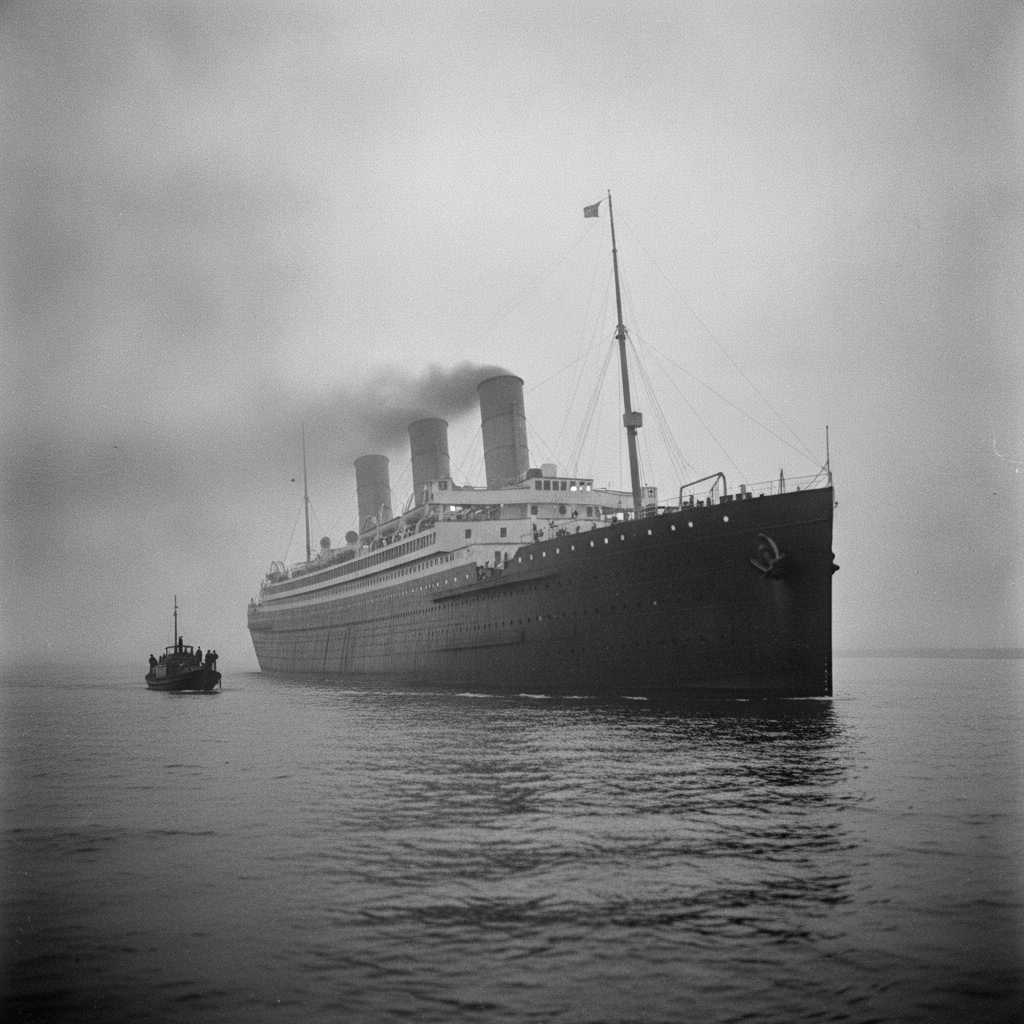
On 20 July a ship called the Montrose left the port of Antwerp, in Belgium, bound for Quebec, in Canada. The crossing was more than 5,000 km and would take about 11 days. There were 266 passengers on board.
Two of them were Mr Robinson and his son.
The captain was a careful man, and he read the newspapers. Almost at once he noticed something odd about this father and son. He saw them squeezing each other's hands, which fathers and sons did not do. The boy's trousers were too tight in the wrong places. The man had marks on the bridge of his nose, as if he usually wore glasses, and he was growing a beard over a freshly shaved moustache.
The captain took a newspaper photograph of Crippen. With chalk, he covered the moustache and the glasses. The face that was left was the face of Mr Robinson.
The Montrose had something that very few ships had in 1910: a wireless telegraph. It could send messages through the air to stations on land, but only within a few hundred kilometres. On 22 July, just before the ship sailed out of range of the English coast, the captain had his operator send a message to his company in England.
The message said, in short: he had strong suspicions that the London cellar murderer and his accomplice were among the passengers. The moustache was gone, a beard was growing. The accomplice was dressed as a boy, but the voice, manner and build were undoubtedly those of a girl.
By that evening the telegram was on the chief inspector's desk.
He looked at the shipping timetables. The Montrose was slow. A faster liner, the Laurentic, was leaving from England the next day for the same river in Canada. If he took it, he could get there first.
His superior gave him permission that night. On 23 July he sailed under a false name.
He was not able to keep it secret. Within a day the newspapers knew. For the next week, readers in Britain and America followed the chase every morning, with maps showing the two ships crossing the ocean. Everyone knew what was happening, except the two people it was happening to. The Montrose was now out of range. Crippen and the typist had no idea.
On about 27 July the Laurentic overtook the Montrose in the middle of the Atlantic. The chief inspector reached the St Lawrence river, the way into Quebec, about a day and a half ahead.
On the morning of 31 July, the Montrose slowed at the mouth of the river to take on a local pilot, as every ship did. A small boat came alongside. Among the men who climbed aboard was one in a pilot's uniform and cap, with 2 Canadian police officers.
The captain sent for Mr Robinson and brought him up to meet the pilots. The man in the pilot's cap held out his hand, took off his cap, and said: "Good morning, Dr Crippen."
According to the chief inspector's own account, Crippen answered: "Thank God it's over. The suspense has been too great. I couldn't stand it any longer."
The typist was found in her cabin, reading a book. When she saw who it was, she screamed and fainted.
The trial and the 27 minutes
The trial opened in London on 18 October 1910 and lasted 4 days.
The prosecution had to prove 2 things: that the remains were Cora's, and that her husband had killed her.
On the first point, the evidence came from science. A Home Office chemist tested the remains and found hyoscine, a powerful plant poison that in tiny doses was used as a sedative. And the pharmacy records showed that on 19 January 1910, 12 days before the supper, Crippen had bought a large quantity of it from a chemist's shop in central London, about a third of a gram. He had signed the poisons register for it. That was far more than any ordinary medical use required.
The defence said the remains must have been buried before the Crippens moved into the house in 1905. The pyjama top answered that. The label was from a London shop, and a witness from the manufacturer testified that this pattern had not been sold before 1908.
Then there was the skin. Among the remains was a piece of skin from the lower belly, about 15 by 18 cm, with a mark on it. Cora had had an operation in America years earlier and had a scar there. Her friend had seen it. A young pathologist at the start of his career told the court that the mark was a surgical scar.
The defence brought 2 doctors who said the mark was only a fold in the skin. Under cross-examination, both admitted they had examined it only briefly, and both now agreed it was a scar. The piece of skin was passed around the jury in a dish.
Crippen gave evidence himself and repeated that Cora had left him. He could not explain the poison, the pyjamas, or why he had run.
The jury was out for 27 minutes. The verdict was guilty.
A few days later the typist was tried separately as an accessory after the fact. She was acquitted.
Crippen was hanged in a London prison on 23 November 1910, at 9 in the morning. He asked that the typist's letters and photograph be buried with him, and the prison governor agreed. In a last letter he wrote that he believed facts would one day come out to prove his innocence.
Here the file reopens
In 2007, a forensic scientist at a university in the United States announced a new result.
The Metropolitan Police had kept a microscope slide with a sample of tissue from the cellar, taken from the piece of skin with the scar. The American team extracted DNA from it. They traced 3 living relatives of Cora through her mother's line, and compared the DNA.
It did not match.
Later, the same team said further tests showed that the tissue on the slide came from a man. They also said they had found hair follicles in the tissue, which a real scar should not have. The work was published in a scientific journal in 2010.
The claim went around the world. A campaign was started for a posthumous pardon. In 2009, the official body in Britain that reviews possible miscarriages of justice said it would not send the case back to the Court of Appeal.
The new result was also challenged. Critics pointed out that it rested on a single slide, about 100 years old, which the team leader himself had called a "less than optimal" sample. They asked whether the slide really came from the cellar, and whether it could have been contaminated by the many people who had handled it over a century. The team answered that its tests were clear.
The hair from the curler, which might settle the matter, is kept in a police museum in London. As of the last published reports, it has not been tested.
**So this is where the documented record stands: a man was convicted of murdering his wife, a woman who was never seen again, and a modern DNA test says the only surviving sample from the cellar did not come from her.**
Conclusions and Open Questions
The investigation itself is not in doubt. Cora disappeared. Her husband lied about it for 5 months, pawned her jewellery, fled under a false name with his lover in disguise, and had bought a poison that was later found in the remains under his cellar floor. The chief inspector did not invent any of that.
What is in doubt is one link in the chain: whose body was it?
**The remains were Cora's, and the verdict was right.** The evidence: the poison he bought 12 days earlier was found in the remains. The pyjamas were from his house and from after 1908. The hair in the curler was bleached, like hers. The scar was where her scar was. And Cora was never seen again, anywhere, by anyone. The problem: the only modern test on the only surviving sample says the tissue is not hers, and not even a woman's.
**The DNA test is wrong, and the slide is not what it seems.** The evidence: a single 100-year-old slide is a fragile basis for overturning a verdict. Labels can be mixed up, and old samples can be contaminated. Some forensic experts have made exactly this criticism. The problem: the team says its results were clear. Nobody has yet shown that the slide came from somewhere else.
**The remains were someone else's, and Cora left alive.** This is what Crippen said at his trial. The problem: then who was the man buried under the cellar floor, full of the same poison Crippen had bought? And why did Cora, who loved the stage and her friends, never write to anyone, never perform again, and never come forward, even when her husband was about to hang?
**Crippen killed Cora, and the body was someone else's victim.** Some writers have suggested this as a way to fit all the facts together. The problem: it requires 2 bodies, and there is evidence for none of them apart from the one in the cellar.
What remains open is the question that one test could close. If the hair in the curler were tested and compared with Cora's relatives, we would know much more.
Until then, the case of the cellar in north London remains the rare file that is both solved and not solved. The court's verdict stands. The man was hanged. And the woman who waved her friends goodbye at the door on the last night of January 1910 has never been found, alive or dead, in any way that everyone accepts.