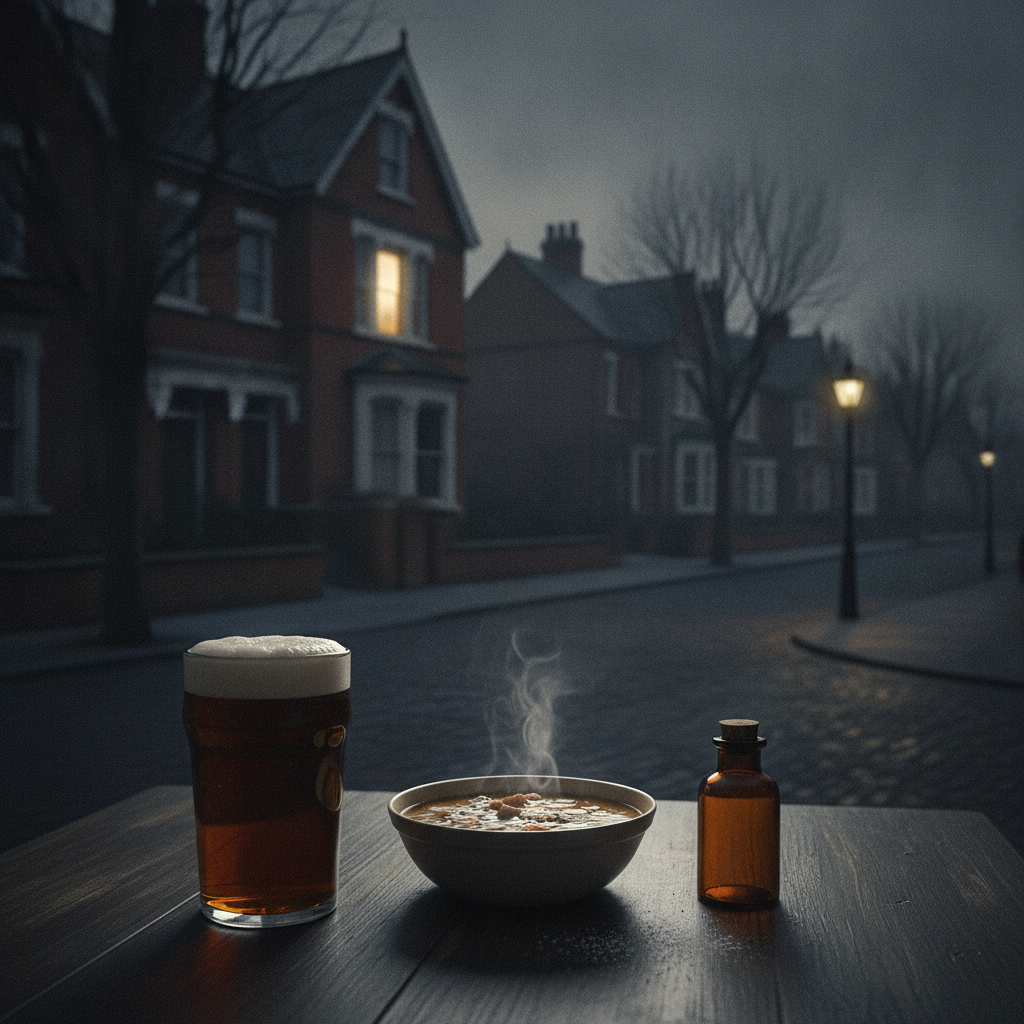
The Croydon Poisonings: 3 Deaths From Arsenic in One Family, and No One Ever Charged
On the evening of 26 April 1928, a retired colonial official named Edmund Duff came home from a short fishing trip.
He had spent a few days in the south of England with an old friend from his years in the colonies. He came back tired and a little unwell. His wife, Grace, had dinner ready: chicken and potatoes.
He barely touched the food. He drank one bottle of beer.
The family doctor came that evening. He found a slight temperature and some nausea. He prescribed aspirin, quinine and rest, and went home.
The next morning was worse. Edmund Duff had a sore throat, he was vomiting, and he had diarrhoea. The doctor came back, this time with his partner. Both men agreed it was an upset stomach.
By the evening he had violent cramps and could not stand up. Nothing the doctors gave him helped. He died a little after 11 at night.
The sources do not agree on the exact day. Some give 26 April for his return, some 23 April for his departure, and the date of his death appears as 26 or 27 April. What they agree on is the order of events: dinner, one night of illness, one day of agony, death.
**This is the first of 3 deaths. Within less than a year, 2 more people from the same family would die in the same way, a few doors apart.**
The family on Birdhurst Rise
To understand the case, you need to know who lived where.
Croydon is a town about 15 km south of central London, in England. In the 1920s it was a comfortable suburb for the professional middle class. Birdhurst Rise is a quiet residential street there.
Edmund and Grace Duff lived at number 29 with their children.
A few minutes' walk away lived Grace's mother, Violet Sidney, a widow in her late 60s, and Grace's unmarried sister, Vera Sidney, who was about 40. Vera lived with their mother and had her own money: an inheritance of about 5,000 pounds from their father.
There was also a brother, Tom Sidney. He was a professional stage entertainer who was often short of money and relied on his mother and sister for help. He was married.
This is the case known as the Croydon Poisonings, and here it is in one sentence: 3 members of one family died of arsenic within 11 months, the poison was hidden in something only the victim ate or drank, and although the police narrowed it down to a handful of relatives, they could never prove who did it.
The first death is closed as natural
After Edmund Duff died, there was a post-mortem and an inquest. An inquest is the English court that decides how a person died.
The doctors who examined his body found no sign of food poisoning. They found no poison except the medicine he had been given. The inquest jury returned a verdict of natural causes.
Nobody else in the house had been ill, although they ate the same chicken. The friend he had stayed with reported that nobody in his house was ill either.
Later, it came out that the first examination had tested only one organ for poison. That organ happened not to contain any arsenic. Nobody looked further.
**For almost a year, the death of Edmund Duff was officially natural.**
Winter 1929: Vera
In January 1929, Vera Sidney started to feel unwell. She was normally an energetic woman. Now she was always tired, and then she was sick.
By 10 February she was too ill to leave the house. The next day she felt better. She went for a long walk and played bridge.
That evening, 11 February, the cook served dinner: soup, then fish, vegetables, potatoes and pudding. Only Vera had the soup. Her mother ate everything else. The cook shared what was left of the soup with the family cat.
That night, Vera was ill. So was the cook. So was the cat.
The soup on 13 February
Two days later, on 13 February, Vera's aunt came to lunch. Grace drove the aunt over but did not stay.
The cook served soup again, made from the same packet of broth powder, followed by veal and vegetables.
Vera ate the soup. The aunt ate the soup. Violet Sidney, the mother, did not.
Vera and the aunt both became violently ill. Vera blamed the soup. The cook could not explain it. Nothing looked wrong with the powder or the pans.
That night Vera's pain was severe. Grace called the same family doctor, who gave her morphine.
On 14 February a specialist was called in. He diagnosed gastro-intestinal influenza, a stomach flu.
Vera Sidney died just after midnight, early on 15 February 1929. She was 40. Once again, the doctors said she died of natural causes.
The aunt was seriously ill but survived. She said afterwards that she had been poisoned.
March 1929: the mother
Violet Sidney was crushed by the death of her daughter. The family doctor prescribed her a tonic to help her through her grief. She was the only person in the household who took it.
On 5 March 1929, after lunch, she took her dose. She said it tasted strange and gritty.
Grace found her pale and weak. The mother said, plainly, that she had been poisoned, and she blamed the tonic. She told the doctor that the liquid had burned her throat.
The doctor looked at the bottle. He saw a gritty sediment at the bottom. The chemist who had prepared the tonic said it contained a tiny dose of strychnine, far too small to harm anyone, and nothing that could cause such symptoms.
By the afternoon she was vomiting and had cramps. The doctor thought it was food poisoning. She lost consciousness, and that evening she died. She was 69.
3 deaths in 11 months. Each one sudden, each one with the same symptoms: vomiting, diarrhoea, cramps. This time the surviving family members themselves asked for an inquest.
**The coroner agreed, and from this point the deaths were no longer treated as natural. They were treated as a possible crime.**
The bodies are dug up
The investigation began with the dead.
On 22 March 1929 (one newspaper of the time gives 21 March), Vera and her mother were exhumed from the grave they shared. On 15 May 1929, Edmund Duff was exhumed as well.
The examination was carried out by the most famous forensic pathologist in Britain at the time, a man whose evidence had sent many murderers to the gallows.
The answer was the same in all 3 bodies: arsenic. Edmund Duff's body held so much that he must have swallowed a large quantity at once. Traces of arsenic were also found in the mother's tonic bottle.
Arsenic is a white powder with almost no taste. In the 1920s it was easy to obtain. Many households kept it, mixed into weed killer and rat poison. The symptoms of arsenic poisoning are vomiting, diarrhoea and cramps, and doctors of that era often mistook them for food poisoning or stomach flu. That is exactly what had happened 3 times on Birdhurst Rise.
Later accounts say that a tin of arsenic-based weed killer was found in a garden shed belonging to the family. The pathologist's evidence was that the poison had reached each victim in something only that victim consumed: Edmund Duff's beer, which nobody else in the house drank; Vera's soup; and the mother's tonic.
That detail is what turned a family tragedy into a murder inquiry. Whoever did this knew the habits of each victim.
Scotland Yard arrives
Local detectives from Croydon went to the houses first. Officers from Scotland Yard, the London police headquarters, then took over. Their file on the case still exists in Britain's National Archives.
The investigators questioned everyone. The family, the cook, the doctors, the neighbours, the chemist. They traced who had been in each house on each day and who had access to the food, the beer and the medicine.
They quickly ran into the central problem of the case. The 3 deaths happened in 2 different houses, months apart. Most of the people who had access to one victim did not have access to another.
The detectives went through the possible suspects one by one.
The cook
The cook had prepared the soup that poisoned Vera and the aunt, and she had access to the mother's kitchen.
But she had no access to the Duff house, where Edmund died. She had no known reason to kill anyone. And she herself had eaten from the soup on 11 February and fallen ill. Investigators did not think a poisoner would knowingly eat her own poison. She was cleared.
The family doctor
The family doctor had treated all 3 victims and signed off the first 2 deaths as natural.
During the investigation he admitted to the police that he and Grace Duff had "been indiscreet". Rumours in the town said the 2 might marry after Edmund Duff's death. That could be a motive to kill the husband.
But it gave him no reason to kill Grace's sister and mother. He was never charged.
The mother herself
Some people suggested that Violet Sidney had poisoned her son-in-law and her daughter, and then, in guilt or grief, poisoned herself.
The jury at her inquest could not rule this out. That is why her inquest ended without a murder verdict.
But nobody found a reason why she would kill either of them. She disliked her son-in-law, but disliking someone is not a motive for murder. And she had lived with Vera, under one roof, for years.
The brother
Tom Sidney was short of money and depended on his mother and sister. Under their wills, he stood to inherit a substantial sum from both of them.
That is a motive for 2 of the deaths. But investigators found no reason for him to want Edmund Duff dead. Nor could they place him in the Duff house with the beer.
The sister and wife
Grace Duff was the only person connected to all 3 victims. She was the wife of the first, the sister of the second and the daughter of the third.
She had been in or near each house around the time of each death. She was present at the sickbeds. She too inherited from her mother.
But there was no direct evidence. Nobody saw her near the beer, the soup or the tonic. No purchase of arsenic was traced to her. She grieved in public and cooperated with the police.
At the inquests, the press of the time reported that she and her children were placed "above suspicion".
The inquests in summer 1929
In summer 1929 the inquests reached their verdicts. The case was followed in newspapers as far away as America and New Zealand.
On 29 July 1929, the jury in Vera Sidney's case found that she had been murdered, probably by poison put in her soup, by a person or persons unknown.
On 31 July 1929, the jury in the mother's case found that arsenic had been given to her, but that there was not enough evidence to say whether she had been murdered or had taken it herself. That is called an open verdict.
The first verdict on Edmund Duff, natural causes, was set aside at the request of the Attorney General. A second inquest heard the evidence from June to August 1929. It ended with a verdict of murder by a person or persons unknown.
The pathologist told the court that the poison had been taken in Duff's beer or in the food at dinner on the evening before he died.
The coroner said that there was no evidence pointing to who had administered the poison. During those months, he and his wife received threatening letters, and police guarded their home.
The decision not to charge anyone
On 29 August 1929, the authorities announced that no charges would be brought. There was not enough evidence against any one person.
That was the end of the official investigation.
**From here, nothing new has ever been proven. Every name that has been put forward since 1929 is a theory, not a finding.**
What happened to the family
The surviving members of the family went separate ways.
Tom Sidney emigrated to the United States. Asked about the case years later, his wife said: "Who can say who did it?"
Grace Duff moved to the south coast of England. She and her brother lost contact around 1940 and never spoke again. She died on 24 June 1973, at the age of 86.
The house at 29 Birdhurst Rise was later demolished. A block of flats stands there now.
Where it stands
The case was never solved.
Nobody was ever arrested, charged or tried. Everyone who was suspected has been dead for decades, so nobody can ever be brought to court.
Several things that could have settled it were never found. Nobody traced who bought the arsenic. Nobody saw who put it into the beer, the soup or the medicine. The first examinations of Edmund Duff and Vera were too limited to catch the poison in time, and by the time the bodies were exhumed, the trail at both houses was cold.
What is certain is this: 3 people died of arsenic, each through something only they consumed, within 11 months, in one family, in one street.
The suspects and the theories
**Theory 1: Grace Duff killed all 3.** This is the theory of a British true-crime writer who published a book in 1975, "The Riddle of Birdhurst Rise". He argued that she killed her husband because she hated him, and her mother and sister for money. The book was published only after her death, because of the libel risk while she lived. Most of the witnesses he interviewed believed she was guilty. The problem: the case rests entirely on circumstantial evidence. She was the person most often present, but that is also true of any devoted daughter and sister who sat at sickbeds. Her financial gain from her husband's death was small. A later writer points out that a small life insurance payment was cancelled out by the loss of his pension.
**Theory 2: Tom Sidney killed his mother and sister for money.** He was in debt, he depended on them, and their wills left him substantial sums. He later emigrated to America. The problem: no motive has ever been found for him to kill Edmund Duff, and the poison in Duff's beer was in a different house. If he did not kill Duff, someone else did.
**Theory 3: there was no murderer at all.** A British writer, in a book called "Poisonous Lies: The Croydon Arsenic Mystery", argued that the 3 deaths may not have been murders. She suggested that some of the arsenic came from innocent sources common at the time, that Edmund Duff and Vera may have died of natural illness, and that the mother took the poison herself out of grief. The problem: the pathologist found a large quantity in Duff's body, and the poison in each case was in something only that person consumed. Most writers find this explanation hard to accept, though not impossible.
Later writers also pointed to earlier sudden deaths in the Duff household: 2 of the couple's young daughters, in 1919 and in the mid-1920s, and an elderly lodger in January 1927. None of these deaths was ever shown to be poisoning. They remain part of the speculation, not of the evidence.
Nearly 100 years later, the question has not changed since the coroner's courtroom in 1929. Someone in this family knew which glass, which bowl and which bottle belonged to whom. Nobody has ever proved who.