Three Siblings, a Cancelled Dance and a Paddock at Dawn: The Gatton murders
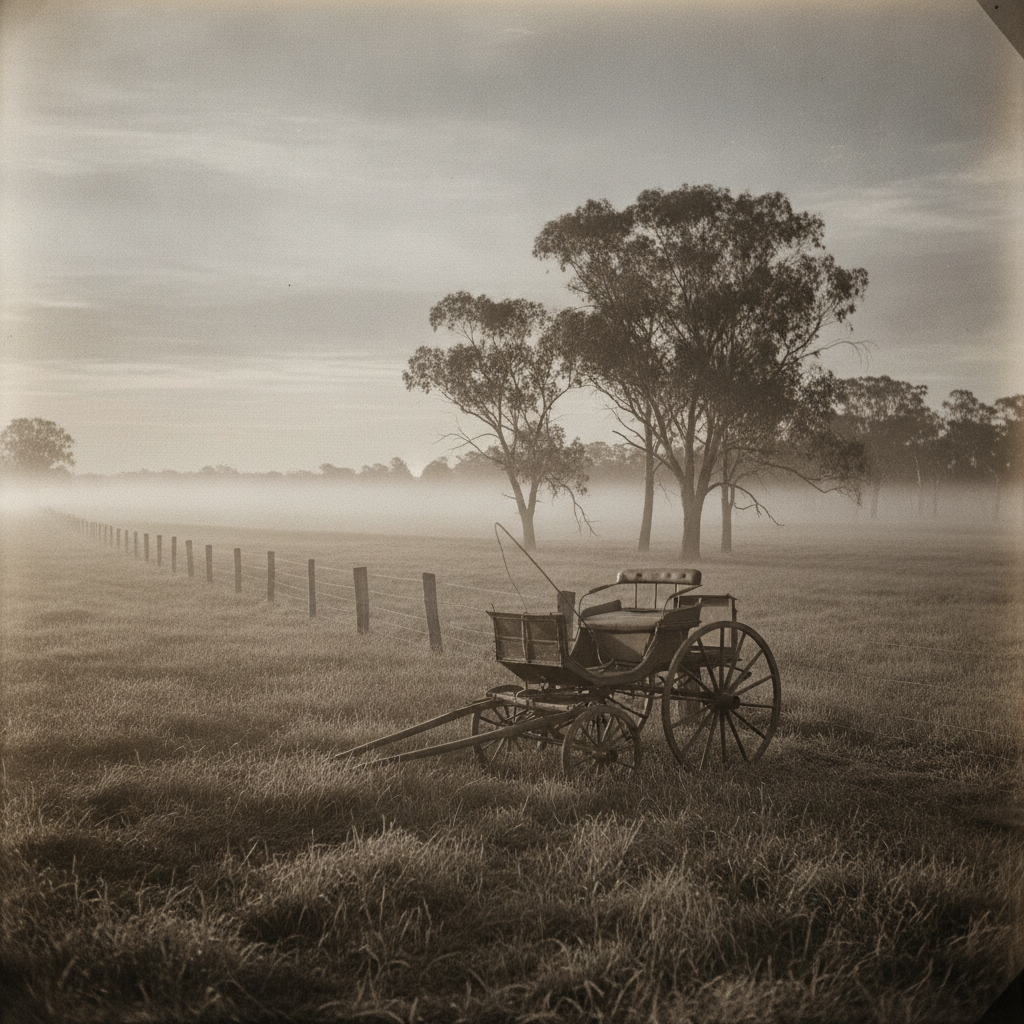
On the evening of Monday, 26 December 1898, Michael Murphy harnessed a horse to a borrowed sulky.
A sulky is a light 2-wheeled cart for 2 or 3 people. This one belonged to his brother-in-law, and it had one wheel that wobbled as it turned.
Michael was 29. He had spent the afternoon at a country race meeting with his youngest sister, Ellen, who was 18. Now the 2 of them, and their sister Norah, who was 27, were going to a dance.
The Murphys were a large Irish-Catholic farming family. Their farm lay on a creek about 13 km outside Gatton, a small farming town in Queensland, Australia, about 90 km west of the city of Brisbane.
The dance was to be held in the town hall in Gatton. It was Boxing Day, a holiday, and a dance was one of the few evenings of entertainment a country district had.
At about 8 in the evening the 3 of them set off. At about 9 they reached the hall.
The hall was dark. The dance had been cancelled.
So they turned the sulky around and started back along the road towards home. It was a warm summer night.
They never arrived.
What this case is
The Gatton murders are, in one sentence, this: 3 young people were killed in a paddock just outside a small town on the night of 26 December 1898, and despite a huge police effort, a Royal Commission and more than 120 years of research, no one was ever charged.
The case became one of the most notorious crimes in Queensland's history. It also became a lesson in how a murder investigation should not be run.
The morning search
On the morning of 27 December the Murphys' mother realised that her 3 children had not come home.
She asked her son-in-law, the man who had lent them the sulky, to go and look for them.
He rode along the road towards Gatton. About 2 km from the town he noticed something on the dusty track: the marks of a wheel that wobbled. He knew that wheel. It was his own.
The tracks turned off the road through a sliprail. A sliprail is a gap in a farm fence closed by loose wooden rails that can be slid aside. The sulky had gone through it into a paddock, a fenced field used for grazing.
He followed the tracks for about 1.2 km into the paddock.
There he found them.
What he found
Michael and Ellen lay on the ground back to back.
Norah lay about 8.5 m away, on a rug that had been spread out on the grass.
The hands of both sisters had been tied with handkerchiefs.
The horse lay dead between the shafts of the sulky. It had been shot in the head. The sulky, the horse and the bodies formed a rough triangle on the grass.
All 3 had been struck violently on the head. Michael and Ellen had died from blows to the skull. A leather harness strap had been pulled tight around Norah's neck. A later examination found that both sisters had been sexually assaulted.
The heat of the summer morning had already set in. Ants were crawling over the bodies.
The first mistake
What the brother-in-law did next was understandable, and it was a disaster for the investigation.
He rode into Gatton, to the hotel, and told the people there what he had found.
Within a short time up to 40 people had hurried out to the paddock. They walked around the bodies. They walked over the ground. Some came to help, some came to look.
Any footprints, hoofprints or wheel marks that the killer had left were most likely trampled into the dust.
The local police officer in Gatton was an acting sergeant. He sent a telegram to police headquarters in Brisbane. But he took no notes at the scene, he did not interview the people there, and he did not guard the paddock. He left 2 civilians in charge of the site, and they did not protect it either.
That afternoon the bodies were moved to the hotel in town.
A doctor from a nearby town examined them there. The examination began at 4 in the afternoon on 27 December and lasted about 1 hour. It was later judged to have been far too quick and superficial.
The telegram that nobody opened
In Brisbane, the next mistake was being made.
The telegram from Gatton reached police headquarters at 12:52 in the afternoon on 27 December. But 27 December was also a public holiday. The telegram sat unopened until 9 the next morning.
One of the Murphy brothers was himself a police officer in Brisbane. He received his own telegram about the deaths on 27 December. He asked for immediate action. He was refused. The detectives believed the report might be a hoax.
At 4 in the afternoon on 28 December, the inspector in charge of the detective branch in Brisbane finally accepted that the murders were real.
He waited about 5 hours before he told the police commissioner.
There was a train to Gatton at midnight. The inspector and 2 detectives did not take it. They left at 7:30 the following morning, 29 December.
They arrived about 48 hours after the bodies had been found. By then the paddock had been walked over by dozens of people, the bodies had been moved, examined and prepared for burial, and the trail was cold.
The Murphy siblings were buried in the Gatton cemetery on 28 December, before the detectives from Brisbane had even set out.
The investigation
When the detectives did arrive, the investigation became enormous.
Over the following months, police took thousands of written statements. They questioned more than 100 people as possible suspects: travelling labourers, local men, people with grudges, people who had been on the road that night.
On 3 January 1899 the government of Queensland offered a reward of 1,000 pounds for information leading to a conviction. It was a very large sum at the time.
The newspapers covered every turn. Reporters from Brisbane and other Australian cities came to Gatton. They criticised the police for bungling the case. The inspector in charge criticised the press for silly and unreliable reporting.
Several things were found, and each one raised more questions than it answered.
Michael's purse was found near his body. It was empty. He was believed to have been carrying 15 shillings.
His hands, unlike his sisters', were not tied when he was found. Nobody could say whether they had never been tied, or whether someone had untied them before the police arrived.
A whip was believed to have been used in the attack. It was never found.
The bullet
The biggest discovery came only after the burial.
The bodies were exhumed, dug up again, for a second examination.
In Michael's skull the doctors found a bullet.
He had been shot in the head. The rushed first examination had missed it, because the bullet wound had been partly hidden by the later blow to his skull.
This changed the picture. The killer, or killers, had carried a revolver. The horse had been shot. Michael had been shot. But the sisters had been beaten.
It also meant that the first official account of how the 3 had died had been wrong.
The magistrate's inquiry
In January 1899, more than 2 weeks after the murders, a formal inquiry opened in Gatton before a police magistrate.
The Murphys' mother gave evidence. She told the inquiry that she knew of someone who held a grudge against her children. The inquiry did not turn this into an arrest.
The brother-in-law who had found the bodies refused to let his wife give evidence. He took her out of the district, to another town. The magistrate criticised him for this in public and ordered her to attend.
Because of this, and because he had been the one to find the bodies, the brother-in-law himself was investigated and talked about in public. He was never charged with anything. Like every other person questioned in this case, he must be considered innocent.
The magistrate's inquiry produced no new answer.
The 2 main suspects
Over the years, 2 men stood out from the more than 100 who were questioned. Neither was ever charged, and both must be presumed innocent.
The first was a swagman. A swagman is a travelling labourer who walked from farm to farm looking for work, carrying everything he owned in a bundle. This man had recently been released from prison. On 7 January 1899 he was arrested, and for a few days the newspapers reported that the Gatton murders had been solved.
Then the police checked his movements. He had a firm alibi. He could be shown to have been somewhere else on Boxing Day. He was released.
The second was a young drifter of about 20. He had arrived in Gatton only a short time before the murders and worked for the town butcher. He lived in a hut about 270 m from the paddock where the bodies were found.
Several people said they had seen him walking along that road on earlier nights. One witness said he had been seen standing near the sliprails of the paddock.
After the murders, his employer, the butcher, noticed blood on his clothing. The young man said it was animal blood, from his work.
In 1898 there was no scientific test that could tell animal blood from human blood. Such a test did not come into use until a few years later.
The butcher told him not to wash one particular jumper. A day or two later the young man washed that jumper, boiled it twice and scrubbed it with a brush.
No further action was taken against him. A few weeks after the murders he left the district.
Where he went
From this point, the documented trail of the young butcher's worker becomes unclear, and the sources disagree.
One account says that soon after he was questioned he joined the army, and that he deserted in May 1899.
Another account, which is less well sourced, says that he died in a hospital in Sydney in 1900 from a gunshot wound, under a different name.
Neither account can confirm what he did, or did not do, on the night of 26 December 1898.
The revolver found in 1906
In 1906, 8 years after the murders, a revolver was found near the butcher's shop where the young man had once worked. It had 4 spent chambers.
Some saw this as a link, because both the Gatton killings and a second murder that same month, described below, are said to have involved 4 shots. But it was never proved that this revolver was the weapon. The claim rests on later interpretation, not on a forensic match.
The other murder
The Gatton case did not happen in isolation.
A few weeks earlier, on 10 December 1898, a 15-year-old boy had gone missing near Oxley, which was then a rural area on the edge of Brisbane. His body was found on 7 January 1899, in a paddock. He had been shot in the back of the head. His pony had also been shot.
A former teacher was charged with the boy's murder. The case against him was dropped and he was never convicted of that killing. He must be presumed innocent of it.
At the time, one police constable became convinced that the same revolver had been used in both cases.
In 2025 2 Australian historians published a book that argues the 2 crimes are connected. They list 26 similarities. Among them: both victims were shot with a revolver of the same calibre, both horses were shot in the head, the victims were taken off the road into paddocks, and the bodies were laid with their feet pointing in the same direction. The authors say the chance of 2 unrelated crimes this similar, weeks apart, is tiny.
This is their argument, not an official finding. The police have never declared the 2 cases linked.
The Royal Commission
In 1899 the government of Queensland set up a Royal Commission. A Royal Commission is a formal public inquiry, with the power to call witnesses. It examined how the police had handled both the Gatton murders and the boy's murder near Oxley.
Its findings were harsh. It called the chain of delays after the Gatton telegram incomprehensible. It found a culpable indifference on the part of the inspector in charge of the detective branch. It said the police force lacked cohesion and efficient organisation to deal with serious crime.
It recommended that the inspector be removed from the detective branch and that a more competent head be appointed.
The doctors who had carried out the examinations also gave evidence. Their accounts of the examination and the burial contradicted each other.
The inspector was moved. Years later, from 1917 to 1921, he served as Queensland's police commissioner, the most senior officer in the state.
Where the case stands
The Gatton murders were never solved. No one was ever charged.
**Here is where what is known ends: the record shows who was killed, where, and roughly how, but it does not show who did it.**
The reasons are plain.
The scene was destroyed within hours by dozens of visitors. The first medical examination missed a bullet. The detectives arrived 2 days late. The key piece of physical evidence, the bloodied jumper, was washed and boiled before anyone could test it, at a time when no test existed anyway. The whip was never found. The revolver found in 1906 was never proved to be the weapon.
Everyone who was ever questioned has been dead for many decades.
The theories
**A stranger on the road.** The theory most often put forward is that a single man, travelling on foot, met the sulky on the dark road and forced it into the paddock with a revolver. The evidence: the sulky turned off the road at a sliprail, the horse was shot, and the attack happened far from any house. The problem: one man controlling 3 adults, including a grown man, is hard to explain, unless Michael was shot first.
**The young butcher's worker.** Many writers have pointed to the young drifter who lived 270 m away. The evidence: his hut was close, a witness placed him near the sliprails, there was blood on his clothes, and he scrubbed it away against his employer's warning before leaving the district. The problem: there was never any proof that the blood was human, he was never charged, and he must be presumed innocent.
**The same killer as Oxley.** 2 historians argue that the boy at Oxley and the 3 Murphys were killed by the same person. The evidence: the 26 similarities, above all the shot horses and the same calibre of weapon. The problem: similarity is not proof, and no forensic match between the bullets of the 2 cases was ever established.
**Someone who knew them.** The mother's testimony about a grudge, and rumours at the time about tensions in and around the family, led some to believe the killer was not a stranger. The evidence: the mother said so herself, under oath. The problem: no name from her testimony led to any charge, and the rumours were never shown to be true.
More than 120 years later, the paddock outside Gatton is still just a paddock. The 3 Murphys are buried in the town cemetery. And the question their mother asked on the morning of 27 December 1898 has never been answered.