Feathers in the Fan: The Murder of Sir Harry Oakes, Nassau 1943
On the evening of Wednesday, 7 July 1943, Sir Harry Oakes had guests at his house in Nassau, the capital of the Bahamas.
Nassau is a small town on an island about 300 km east of Miami, in the United States. In 1943 it was a quiet British colony, full of rich people who had come for the sun and the low taxes.
Harry Oakes was the richest of them all. He was 68 years old.
His house was called Westbourne. It stood by the sea, a short drive from the town centre.
That evening a few people came for dinner and cards. There were neighbours, and there was the niece of his closest friend. The friend himself, a local real-estate dealer, was also there.
It was a heavy, wet night. A storm was building over the island.
By 11 pm all the guests had gone home. Only the friend stayed. Harry Oakes offered him a guest room, because of the rain, and he accepted. His room was along the same upstairs porch as Harry Oakes's bedroom.
The two men talked for a while. Then Harry Oakes went to bed.
Nobody but his killer saw him alive again.
The doctors who examined the body later put the time of death between 2 am and 5 am, during the worst of the storm.
The morning of 8 July
At about 7 am the friend got up and went to Harry Oakes's room to ask about breakfast.
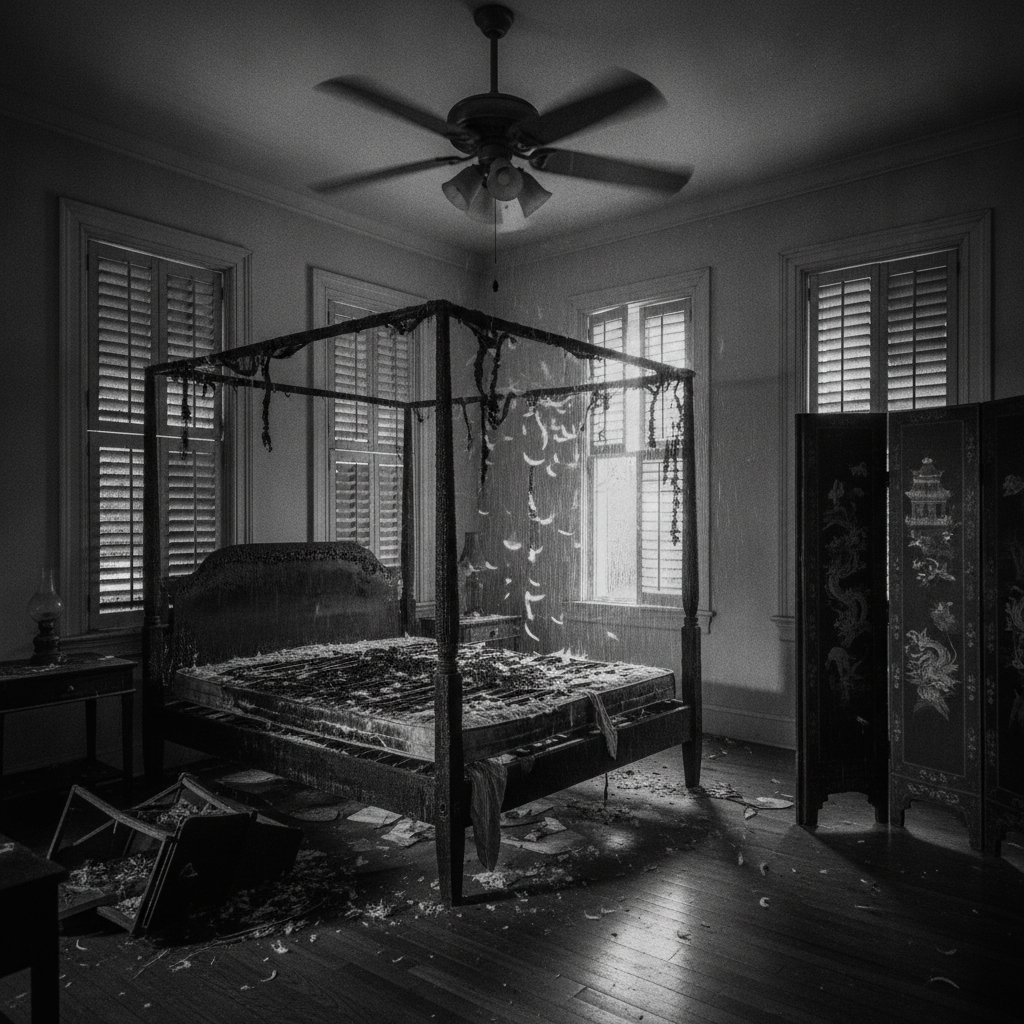
He found Harry Oakes lying on his bed. The body was partly burned. The bed and the mosquito net around it were scorched.
There were 4 wounds behind his left ear, made by a sharp, pointed tool. The skull was cracked.
Someone had poured a flammable liquid over the body, probably an insecticide, and set it on fire. The burns were worst around the eyes.
And there were feathers. Someone had torn open a pillow and scattered the feathers over the body. When the friend walked in, the electric fan in the room was still running, and the feathers were blowing over the dead man.
The friend later told the court that at first he believed Harry Oakes was still alive. He lifted his head, gave him water, and wiped the blood from his face with a towel.
Then he went to the telephone.
Who Harry Oakes was
To understand why this death shook a whole empire, you need to know who the dead man was.
Harry Oakes was born in 1874 in the state of Maine, in the north-east of the United States. He studied medicine for 2 years and then dropped out.
In 1898 he went north to the gold rush in Alaska. For about 15 years after that he followed gold rushes around the world: California, South America, Australia. He found nothing.
Then, in Canada, in the far north of the province of Ontario, near a small mining town called Kirkland Lake, he finally struck it. In 1918 his claim became the Lake Shore mine, one of the most productive gold mines in the Western Hemisphere.
Almost overnight, a poor prospector became one of the richest men in the world.
He married, had children, and lived in Canada. But Canada wanted a large share of his income in tax. In the 1930s he moved his fortune and his family to the Bahamas, where the taxes were low.
He gave large sums to charity, including to a hospital in London. In 1939 the king of Britain gave him a hereditary title, baronet. From then on he was Sir Harry Oakes.
In the Bahamas he owned land, hotels, an airfield and a great deal of Nassau itself. He was rough, loud and impatient. He was also the biggest employer on the island.
The son-in-law
In 1942, when she was just 18, his eldest daughter Nancy married a man he could not stand.
His name was Alfred de Marigny. Everyone called him Freddie. He was from the island of Mauritius, in the Indian Ocean, 32 years old, twice divorced, a yachtsman and a charmer who used the title of count.
Harry Oakes believed he had married Nancy for her money. The two men had argued openly, and the whole town knew it.
On the night of the murder, Alfred de Marigny was giving his own dinner party at his own house, a few kilometres away. Several guests later said he was with them, and that he drove two women home late at night.
On the night Harry Oakes died, Nancy was not on the island. So once his own guests had gone home, nobody could say where Alfred de Marigny was for the rest of the night.
A governor takes charge
Here the case took its first strange turn.
The governor of the Bahamas in 1943 was no ordinary official. He was the former king of Britain, who had given up his throne in 1936 to marry an American woman. During the war he had been sent to govern these islands, far from Europe.
He knew Harry Oakes well. When he heard of the death, he took personal control of the investigation, which was highly unusual for a governor.
He first tried to stop the news from being published. It did not work. The owner of the main Bahamian newspaper, who had been a friend of Harry Oakes, had the story out within hours, and it went around the world.
The governor did not trust the small Nassau police force. Because of the war, it was hard to bring detectives from Scotland Yard in London. So he telephoned Miami, and asked for 2 American police captains he knew. One of them had once guarded him during a visit to Miami.
The 2 captains flew in the same day.
**From this moment on, nearly everything about the investigation would later be challenged in court.**
How the scene was handled
The 2 Miami captains were presented as experts in fingerprints. They arrived without the special camera used to photograph prints at a crime scene. According to one account, they had also left their fingerprint kits in Miami.
The Nassau police had no such equipment either.
The bedroom was not sealed. Over the next hours, local officials and businessmen were allowed to walk through the house and look at the bed where the body had lain. Nobody stopped them from touching things.
There were real clues in that house.
There were muddy footprints on the stairs leading up to the bedroom.
There was a bloody handprint on the wall beside the bed.
There was a folding Chinese screen standing by the bed, marked with blood and fingerprints.
Photographs were taken of the handprint. Later it emerged that the photographic plates had been exposed to daylight and ruined. Later still, the handprint itself was washed off the wall.
Whose hand made that print has never been known.
There were also blisters on the body that the doctors could not explain. They did not seem to come from the fire.
36 hours
The captains questioned the household and the guests. They questioned the friend who had slept down the hall. He told them he had woken during the night because of the storm, but that he had heard nothing unusual. He had seen no fire and smelled no smoke.
Then they questioned the son-in-law.
They took him to Westbourne and spoke with him for hours in a room upstairs. During the questioning, he was given a glass of water.
They examined his hands and his beard, and said they found singed hairs. Alfred de Marigny said that was easy to explain: he lit cigars, he had lit candles at his dinner party, and he liked to cook.
On the evening of 9 July, about 36 hours after the body was found, the police arrested Alfred de Marigny and charged him with the murder of Harry Oakes.
The case against him was simple. He hated his father-in-law. He had been near the house that night. He had burned hairs on his arms. And, the captains said, his fingerprint had been found on the Chinese screen beside the bed.
In the Bahamas in 1943, murder carried the death penalty. A rope was ordered for the hanging.
The wife who did not believe it
Nancy de Marigny came home and stood by her husband.
She hired a well-known private detective from New York and his team, and a Bahamian defence lawyer. She asked for her husband to be given a lie-detector test.
When her detective arrived at the house, he found police officers cleaning the walls. The handprint and other marks were being scrubbed away.
The trial opened on 18 October 1943 in the Supreme Court of the Bahamas in Nassau. It lasted for weeks, and reporters came from all over the world. It was the most famous trial of the war years, outside the war itself.
The fingerprint falls apart
The heart of the prosecution was the print. One of the 2 Miami captains said that the little finger of Alfred de Marigny's right hand had left its mark on the Chinese screen.
Under cross-examination, the story came apart piece by piece.
The captain said he had identified the print on 9 July. His own partner told the court he had not heard about it until 19 or 20 July, 10 days later.
The print had not been photographed on the screen, where it was supposedly found. It had been lifted off with tape, a method that destroyed the original mark. So there was no way to show where on the screen it had been, or that it had been on the screen at all.
A fingerprint expert called by the defence pointed out something else. The screen had a painted pattern on it. If the print had been lifted from the screen, traces of that pattern should have appeared around it. They did not.
The defence put it to the captain directly: the print had not come from the screen. It had come from the glass of water Alfred de Marigny had held during his questioning. The captain denied this.
The captain had also told the court that he had fingerprinted everyone allowed into the bedroom. Then he admitted that this was not true. Dozens of other prints had been taken, and weeks later many of them had still not been examined.
The friend who had slept down the hall was the prosecution's main witness. His evidence did not go well either. A Nassau police officer swore that he had seen him in the centre of town that night, at about midnight, in a car. The friend denied it, and said he had never left the house.
The verdict
On 12 November 1943 the jury of 12 retired to decide.
They came back in under 2 hours. By 9 votes to 3, Alfred de Marigny was found not guilty.
The same jury then did something unusual. All 12 recommended that he be deported from the Bahamas. Soon afterwards he was sent away, and he left for Cuba with Nancy.
The marriage did not survive. The couple separated in 1945 and divorced in 1949.
**After the acquittal, nobody else was ever charged with the murder of Harry Oakes. There were no further court proceedings.**
The governor had arranged to be away from the Bahamas during the trial, so he was never called as a witness. He did not speak publicly about the case for the rest of his life.
The later attempts
The case did not go away.
According to one later author, Scotland Yard looked at the case again about 4 years after the trial. That review never led to any new charge.
In May 1959, 16 years after the murder, a member of the Bahamian parliament who also edited a local newspaper stood up in the House of Assembly. He said there was new evidence, and that he could name the killer. The House voted to reopen the case.
The New York detective who had worked for the defence was supposed to be the source of the new evidence. He said he had none, and refused to come back to the Bahamas.
The former governor, by then living in Paris, was invited to give evidence. He declined.
On the night of 14 June 1959, shots were fired into the house of the member of parliament while he lay in bed upstairs. Police recovered 2 bullets. Reports speak of 3 shots in all. He was not hit. After that, the attempt to reopen the case faded away.
There is also a darker footnote. Some accounts say that an American woman who had been asking questions about the Oakes case in Nassau was found dead at the bottom of a well. The sources disagree on the year, 1950 or 1952, and no link to the murder was ever shown.
Where it stands
The murder of Sir Harry Oakes is officially unsolved.
The evidence that might have settled it is gone. The handprint on the wall was photographed on plates that were ruined, and then it was washed away. The footprints on the stairs were never matched to anyone. The scene was walked through by visitors before it was properly examined. The one piece of physical evidence that reached the court, the fingerprint, was shown to be unreliable.
Everyone involved is now dead. Alfred de Marigny died in 1998. The friend who found the body died in 1973. The former king died in 1972.
The theories
Every theory below is only a theory. None was ever tested in court.
**The casino theory.** Books published in 1972 and 1988 argued that Harry Oakes was killed by associates of an American organised-crime figure who wanted to open casinos in the Bahamas, and that Harry Oakes stood in the way. The problem: no direct evidence has ever tied any named gangster to the house that night.
**The friend in the guest room.** One author wrote that the friend who slept down the hall brought in someone to carry out the killing, and that years later the friend told people close to him he had been involved. Another author wrote in 2005 that local businessmen, the friend among them, acted to stop Harry Oakes moving his fortune out of the Bahamas, to Mexico. A 2021 book noted that some 15 million dollars of the fortune was never found. The problem: the friend was never charged, and his account of the night, though doubted, was never disproved.
**The wartime money.** Some writers pointed to a Swedish millionaire living in Nassau, who was suspected of ties to Nazi Germany, and to secret money transfers during the war. The problem: this rests on suspicion about wartime dealings, not on evidence from the scene.
**The son-in-law after all.** A 2006 book argued that Alfred de Marigny was the killer, citing the later Scotland Yard review. The problem: a jury heard the case against him and acquitted him. In law he was innocent, and he must be regarded as innocent.
What is certain is small. A man went to bed in a storm. In the morning he was dead, burned, and covered with feathers. The investigators who were sent to find his killer lost the evidence that might have named one.