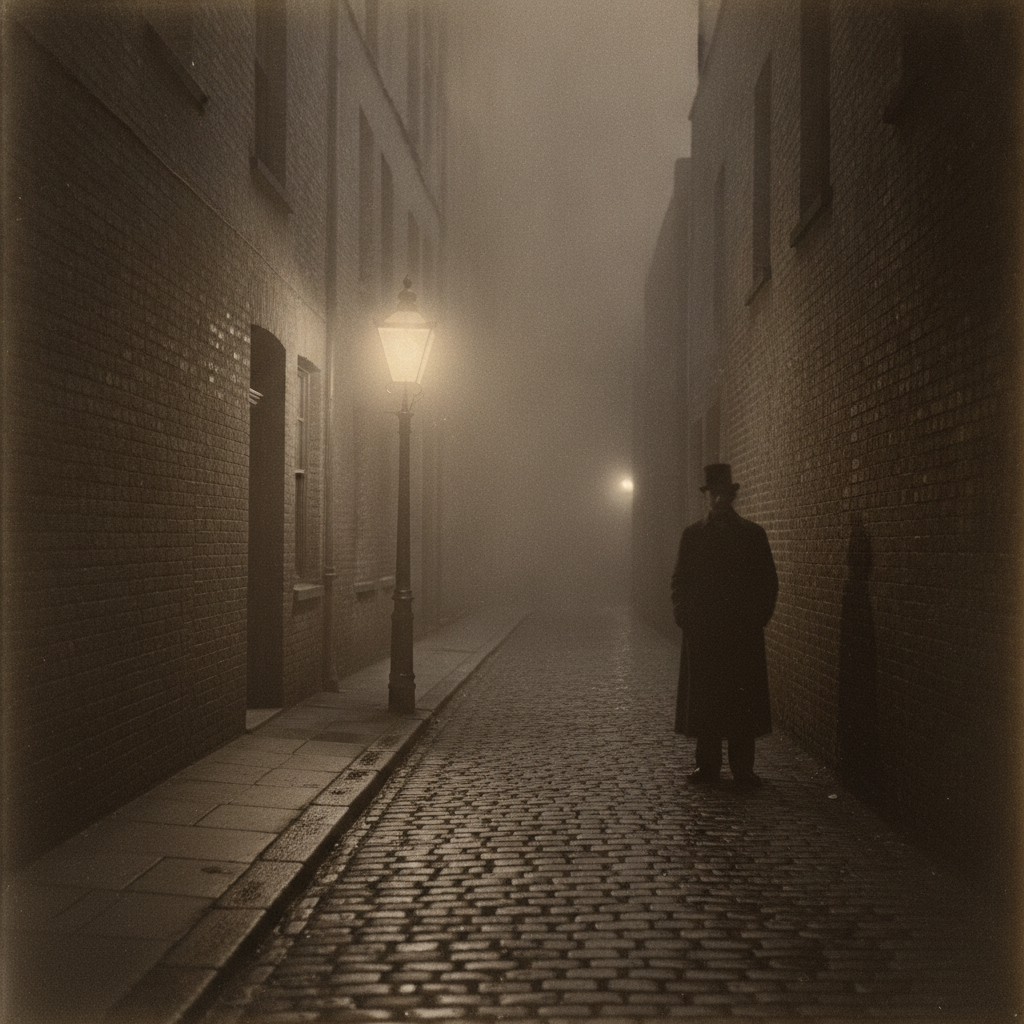
Jack the Ripper: 5 Women, 10 Weeks, and a Killer No Court Ever Named
In the autumn of 1888, the poorest district of London was afraid of the dark.
Whitechapel lies in the East End of London, about 3 km east of St Paul's Cathedral. In 1888 around 80,000 people lived crowded into its streets. About 8,500 of them slept each night in cheap lodging houses, where a bed cost 4 pence and a place on a rope to lean against cost 2 pence. Those who did not have the money slept in doorways.
The police counted 1,200 women in the district who sold sex to pay for that bed. Most were not young. Many were widowed or separated from their husbands, and many drank.
Between the end of August and the start of November that year, 5 of these women were murdered in the streets and yards of Whitechapel and the district next to it. Each had her throat cut. Most were then mutilated. The killer was never caught, and to this day nobody knows who he was.
The newspapers gave him a name taken from a letter that may have been written by a journalist. The name was Jack the Ripper.
This is the story of those 10 weeks, of the investigation that followed, and of why it failed.
The first night
At about 3:40 in the morning on Friday 31 August 1888, a man walking to work along a dark street called Buck's Row saw something lying in front of a stable gate. At first he thought it was a tarpaulin. It was a woman.
Her name was Mary Ann Nichols. She was 43, and everyone called her Polly. She had 5 children and had been separated from her husband for years.
A few hours earlier she had been turned away from a lodging house because she did not have the 4 pence for a bed. She laughed, told the deputy she would soon have the money, and pointed to the new bonnet she was wearing.
About an hour before her body was found, a friend met her on a nearby corner. Polly said she had earned the money for her bed 3 times that day, and had drunk it each time. Then she walked off alone.
A police constable arrived within minutes. Her throat had been cut twice, so deeply that the blade reached the spine. Only at the mortuary did the doctors find that her abdomen had also been cut open.
There was very little blood on the ground. Nobody in the houses along the street had heard a scream.
At first the local police thought this might be the work of one of the gangs that robbed women in the district. A week later, it happened again.
A pattern appears
On Saturday 8 September, at about 6 in the morning, a man who lived at 29 Hanbury Street went down to the back yard and found a woman's body by the steps. The house was about 1 km from Buck's Row, in the neighbouring district of Spitalfields.
Her name was Annie Chapman. She was 47. She had once had a home and a husband who sent her a small weekly allowance. When he died in 1886, the money stopped. She was also ill. The post-mortem later found a disease of the lungs and of the brain that was already killing her.
She too had been turned away from a lodging house that night, because she had no money for a bed.
At about 5:30, a woman walking along Hanbury Street saw Annie talking to a man outside number 29. She saw him only from behind. She described him as dark, in a deerstalker hat and a dark coat, looking "shabby genteel". She heard him ask "Will you?" and heard Annie answer "Yes."
The police surgeon believed Annie had died earlier than 5:30. The witness's time and the doctor's estimate never agreed, and the question was never settled.
Her throat had been cut, like Polly's. This time the killer had also opened her body in the yard, and had taken away her womb. The police surgeon said the man must have had some knowledge of anatomy. Other doctors would later disagree.
Now the newspapers had their story: a single killer was hunting women in Whitechapel. Crowds came to Hanbury Street. Neighbours charged a penny to look over the fence into the yard.
The night of 2 murders
On the night of Saturday 29 to Sunday 30 September, the killer struck twice in less than an hour.
At about 1 in the morning, a man drove his pony and cart into a dark yard off Berner Street, in Whitechapel. The pony shied. On the ground lay a woman. Her throat had been cut, and the blood was still flowing.
Her name was Elizabeth Stride. She was 44 and had been born in Sweden. Several people said they had seen her with a man that evening. They described him differently: fair or dark, shabby or respectable.
She had a single cut across the neck, about 15 cm long. There were no other wounds. The police believed the killer had been disturbed, perhaps by the cart itself, and had slipped away in the dark.
He did not go home.
At 1:44, a police constable walking his regular beat shone his lamp into a corner of Mitre Square, a small square about 1 km west of Berner Street. He had passed through the same square about 15 minutes earlier and seen nothing. Now a woman was lying there.
Her name was Catherine Eddowes. She was 46. She had come back to London the day before, after weeks of picking hops in the fields of Kent with her partner. That evening she had been arrested for being drunk in the street and held at a police station. She was released at about 1 in the morning. On her way out, she gave a false name.
At 1:35, 3 men leaving a club saw a woman they later believed was Catherine. She was standing at the entrance of a passage into the square, talking quietly with a man. Only one of the 3 looked properly. He described a man of about 30, about 1.70 m tall, of medium build, with a fair moustache.
Less than 10 minutes later she was dead.
Mitre Square was not in the area of the Metropolitan Police, which covered Whitechapel. It lay inside the City of London, which had its own separate police force. From that moment, 2 police forces were hunting the same man.
Catherine's throat had been cut, and her body was mutilated far worse than the others. Her face had been cut. Her left kidney and her womb had been taken. The City police surgeon said the work would have needed at least 5 minutes, in a square that a constable walked through every 15.
A piece of apron and a line of chalk
At 2:55 that morning, a Metropolitan constable found something in the doorway of a building in Goulston Street, about 500 m from Mitre Square, back towards Whitechapel. It was a piece of a woman's apron, wet with blood. It was later matched to the apron Catherine Eddowes had been wearing.
The killer had cut it off and carried it away with him. Then, on his way back into Whitechapel, he had dropped it.
On the wall above it, someone had written a line in chalk: "The Juwes are The men That Will not be Blamed for nothing."
Nobody knows whether the killer wrote it, or whether it had been there before.
The Commissioner of the Metropolitan Police came to the doorway before dawn. Many Jewish immigrants lived in the street, and anger against them was already running high. He feared that if the words were seen in daylight, there would be a riot. He ordered them washed off before they could be photographed.
An officer of the City police asked that only the word "Juwes" be rubbed out, and the rest kept until a photographer arrived. He was refused.
It was one of the very few clues in the case, and it was gone within hours.
The letters
By then, the killer already had a name.
On 27 September, a news agency in London received a letter written in red ink, dated 2 days earlier. It began "Dear Boss". The writer mocked the police, said he would keep on "ripping" women, and promised to clip the ears off the next one. It was signed "Jack the Ripper".
The agency passed it to Scotland Yard. Most officers thought it was a hoax. After the double murder, the police published it, hoping somebody would recognise the handwriting. Nobody did. Instead, the name went around the world.
On 1 October came a postcard in the same handwriting, which spoke of a "double event". The police noted that it arrived more than a day after the murders, when the details were already in every newspaper.
Hundreds of letters followed, from all over Britain. Almost all were plainly the work of cranks. Some senior officers later said they believed a journalist had written the first letter to sell newspapers. That was never proved either.
One letter was different. On 16 October, the head of a committee of local businessmen, which had set up its own night patrols, received a small box in the post. Inside was half of a human kidney, kept in alcohol. The letter with it was headed "From hell". The writer said he had fried and eaten the other half.
A doctor at the London Hospital examined the kidney. He said it was human, and from the left side. He could not say more. Catherine Eddowes's left kidney had been taken. Whether this was her kidney, or a medical student's prank with a specimen from a dissecting room, was never settled.
The last room
Then, for more than 5 weeks, nothing happened.
On the morning of Friday 9 November, the landlord of a row of small rooms off Dorset Street, in Spitalfields, sent his assistant to collect rent from a tenant who was well behind.
The tenant was Mary Jane Kelly. She was about 25, younger than the others. She said she had been born in Ireland and raised in Wales. Unlike the others, she had a room of her own: number 13, Miller's Court.
At 10:45 the assistant knocked. Nobody answered. He went round to the side, pushed aside the coat that covered a broken window pane, and looked in.
What he saw made him run for the landlord. The landlord ran for the police.
For the first time, the killer had not been out in the street, where he might be disturbed. He had been alone behind a closed door, with a fire burning for light. The mutilation of Mary Jane Kelly was the worst of all. The police photographed the room, one of the earliest crime scene photographs taken in Britain. Her heart was missing.
A neighbour had heard her singing late into the night. Another woman said that at around 4 in the morning she heard a faint cry of "Oh, murder!" It was a common cry in that street, and she went back to sleep.
The same week, the Commissioner of the Metropolitan Police resigned, after weeks of attacks in the newspapers.
What the police did
It is often said that the police did nothing. The records show the opposite.
Senior detectives were sent from Scotland Yard to Whitechapel. A chief inspector at the Yard was put in charge of reading every report on the case.
Officers went from house to house through the district. More than 2,000 people were questioned. More than 300 were investigated as possible suspects. 80 were held for a time.
Because of the way the bodies were cut, the police suspected a man used to using a knife on animals. They visited 76 butchers and slaughtermen, and checked every employee who had worked for them in the previous 6 months. All were cleared.
They also checked the drovers who came over with cattle on boats from mainland Europe, against the sailing dates of every ship. No single boat matched all the murder dates.
In October, the police even tested 2 bloodhounds in a London park, to see whether dogs could follow a killer's trail through city streets. The trial was not a success, and the dogs were never used at a scene.
After Mary Jane Kelly's death, a police surgeon was asked for his opinion of the killer. His report is often called the earliest surviving offender profile. He wrote that all 5 murders were the work of one man. He thought the killer had no surgical skill, not even the skill of a butcher. He described a quiet, solitary man, probably neat and respectable in appearance, who would not look like a murderer, and who lived alone or with people who suspected nothing.
None of it led to an arrest.
Why nothing worked
Today the reasons are clear.
There was no fingerprinting. British police only began to use fingerprints in 1901. There was no way to tell one person's blood from another's. Witnesses had seen a man in the dark for a few seconds, and their descriptions were vague and contradicted each other.
The scenes were not protected. Bodies were moved, yards were washed down, and crowds walked through. At Hanbury Street, people paid to look.
2 separate police forces were working on the same killer. And the head of the detective branch at Scotland Yard was on leave in Switzerland during 3 of the 5 murders.
And the killer chose his ground well. The district was a maze of narrow streets and yards that he clearly knew. A man with blood on his hands could wash at a street pump and vanish among 80,000 people.
Here the documented record ends. After 9 November 1888, there is no established fact that tells us who the killer was.
Where it stands
More women were killed in Whitechapel over the next 3 years. In February 1891, a woman named Frances Coles was found under a railway arch with her throat cut, and a constable heard footsteps running away. A man was arrested, then released for lack of evidence. The police could never say whether any of these later deaths were the same killer's work.
The official police file covers 11 murders, from April 1888 to February 1891. The investigation was quietly closed in 1892.
Most historians today accept 5 victims: Mary Ann Nichols, Annie Chapman, Elizabeth Stride, Catherine Eddowes and Mary Jane Kelly. Some add 1 or 2 more.
Since then, much of the evidence has gone. Most of the City of London police files were destroyed when German bombs hit London in the Second World War. Many papers from the Metropolitan Police file disappeared over the decades, some taken as souvenirs. A few, including the "Dear Boss" letter, were sent back anonymously in 1987.
No weapon was ever found. No confession was ever accepted. Nobody was ever charged with any of the 5 murders.
The case is unsolved. Every man who could ever have been charged has now been dead for about a century.
The names on the record
Over the years, writers have accused more than 100 people. Only a handful of names come from the police officers of the time. All of these men are long dead, and none of them was ever charged. What follows are those officers' theories, not proven facts.
Montague John Druitt. In 1894, a senior Scotland Yard officer wrote a private report naming 3 suspects. He favoured this one: a 31-year-old barrister and teacher whose body was found in the River Thames at the end of December 1888, weeks after the last murder. The evidence: the timing, and the officer's claim that the man's own family suspected him. The problem: nothing links him to Whitechapel. He lived in another part of London, and a few hours after Annie Chapman's murder he was playing in a cricket match there. The officer who wrote the report joined the police only after the murders, and the report contains clear errors of fact.
Aaron Kosminski. A Polish-born Jewish barber who lived in Whitechapel and was committed to an asylum in 1891. He died there in 1919. The head of the detective branch wrote in his memoirs that the killer was a poor Polish Jew, identified by a witness who then refused to testify against a fellow Jew. In the margin of his own copy of that book, the chief inspector who had coordinated the case wrote the name "Kosminski". The evidence: the word of 2 of the most senior officers on the case. The problem: the identification is described only in those notes, written years later, and no record of it has ever been found. The asylum records describe a man who was not violent towards others. In 2014, and again in a scientific journal in 2019, 2 researchers said DNA from a shawl said to have been found beside Catherine Eddowes matched a relative of Kosminski. Other geneticists rejected the claim. Nobody can show that the shawl was ever at the scene, it passed through many hands over 130 years, and the full data was not made available for others to check.
Michael Ostrog. The third name in the 1894 report: a Russian-born con man and thief, in and out of prisons and asylums. The problem: researchers later found records showing he was held in a prison in France while the murders took place.
Francis Tumblety. An American seller of quack medicines. He was arrested in London in November 1888 on a separate charge, then fled to France and on to America. A retired senior detective named him in a private letter in 1913. The problem: no evidence places him at any of the scenes. His name appears in the police record only in that one letter, written 25 years later.
Severin Klosowski. A Polish-born barber's assistant who lived in Whitechapel in 1888. Under the name George Chapman, he later poisoned 3 women and was hanged in 1903. That year, one of the detectives who had led the 1888 hunt told a newspaper he thought this was the man. The problem: he killed his later victims slowly, with poison. Killers rarely change their method so completely.
Each theory explains part of the story. None explains all of it.
For more than a century, the 5 women were remembered mainly as the victims of a famous name. In 2019 a historian went back to their lives in a book called "The Five: The Untold Lives of the Women Killed by Jack the Ripper": their children, their marriages, their work, and the bad luck that brought each of them to the same streets in the same autumn.
The man who killed them was never named by any court. He is known only by a name from a letter that he probably never wrote.