Ted Bundy: The Charming Stranger Who Killed Across America, and How He Was Finally Caught
In the winter of 1974, young women in the north-west of the United States began to disappear.
They did not run away. They left their rooms, their bags, their cars and their friends behind. Some vanished from their beds at night. Others vanished in daylight, in the middle of a crowd.
At first nobody connected the cases. They happened in different towns, under different police forces. Each force saw only its own missing girl.
Over the next 4 years, the same pattern moved across at least 6 states: Washington, Oregon, Utah, Colorado, Idaho and finally Florida.
The man behind it was Ted Bundy. He was a law student. He was polite, well dressed and good-looking. People who met him said he was charming. That was exactly why he was so hard to catch.
This is the story of the Ted Bundy case: the crimes, the long investigation that kept missing him, and the small, almost accidental moments that finally stopped him.
The first winter
The first known attack came on 4 January 1974, in Seattle, a large city in the north-western state of Washington.
A young woman was beaten in her bed, in a basement apartment. She survived, but with permanent brain damage.
4 weeks later, on 1 February, a 21-year-old student named Lynda Ann Healy disappeared from her room in a shared house in Seattle. She was never seen alive again.
After that, the disappearances came roughly once a month.
On 12 March, a 19-year-old student vanished in Olympia, the capital of Washington state. On 17 April, an 18-year-old vanished in Ellensburg, in the centre of the state. On 6 May, a 20-year-old vanished in Corvallis, in the neighbouring state of Oregon. On 1 June, a 22-year-old vanished near Burien, just south of Seattle. On 11 June, an 18-year-old vanished from an alley next to the University of Washington.
They were all young women. Most of them were students.
The police had no bodies, no crime scene and no suspect. They had only a growing list of names.
A sunny day at the lake
On Sunday 14 July 1974, the case broke open in the worst possible way.
It was a hot summer day at Lake Sammamish State Park, on a lake just east of Seattle. The park was crowded with families and swimmers.
In the middle of that crowd, a young man walked up to several women. His arm was in a sling. He said his name was Ted. He asked for help loading a sailboat onto his car, a Volkswagen Beetle.
Some women said no. 2 women did not come home. Janice Ott, 23, and Denise Naslund, 19, disappeared from the park that day, a few hours apart.
Nobody saw a struggle. Nobody heard a scream. They simply never came back to their towels.
For the first time, the police had witnesses. Several women described the same man: young, attractive, polite, his arm in a sling, calling himself Ted, driving a Volkswagen. The police published a drawing of his face.
On 6 September, hunters found the remains of the 2 women in woods near the town of Issaquah, not far from the lake.
6 months later, in March 1975, forestry students found more remains on Taylor Mountain, also east of Seattle. They belonged to 4 of the missing women, including Lynda Ann Healy.
Now there was no doubt. One man was taking these women.
A name among thousands
The detectives set up a special team. Among themselves they called it the "Ted" task force.
The public response was enormous. At its peak, the team received up to 200 tips a day. Every tip was a name. Every name had to be checked.
In the end, the investigators looked at more than 2,800 people.
One of those names was Ted Bundy.
He was reported more than once. His girlfriend in Seattle called the police and said he looked like the drawing and drove a Volkswagen. A crime writer who knew him personally gave his name. So did a state employee, and a psychology professor at the university.
The detectives did look at him. But on paper he did not fit. He was a clean-cut law student with no criminal record and a promising future. The detectives doubted that a man like that could be the killer. His name stayed on the list, among thousands of others.
The team then tried something new for its time. It put its different lists, each one built from a different kind of lead, into the county's payroll computer, and asked which names appeared on more than one of them.
Out of thousands of names, only 26 appeared on 4 lists. Ted Bundy was one of the 26.
From these, the detectives made a list of their 100 best suspects. By the time a phone call came from Utah, Bundy's name was at the top of it.
But by then, he had been gone from Seattle for a year.
Utah
In late summer 1974, Bundy moved to Salt Lake City, the capital of the state of Utah, to study law there.
Within weeks, the pattern began again.
On 2 October, a 16-year-old girl disappeared in Holladay, a suburb of Salt Lake City. She was never found. On 18 October, a 17-year-old disappeared in Midvale; her body was found 9 days later. On 31 October, another 17-year-old disappeared in Lehi; her body was found on Thanksgiving Day, at the end of November.
Then, on the evening of 8 November 1974, something different happened. A victim got away.
Carol DaRonch, 18, was at the Fashion Place Mall in Murray, near Salt Lake City. A man came up to her. He said he was a police officer named Roseland. He told her that someone had tried to break into her car, and asked her to come with him.
She got into his Volkswagen. He did not drive to a police station. He stopped the car and snapped a handcuff onto one of her wrists.
She fought back. She threw herself out of the car, ran into the road and waved down a passing car with a couple inside, who took her away.
She was alive. She had seen his face. She remembered the car.
That same evening, a 17-year-old named Debra Kent disappeared after leaving a school play in Bountiful, north of Salt Lake City. Outside the school auditorium, investigators later found a small key for handcuffs. Debra Kent was never found.
In December 1974, Bundy's girlfriend called the police again, this time the sheriff's office in Salt Lake County. His name went onto their list too. But there was no evidence that tied him to anything in Utah. Not yet.
Colorado
In early 1975, the disappearances moved east, to the state of Colorado.
On 12 January 1975, Caryn Campbell, a 23-year-old nurse, was on a ski holiday at the Wildwood Inn in Snowmass Village, near the resort town of Aspen. She walked down a hotel corridor to fetch a magazine from her room, and never arrived. Her body was found about a month later.
On 15 March, a 26-year-old woman disappeared in Vail, another ski town. On 6 April, a 25-year-old disappeared in Grand Junction, in western Colorado. Neither of them was ever found.
In May, a 12-year-old girl was abducted in Pocatello, in the state of Idaho. In June, a 15-year-old girl disappeared from a university campus in Provo, Utah.
By now, about 20 young women were dead or missing, in 5 states. And still no police force knew that all of these cases belonged to one man.
The traffic stop
The breakthrough, when it came, had nothing to do with the murders.
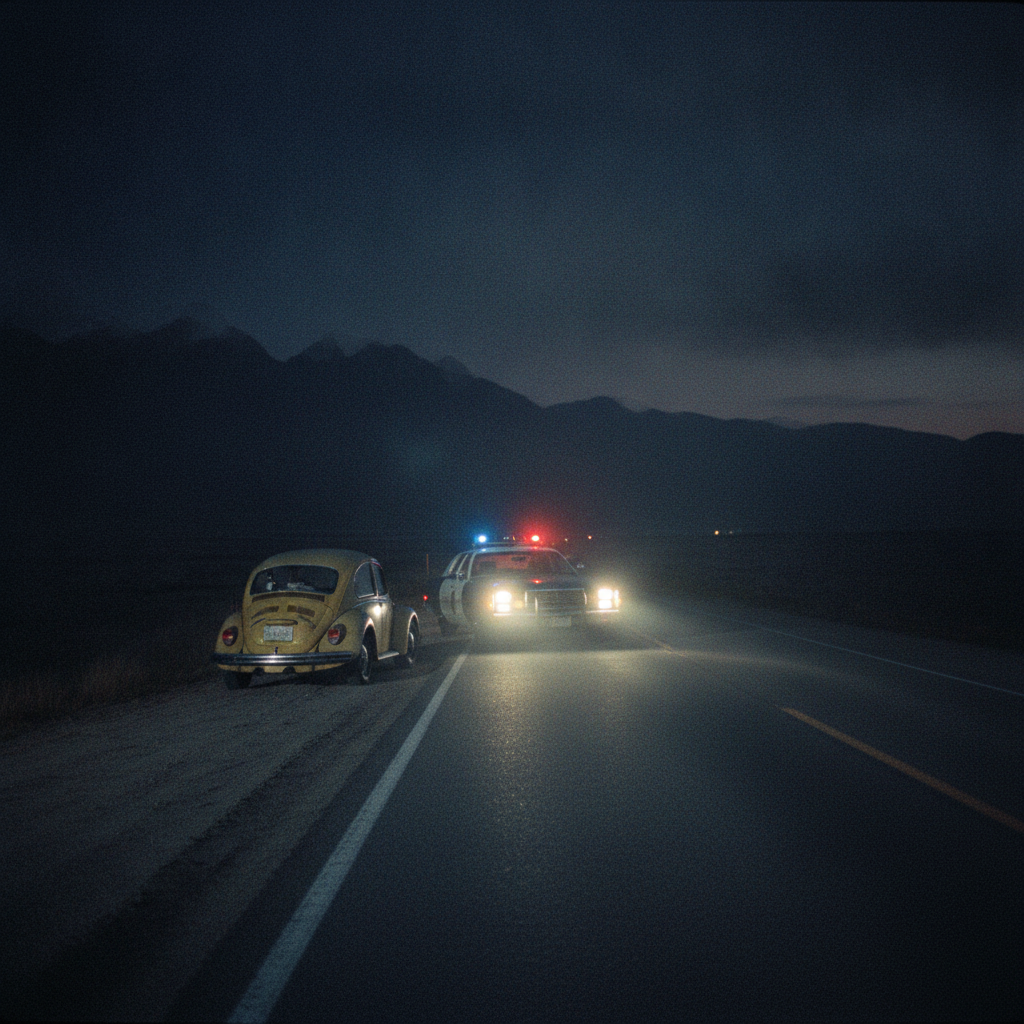
In the early hours of 16 August 1975, a Utah highway patrolman stopped a Volkswagen Beetle in Granger, a suburb of Salt Lake City.
He looked inside. The front passenger seat had been taken out. In the car he found a ski mask, a second mask made from tights, a crowbar, handcuffs, rubbish bags, rope and an ice pick.
Bundy said these were ordinary household things. He was arrested on suspicion of possessing burglary tools.
A detective from the Salt Lake County sheriff's office read the report. He recognised the name. It was the name Bundy's girlfriend had given in December. And Bundy drove a Volkswagen, like the man who had tried to take Carol DaRonch.
The Utah detectives called Seattle. The "Ted" task force checked its list. Bundy was at the top.
For the first time, two police forces, more than a year apart, were looking at the same man.
The hair in the car
In September 1975, the police seized the Volkswagen. Bundy had already sold it and had it thoroughly cleaned.
It did not help him. Experts at the FBI laboratory found hairs inside the car. They matched hair from 3 different women: Caryn Campbell, the nurse from Colorado; the 17-year-old from Midvale; and Carol DaRonch.
An FBI specialist said that the chance of such a coincidence was "mind-boggling".
On 2 October 1975, Carol DaRonch picked Bundy out of a police line-up.
Bundy chose to be tried by a judge, without a jury. In February 1976, the judge found him guilty of kidnapping and assault. In June 1976, he was sentenced to between 1 and 15 years in Utah State Prison.
Meanwhile, in November 1975, about 30 detectives and prosecutors from 5 states met in Aspen, Colorado, to compare their files. For the first time, all the separate pieces were laid out on one table.
In October 1976, prison guards found Bundy in the prison yard with an escape kit. The same month, Colorado charged him with the murder of Caryn Campbell.
Two escapes
In January 1977, Bundy was moved to Aspen to stand trial. He decided to act as his own lawyer. That gave him the right to work in the courthouse law library, without leg chains.
On 7 June 1977, during a break in a court hearing, he jumped out of a second-floor window of the courthouse. He hurt his ankle when he landed. He fled into the mountains above the town, broke into a cabin for food and clothes, and wandered for days.
On the 6th day, police stopped him as he was driving a stolen car, and took him back.
6 months later he tried again. This time it worked.
In the Garfield County jail in Glenwood Springs, Colorado, he cut a hole in the ceiling of his cell. On the night of 30 December 1977, he crawled through it into the apartment of the chief jailer, changed into ordinary clothes and walked out through the front door.
Nobody noticed he was gone until about noon the next day. By then he was in Chicago.
Florida
On 8 January 1978, Bundy arrived in Tallahassee, the capital of Florida, in the south-east of the United States. He rented a room under a false name, close to the campus of Florida State University.
He was now on the FBI's list of the 10 most wanted fugitives. But nobody in Tallahassee knew his face.
1 week later, in the early hours of Sunday 15 January 1978, a man entered the Chi Omega sorority house, a residence for women students at the university.
He attacked 4 women in their sleep with a wooden club. Margaret Bowman, 21, and Lisa Levy, 20, were killed. Kathy Kleiner and Karen Chandler, both 21, survived with severe injuries. Kathy Kleiner later said that the headlights of a car, shining into the room, interrupted the attack.
A student who came home late saw a man leaving the house through the front door, holding a club. She saw him clearly enough to describe him.
The same night, 8 blocks away, a 21-year-old dance student named Cheryl Thomas was beaten in her bed, in a basement apartment. She survived. She was left deaf in her left ear, with damage to her balance that ended her career as a dancer.
The last victim
On 9 February 1978, in Lake City, a small town in northern Florida, a 12-year-old girl named Kimberly Leach was taken from her junior high school.
A witness saw a man leading her towards a white van.
She was missing for almost 2 months. Her remains were found on 7 April 1978, in an old pig shed near Suwannee River State Park, about 56 km north-west of Lake City.
She was the youngest of Bundy's victims in Florida, and the last of all his known victims.
The stop in Pensacola
At about 1 a.m. on 15 February 1978, a police officer in Pensacola, in the far north-west of Florida near the border with Alabama, noticed a Volkswagen Beetle. He ran a routine check on its number plate. The car was stolen.
He stopped it. The driver kicked his legs out from under him and ran. The officer fired 2 warning shots, chased him, brought him down, and fought with him over his gun. In the end he got the handcuffs on.
In the car were stolen identity documents, 21 stolen credit cards and a stolen television.
At first the man would not give his real name. On the way to the station, he said to the officer: "I wish you had killed me."
Within days, Florida police knew who he was: Ted Bundy, the prisoner who had escaped from Colorado.
The tooth marks
Now the investigators had to prove what had happened in the Chi Omega house.
The strongest physical evidence was very unusual for its time. The killer had bitten one of the victims, Lisa Levy. The police had photographed the bite marks.
The investigators obtained a court order to take casts of Bundy's teeth. 2 forensic dentists compared the casts with the photographs. Bundy's teeth were uneven and chipped in a distinctive way, and the dentists testified that they matched the marks.
The trial was moved to Miami, at the southern end of Florida, because the publicity in Tallahassee made a fair jury impossible there. It began in June 1979. It was the first trial ever broadcast on television across the whole United States.
The student who had seen the man leaving the house identified Bundy in court. Another witness placed him near the house that night.
Bundy again insisted on directing much of his own defence.
On 24 July 1979, after less than 7 hours of deliberation, the jury found him guilty of the murders of Margaret Bowman and Lisa Levy. The judge sentenced him to death.
The second trial
About 6 months later, a second trial began in Orlando, in central Florida, for the murder of Kimberly Leach.
Here the key evidence was fibres. Fibres found in the white van and on the girl's body came from clothing with an unusual fault from the factory. They matched the jacket Bundy was wearing when he was arrested in Pensacola.
An eyewitness also told the jury that he had seen Bundy leading the girl to the van.
The jury took less than 8 hours. Guilty.
During the sentencing hearing, Bundy did something nobody expected. He was questioning a friend who had come to testify in his favour, and there, in the courtroom, he asked her to marry him. She said yes. Under an old Florida law, a declaration in front of a court official was enough, and he announced that they were now legally married.
On 10 February 1980, he received his third death sentence.
The end
Bundy spent more than 9 years on death row, appealing every decision.
In October 1984, he offered his help to detectives in Washington state who were hunting another serial killer, the so-called Green River Killer. 2 detectives travelled to Florida to interview him. That killer was not caught for about 17 more years.
In his final years, Bundy began to confess, a little at a time. Many detectives and families saw it as an attempt to buy time. In 1986 he described his crimes in detail to an FBI agent. In the last days before his execution, he confessed to the killings in Washington and Oregon that the "Ted" task force had investigated 15 years earlier.
In all, he admitted to about 30 murders in 7 states. The police confirmed 20.
On 24 January 1989, at 7:06 in the morning, Ted Bundy was executed in the electric chair at Florida State Prison, in Raiford. He was 42 years old. He was pronounced dead at 7:16.
What remains open
The case is solved. But not every family got an answer.
The remains of several of his victims were never found. Among them are the student from Olympia, the 16-year-old from Holladay, Debra Kent from Bountiful, and the 2 young women from Vail and Grand Junction.
And the true number of his victims is not known. He confessed to about 30. Some investigators believe there were more. That number died with him.