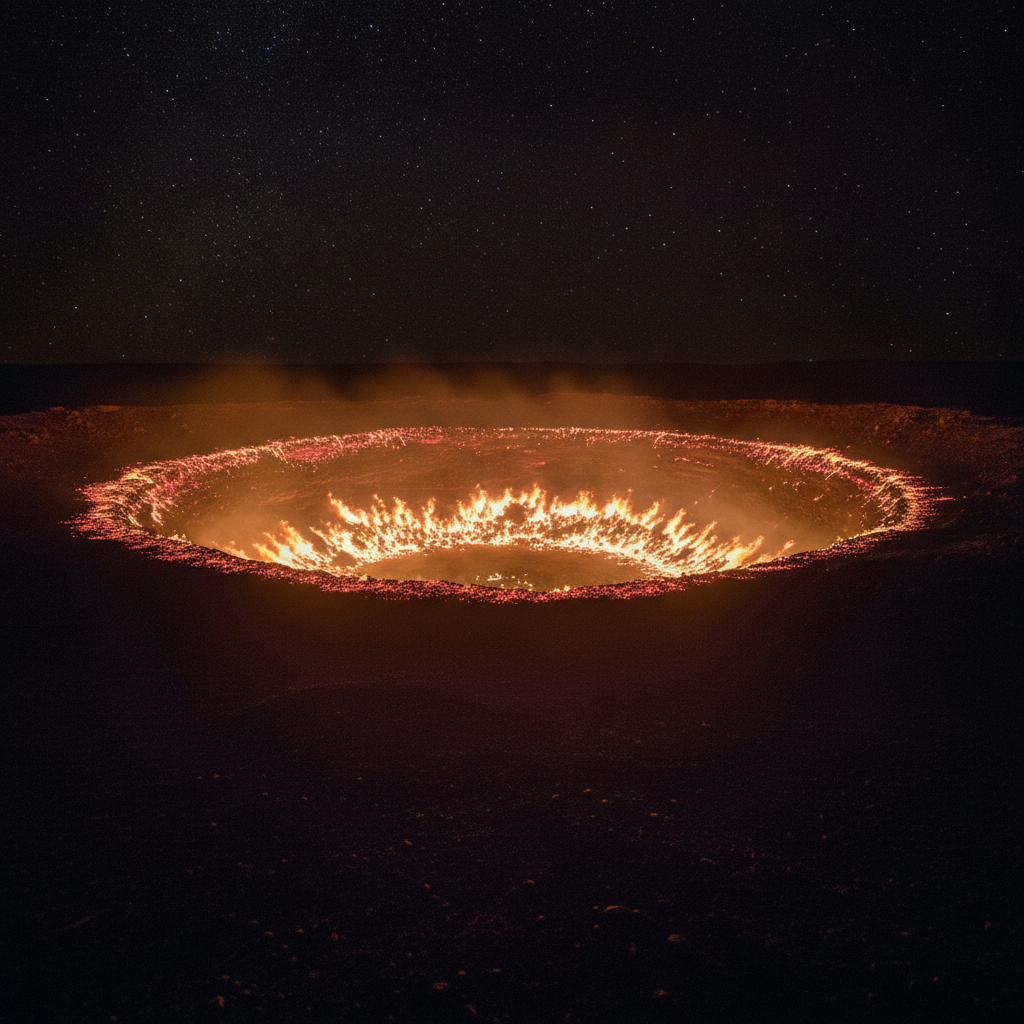
The Fire Nobody Filed: Half a Century at the Door to Hell
You see it before you reach it. Driving north from Ashgabat across the Karakum, the desert is black and featureless after sunset, and then a low orange stain appears on the underside of the sky, hours before the road gets there. Up close the ground is warm through the soles of your boots. The pit is roughly seventy metres across and perhaps twenty deep, and until recently its walls and floor were covered with hundreds of separate flames, some the size of a candle and some the size of a car, all of them fed by gas rising out of the rock. It roars. The heat pushes you back from the rim. Local people call it the Gate of Hell, and the name has stuck in every language the tourists brought with them.
The story that comes with the crater is told everywhere, in the same words, with the same confidence. In 1971 a team of Soviet geologists was drilling for natural gas in the Karakum. The ground beneath the rig gave way and swallowed it, leaving a wide pit that began to vent methane. Worried that the gas would poison people and livestock nearby, the engineers set it alight, expecting the pocket to burn itself out within a few weeks. It has been burning ever since.
It is a very good story. It has a date, a cause, a reasonable decision and an ironic outcome. What it does not have is a source.
When researchers have gone looking for the paperwork, they have come back empty. Turkmenistan's geology department has no incident report from that period. There is no Soviet drilling log, no ministry memorandum, no contemporary newspaper item, no photograph from the 1970s showing a burning pit at Darvaza. The 1971 date is repeated on travel sites and encyclopaedia pages without a citation behind it, and every attempt to trace it upstream ends in another article repeating the same sentence. As far as the public record goes, the most famous industrial accident in Central Asia has no file.
There are reasons for that beyond carelessness. Industrial accidents in the Soviet Union were routinely classified. Failures at gas and oil installations embarrassed ministries and were removed from the record or never entered into it. After independence Turkmenistan became one of the most closed states on earth, its archives effectively unreachable and its official history written to order. A missing document is not proof of anything by itself. But when the only evidence for a widely repeated fact is that everyone repeats it, that is worth saying out loud.
The people who might know tell a different story. Turkmen geologists who worked in the region for decades have said that the collapse at Darvaza happened not in 1971 but sometime in the 1960s, and that the pit sat there as an open hole venting gas for years, unlit. On this account the fire was started only in the 1980s, and for the same reason given in the popular version: to stop poisonous gas drifting across the desert. A 2010 report from the Turkmen geologist Anatoly Bushmakin placed both the collapse and the ignition in the early 1980s. The accounts do not agree with each other either. What they agree on is that 1971 is not where the evidence points.
The crater's other famous visitor could not settle it. In November 2013 the Canadian explorer and storm chaser George Kourounis, after two years of preparation, was lowered on a line to the floor of the burning pit in a heat-reflective suit and a harness rated for the conditions, and spent roughly seventeen minutes at the bottom. The purpose was scientific: he collected soil from the crater floor, and analysis afterwards reported bacteria living in it, organisms surviving in hot, gas-saturated ground where nothing should. He also asked, on the ground and afterwards, how the thing had started. He found what everyone else finds. There is, as he put it, a lot of disagreement about how it began, and the Soviet-era paperwork is missing, incomplete or still closed.
The crater's fame grew anyway, and it grew quickly. Through the 2000s Darvaza turned from a rumour traded among oil workers into the one thing outsiders knew about Turkmenistan, a country that otherwise admitted very few of them. Tour operators built a circuit around it: the long drive north from Ashgabat, tents pitched at a careful distance from the rim, a night of orange light and roaring, and the drive back at dawn. Photographers came, then film crews, then a government that had to decide what to do about a hole in its own gas field that the rest of the world had learned to love. Somewhere along the way the popular account hardened into fact. Repetition is not evidence, but it behaves like evidence: by the time anyone thought to ask where the 1971 date had come from, it had been printed so often that asking looked like pedantry rather than method.
The modern chapter is political rather than geological. In 2010 the Turkmen president ordered experts to find a way to close the crater. Nothing visible happened. In 2022 the order was repeated in stronger terms: the fire was to be put out entirely, on the grounds that it harmed the environment and the health of people living nearby, and that valuable gas which could be exported for profit was going up in flames instead. Work followed, including drilling intended to draw gas away from the crater.
By 2025 the difference was obvious to anyone who had seen it before. Where there had been a continuous inferno there was now a charred bowl with scattered pockets of flame, and researchers reported that the fire had shrunk to roughly a third of its former extent. That is not straightforwardly good news. Burning methane converts it to carbon dioxide, which is a far weaker greenhouse gas; methane that simply seeps out unburned is many times more damaging. Monitoring by Carbon Mapper recorded emissions at the site of about 1,960 kilograms per hour in October 2025, above the average of roughly 1,300 kilograms per hour measured from 2022 to 2025. The flames are going down. The gas, on that reading, is not.
Conclusions and Open Questions
The familiar 1971 account is not impossible. Drilling rigs really are lost to collapse over shallow gas, and lighting an uncontrolled methane vent is a recognised, if crude, field response. Its strength is that it is mechanically plausible and matches how such sites behave. Its weakness is total: nobody has produced a document, a photograph, a name or a contemporary report, and the story appears to enter wide circulation only in the 1990s, when the crater became a destination. A tidy narrative that arrives with tourism, and not before, deserves suspicion.
The geologists' version, a collapse in the 1960s and an ignition in the 1980s, has the advantage of coming from people who were professionally present in the region. Bushmakin's account, placing both events in the early 1980s, comes from the same milieu. Their strength is proximity. Their weakness is that they are recollections given decades later, they contradict one another on dates, and they are no better documented than the version they contradict. Two undocumented stories do not make one documented one.
A third possibility is that the collapse was not caused by drilling at all, or not only by it. Darvaza is not the only crater in this part of the Karakum. Two others lie within a short drive, one holding water and one bubbling mud and gas, and nobody claims a drilling rig fell into those. Sinkholes form naturally above shallow gas reservoirs when the roof rock fails. The strength of this reading is that the neighbouring craters show the ground here does collapse on its own. Its weakness is that it explains the hole and not the fire, since somebody still had to put a flame to it.
What is genuinely unexplained is not the chemistry but the record. Nobody has established who lit the crater, on what date, or on whose authority, and there is no confirmed reason to believe the answer was ever written down. A second open question is more scientific: a gas pocket expected to burn out in weeks has been fed continuously for around half a century, which says something substantial about the size and recharge of the reservoir underneath, something that has never been published. And a third question is now urgent rather than historical. If the fire is extinguished and the gas keeps rising, a spectacular flame will have been traded for an invisible plume. The Gate of Hell may close without anyone being able to say when it opened, or what it will leave behind.