The City Under the Cellar: 85 Metres of Tunnels Nobody Can Date
In 1963 a man in a small town in central Turkey decided to enlarge a room in his house.
He took a hammer to the back wall of his cellar. The wall came down, and behind it there was a space.
Not a gap. A room, cut out of the rock, with a passage leading away from it into the dark.
He had opened the top of a city buried under his own street. Below his house, going down floor after floor, lay tunnels, staircases, stables, storerooms, kitchens, wells, chapels and air shafts, carved by hand out of soft volcanic rock.
The town is called Derinkuyu. The name means deep well.
Here is the mystery, stated plainly. The place is enormous, it is real, and anyone can walk into it today. What nobody can say is who dug the first tunnels, or when.
What is actually down there
Derinkuyu sits in the region of Cappadocia, in central Turkey, roughly 300 km south-east of the capital.
The rock under the whole region is tuff: volcanic ash, compressed into stone. It is soft enough to cut with iron tools and hard enough to hold a ceiling without supports. That single property is why this landscape is full of carved houses, carved churches and carved cities.
The complex reaches about 85 m below the surface. Most guidebooks describe 18 levels; roughly 8 of them are open to visitors, and archaeologists differ on what counts as a level at all.
Estimates of how many people it could hold run to about 20,000, together with their animals and enough food to last a siege.
Everything a town needs is cut into the rock. Stables near the top, where animals did not have to be led down far. Storerooms and cellars. Kitchens with ovens of a kind still used in the region. Presses for wine and oil. A long barrel-vaulted hall, reported as a school. Chapels, and on the lowest level a cross-shaped church.
More than 600 separate entrances have been found, most of them inside private houses in the town above.
The whole thing was still there, under an inhabited town, and nobody living had any idea.
The problem: you cannot date a hole
This is the heart of it, and it is worth understanding, because it explains why the argument has never been settled.
Archaeologists date a site by what is in it. Pottery, charcoal from a fire, bones, a coin, a piece of wood in a wall: all of these can be tied to a period, and some can be dated in a laboratory.
An empty cut in rock offers none of that. Removing stone leaves no material behind. The tuff itself is millions of years old and says nothing about when a chisel touched it.
Now add the second problem. This place was not dug once. It was used, enlarged, re-cut and re-used over many centuries, and every later generation cut away the surfaces left by the earlier ones.
So the tunnels you walk through today are mostly the work of the last people to enlarge them. The first tunnels, whoever made them, are either gone or are buried inside later work and cannot be told apart from it.
**What follows from here is argument, not evidence. Nobody has produced a datable object from the original digging.**
The two names put forward most often are the Hittites, an empire that dominated the region in the second millennium BC, and the Phrygians, who were there from around the 8th century BC.
Both suggestions rest on the same reasoning: these peoples were in this landscape, they had the tools, and they had enemies. Neither suggestion rests on an object found in the tunnels.
The doors
What is not in doubt is what the place was for.
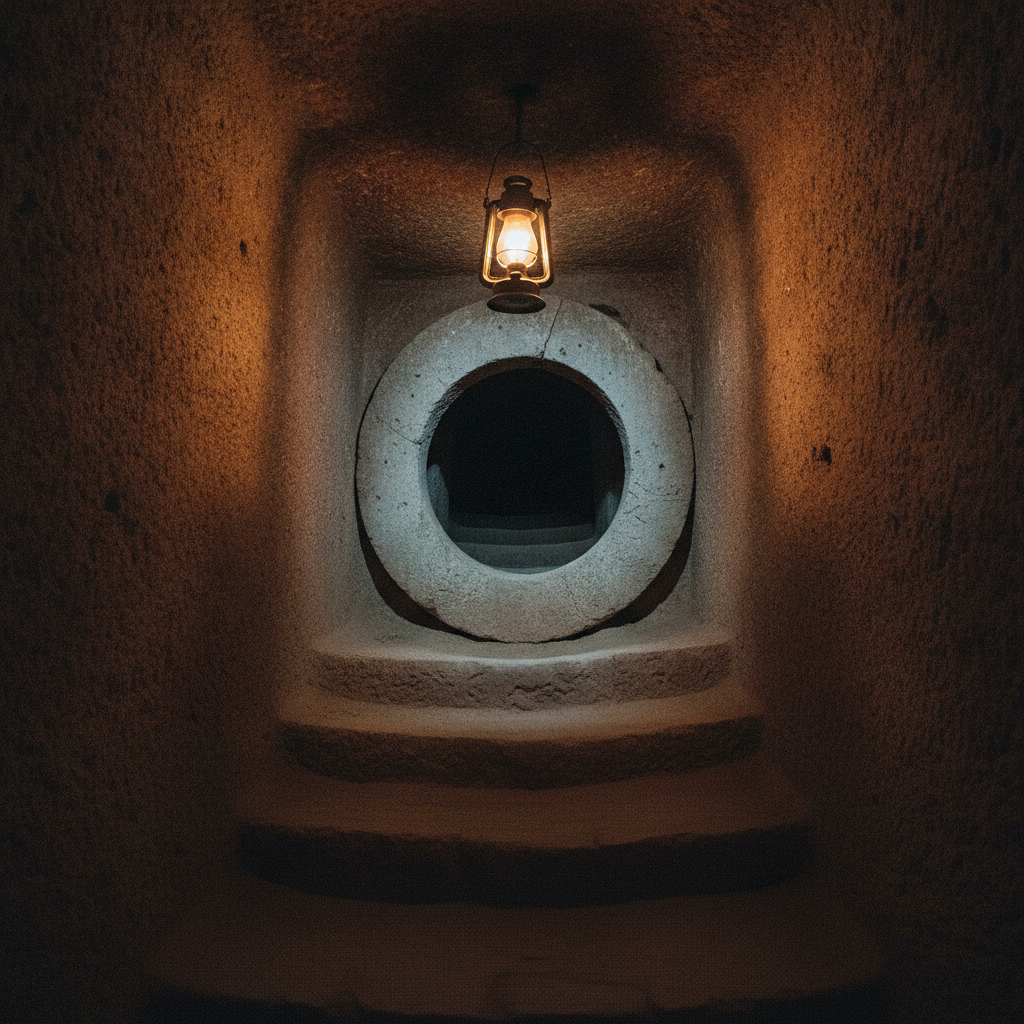
At intervals along the passages stand round stone doors, like millstones set on edge. They are up to about 1.5 m across and weigh up to about 500 kg.
Each one sits in a carved recess beside the tunnel. To close it, people inside rolled it across the passage. To open it, they rolled it back.
It can only be worked from the inside. There is no handle, no purchase, nothing on the outer face for an attacker to pull or push against. A man standing in the tunnel outside cannot move 500 kg of stone that has no grip on it.
In the middle of each door is a small round hole. It let the defenders see who was on the other side, and let them push a spear through it.
Each level could be sealed off from the one above it in the same way, so an enemy who got through one door faced another.
This is not storage. This is not a cellar. This is a building designed around the assumption that someone would come to kill the people inside.
The air
The harder engineering problem was not the digging. It was breathing.
A sealed space 85 m underground with thousands of people and their animals in it becomes unbreathable within hours.
The solution runs through the whole complex. More than 50 vertical shafts connect the levels to the surface, along with thousands of smaller ducts cutting between chambers. One main shaft measures roughly 3 m by 2.8 m. A well goes down about 55 m.
The openings of the shafts were placed so that air moves through the system rather than sitting in it, and the shafts also carried water, and voices from level to level.
The wells were deliberately not connected to the surface everywhere, so that an enemy above could not poison the water of the people below.
Whoever planned this understood ventilation, water supply and siege warfare, and planned all three at once.
Who hid here, and from whom
From this point the record is much better.
Between roughly 780 and 1180 the region lay on a war frontier, raided repeatedly from the south and east. Local Christian communities enlarged the underground cities heavily in exactly this period. The churches and chapels cut into the rock belong to them.
The complex was used again when new invaders came through in the 11th century, and again in the 14th.
It stayed in use, on and off, for a very long time. In 1923, when Christian residents left the region under the population exchange between Greece and Turkey, the tunnels were abandoned and their entrances forgotten.
Forty years later a man knocked down a wall in his cellar.
The oldest written clue, and why it may not apply
There is one ancient text that comes up in nearly every account of Derinkuyu.
Around 370 BC a Greek soldier and historian wrote a description of a march through Anatolia. He described villages where the people lived underground: the entrance like the mouth of a well, wide below, with ramps cut for the animals and ladders for the people, and goats, sheep, cattle and poultry kept down there with them.
That is an unmistakable description of this kind of settlement, written 2,400 years ago.
But there is a problem with how it is usually used. The passage describes villages the army passed through in what is now eastern Turkey and Armenia, not Cappadocia. Popular accounts attach it to Derinkuyu; the text itself does not.
What it does prove is that underground living was normal in Anatolia at that date, which is something.
Conclusions and Open Questions
**Everything physical about the site is documented.** The depth, the shafts, the doors, the rooms, the wells and the tunnel that connects it to a second underground city about 9 km away are all measured and mapped. The problem: none of it carries a date. The whole dispute is about the age of the earliest cutting, and that is the one question the rock cannot answer.
**The Byzantine phase is certain; nothing before it is.** Churches, crosses cut into walls and the pattern of enlargement tie the big expansion to the period of raids from the south. The problem: that same expansion destroyed the evidence of whatever was there first. The better documented phase erased the one people actually argue about.
**The Hittite and Phrygian attributions are reasoning, not findings.** Both peoples were in this landscape with the right tools and real enemies. The problem: no object from either has been recovered from the original tunnels. These are candidates, not conclusions, and they are often repeated as if they were settled.
**The site is not fully explored.** More than 600 entrances have been located, many tunnels are blocked by collapse, and only part of the complex is open. The problem: the parts most likely to hold early material are the deepest and the least accessible, and clearing a collapsed tunnel in soft rock is slow and dangerous work.
One thing is worth saying at the end, because it is easy to lose among the numbers.
This was not a monument. Nobody built it to be admired. Every metre of it was cut by people who expected, at some point in their lives, to hear that riders were coming, and to have to take their children and their animals underground and roll a stone across the door behind them.
They did that for centuries. And then they stopped, and the town above forgot the city below well enough that it took a man with a hammer to find it again.