Documented

The Sleep That Lasted Decades: The Forgotten Plague of 1917

2026-07-02 · Strange Mass Events · 8 min read

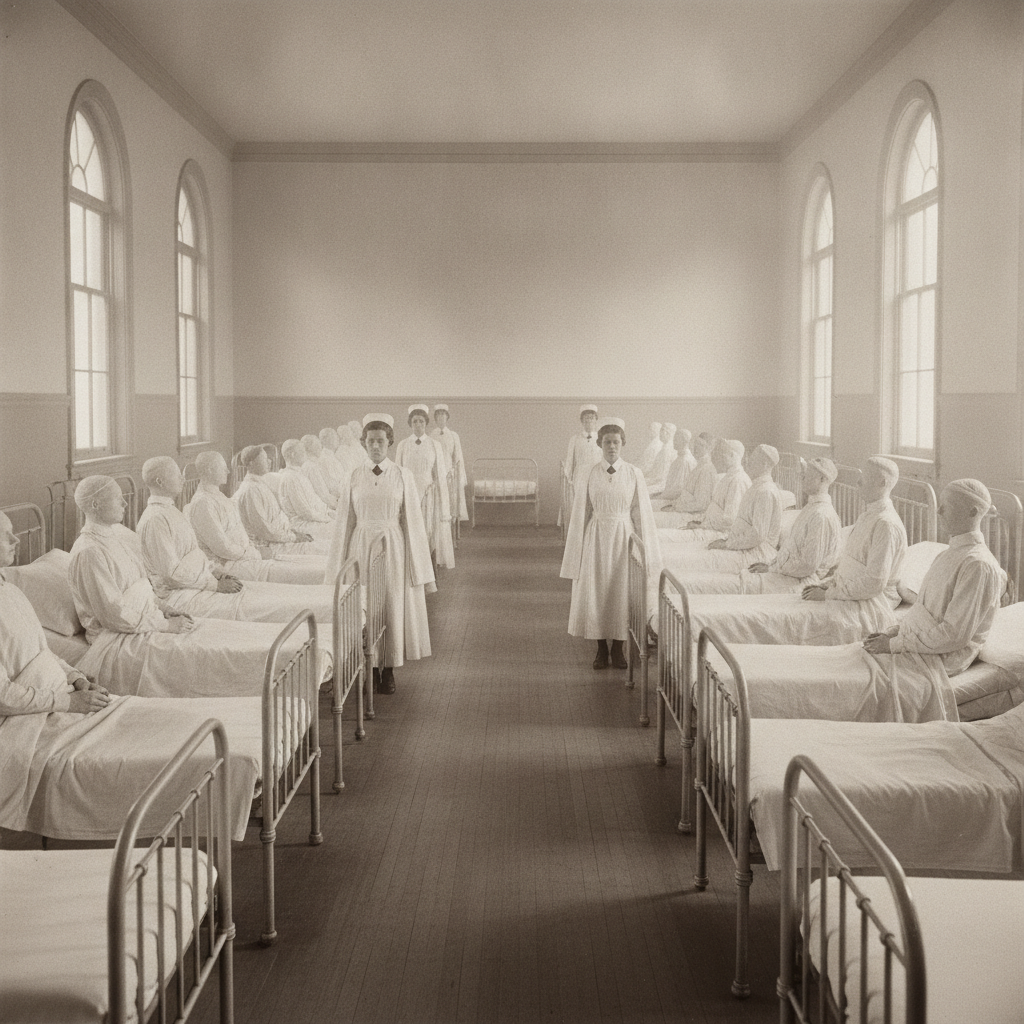
In the winter of 1916, with the First World War grinding into its third year, physicians across Europe began seeing patients whose chief complaint fit no disease in the textbooks. The patients were sleepy. Not tired, not merely worn down by rationing and bad news, but overwhelmingly, irresistibly sleepy. A man would sit down to a meal and fall asleep with the fork halfway to his mouth. Some sank into a stupor from which they could barely be roused and slept for days or weeks on end. A few slipped into a coma and never woke again. Others suffered the exact reverse and could not sleep at all, lying awake night after night in a torment of insomnia.

In Vienna, the neurologist Constantin von Economo studied a series of these patients, concluded that he was looking at something genuinely new, and in 1917 gave it a name: encephalitis lethargica, an inflammation of the brain that brought sleep. The name stuck, and it has never been replaced.

It arrived in the middle of a dispute over priority. Roughly ten days before von Economo read his paper in Vienna, the French physician Jean-Rene Cruchet had published a description of some forty cases among soldiers and civilians in France, under the label subacute encephalomyelitis. Cruchet saw a diffuse, scattered illness with no single shape. Von Economo saw one disease with a signature of its own. It was von Economo's framing that prevailed, and his name that entered medicine.

Von Economo did more than name it. Cutting into the brains of patients who had died, he found the damage concentrated in the grey matter around the base of the brain, and from the pattern of that damage he drew a conclusion that outlived the epidemic entirely: the machinery governing sleep must lie there, in the hypothalamus, with one zone promoting sleep and another promoting wakefulness. A disease no one could cure had handed medicine the foundations of the modern science of sleep.

In the clinic the acute illness wore faces that seemed to contradict one another. In the commonest, the somnolent form, patients drooped irresistibly into sleep while the muscles of the eyes failed, leaving the lids heavy and the gaze wandering or crossed. In a second form patients were flung into the opposite state: restless, agitated, unable to sleep at all, sometimes wildly overactive, and among children this could curdle into a destructive mania that frightened their families. In a third they turned rigid and slow from the very beginning. Von Economo came to describe all of these as one disease.

The public did not use his term. Watching relatives fall asleep at looms and at dinner tables, people called it the sleepy sickness, and doctors took care to distinguish it from the African sleeping sickness carried by the tsetse fly, with which it shared nothing but a name and a symptom.

Over the following decade the disease travelled. It reached Britain, France, North America and far beyond, striking capital cities and remote villages with the same indifference and following no visible chain of contagion. Cases surfaced in the same season on opposite sides of the world. Estimates of the toll vary widely; a commonly cited figure holds that around a million people were affected and that perhaps half a million died during the epidemic years. All of this happened while the great influenza pandemic of 1918 was tearing through the same countries, filling the same hospitals and the same newspapers.

For many of those who survived the acute illness, the ordeal was only beginning. Over months or years they developed what doctors named post-encephalitic parkinsonism. They grew rigid and slow. Their faces stiffened into expressionless masks and their voices faded to a whisper. Their eyes would sometimes roll upward and lock in place for minutes or hours at a time, in episodes the physicians called oculogyric crises. Patients who lived through those crises described something the observing doctors could not see: in the same instant that the eyes turned up, the mind was seized by a single intrusive thought or compulsion that could not be shaken loose.

The cruellest feature was that the patients were not absent. Behind the motionless bodies the mind very often stayed awake and aware, remembering, listening, following conversations, understanding everything, and it stayed that way for years and in some cases for decades. Some patients froze in mid-gesture, a hand half raised or a step half taken, and could be coaxed into a few seconds of fluid movement by a touch, a ball thrown towards them or a bar of music, as though a machine had jammed rather than a person fallen ill.

Then the epidemic ended almost as abruptly as it had begun. After roughly 1927 the wave of new cases collapsed, and encephalitis lethargica all but disappeared from the world. Only scattered and heavily disputed cases have been reported since, and in the century that followed no comparable outbreak has ever returned. Doctors still reach for the old diagnosis occasionally, when a patient sleeps, stiffens and stares in a way that nothing else explains.

The survivors, meanwhile, were still alive. Four decades after the epidemic, in the late 1960s, the neurologist Oliver Sacks found a ward of them at Beth Abraham Hospital in the Bronx: men and women who had sat motionless and silent since the illness of their youth, some of them for thirty or forty years. In 1969 he began treating them with L-DOPA, a then new drug that floods the brain with the dopamine those damaged regions could no longer produce.

Ad

The effect was extraordinary. Patients who had not moved or spoken in decades woke, spoke, stood, walked, laughed; some of them danced. For a few weeks in the summer of 1969 the ward came back to life, and its patients talked about the decades they had lost as though they were waking from a single night's sleep. The reprieve did not hold. For many it flickered, distorted and faded, and it could not simply be dialled back by adjusting the dose. Sacks recorded the whole episode in his 1973 book Awakenings, later made into a film with Robert De Niro and Robin Williams, which is the reason most people have heard of the disease at all.

Conclusions and Open Questions

A century of investigation has narrowed the suspects without naming the killer. No single cause of encephalitis lethargica has ever been confirmed.

The oldest suspicion belonged to the doctors who lived through it, and it pointed at the 1918 influenza. Its whole strength was the coincidence of timing: two unprecedented illnesses moving through the same populations in the same years. Its weakness surfaced much later, when a team led by the virologist John Oxford examined brain tissue preserved from victims and found no influenza RNA in it. Most researchers now doubt that the flu virus was the direct cause, although an immune reaction triggered by it cannot be ruled out.

A second explanation, proposed in a 2004 study by Russell Dale and colleagues in London, recast the disease as autoimmune. Of twenty modern patients with an encephalitis-lethargica-like illness, the great majority carried antibodies attacking the basal ganglia, and many showed signs of a recent streptococcal throat infection, suggesting that the immune system, provoked by strep, had turned on the brain. The strength here is a plausible mechanism. The weakness is that it rests on a small modern series that may not correspond to the historic epidemic at all, and that streptococcus was everywhere in 1917 without producing sleepy sickness.

A third answer, from other researchers working on the same archived tissue, argued for an enterovirus related to poliovirus and offered physical viral traces in support. That finding has never been consistently reproduced.

All three run into a problem with the evidence itself. The brains that survive are a scarce handful of specimens soaked in formalin by pathologists of the 1920s, fixed in a way that no one then knew would one day frustrate the very molecular tests investigators now most want to run. Every modern researcher is working a crime scene that was mopped clean a hundred years ago.

Some argue that the trail runs back further than 1916, to an obscure sleeping illness called nona reported in the 1890s, and read it as the first tremor of the same thing. The records are too thin to test the claim either way.

One theory holds that encephalitis lethargica was never a single disease. On this view the name simply gathered up several overlapping inflammations of the brain that happened to cluster in one exhausted, malnourished, war-worn decade, and its apparent disappearance is partly an artefact of doctors having stopped filing cases under that heading. A related suggestion is that the war itself, with its crowding, hunger and mass movement of bodies, opened a window in which an ordinary infection could do extraordinary harm, a window that closed as Europe recovered. Neither can be proved from the surviving record.

What remains unexplained is the core of the case. Why a disease should appear from nowhere, sweep through a million lives and then vanish so completely that a full century has passed without its return. Why no preserved brain, in all that time, has yielded a definitive culprit. How one illness could drown some victims in endless sleep, freeze others wide awake and lucid for the rest of their lives, and rob a third group of sleep entirely.

And underneath all of it sits the question the doctors of 1927 never got to answer. If we never learned what caused it, no one can be certain that it ended, rather than simply stopped being recognised.

Free reads left this month: 0

Share this story:

Reader comments (0)
Only active subscribers with verified payment can post comments. Get full access