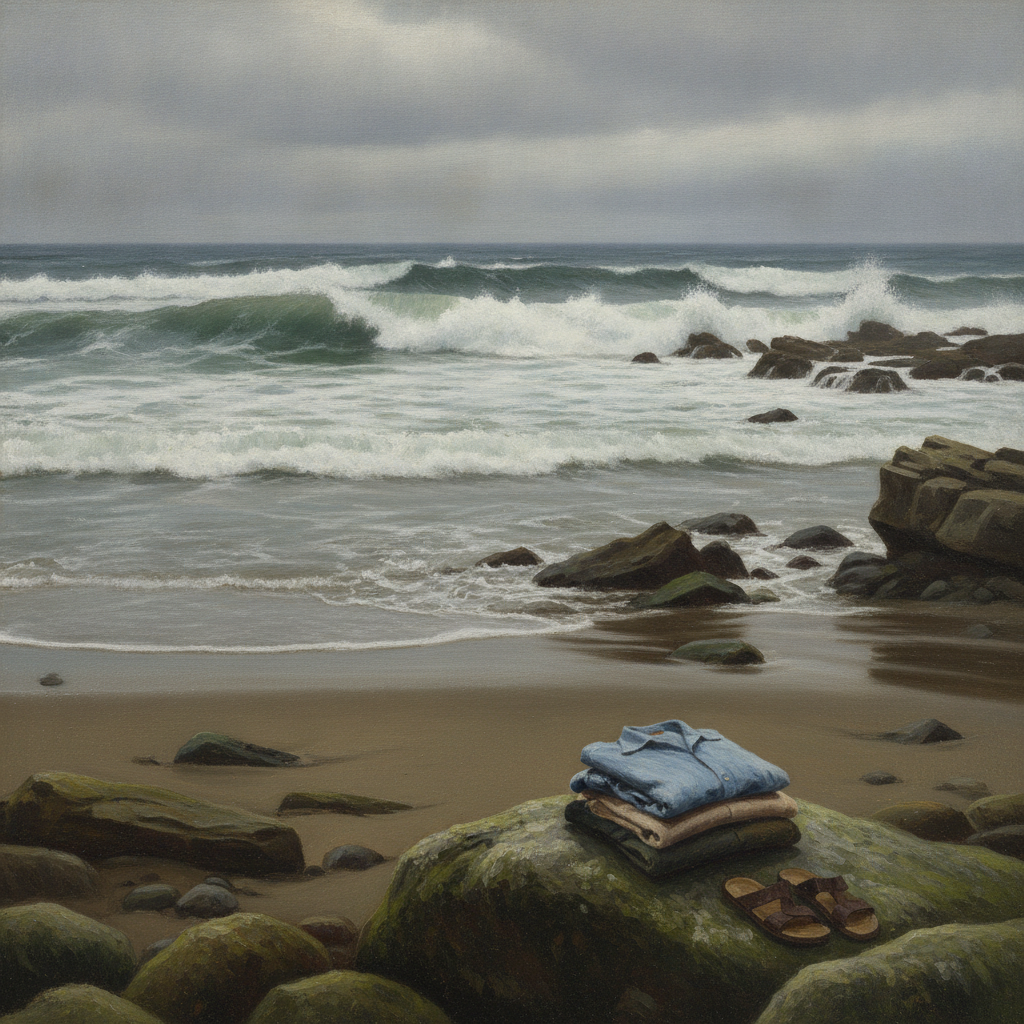
The Prime Minister Who Walked Into the Sea
Cheviot Beach is not really a public beach. It sits on the ocean side of Point Nepean, at the tip of the Mornington Peninsula south of Melbourne, inside Commonwealth defence land. It is reached by a rough track, it is fringed by reef, and the water above it is one of the most treacherous stretches of the Victorian coast, where the swell of Bass Strait meets the rip running out of Port Phillip Bay. Sunday 17 December 1967 was a warm, bright day there, with a heavy swell and visible currents cutting across the bay.
Harold Edward Holt, the seventeenth prime minister of Australia, knew that beach better than almost anyone. He was 59. He had entered federal parliament at 27 and become a minister at 31, spent sixteen years as treasurer and deputy to Robert Menzies, and finally taken the top job in January 1966. He had won a large election victory that same year. He was also, unusually for a national leader, a serious skin diver. Introduced to spearfishing in 1954, he swam and dived through every season, disliked air tanks as cumbersome, and had a reputation for remarkable endurance beneath the surface. Contemporaries noted a distinction that would matter later: he was very strong underwater and much less strong on top of it.
That weekend he had come down from Canberra. His wife Zara had stayed behind to finish preparations for the annual Christmas party. On the Sunday morning Holt drove to Portsea with friends to watch the British solo yachtsman Alec Rose sail in through the heads of Port Phillip Bay, a small piece of maritime theatre that drew a crowd. Afterwards the group decided to go on to Cheviot Beach.
Four people were with him: Marjorie Gillespie, a neighbour and friend with whom he was having a relationship, her daughter Vyner, and two family friends, Alan Stewart and Martin Simpson. They arrived at around a quarter past twelve. The sea was rough. Stewart went in but stayed close to shore, and later described feeling a powerful undertow even in shallow water.
Holt walked in and kept going. He swam out past the point where the others had stopped, into deeper water off the reef. Marjorie Gillespie watched from the sand. What she saw, she said afterwards, was the water simply taking him: he went, in her words, like a leaf being drawn away, so quick and final that there was no struggle to see and no moment to shout.
The alarm went out within minutes. What followed became one of the largest search operations in Australian history. Police search and rescue units, around three dozen navy divers, army personnel, air force helicopters, boats and hundreds of civilian volunteers converged on the peninsula. More than 190 people were involved by the end of the first day, and the number eventually passed 340. Divers worked the reef and the gullies. Aircraft flew the coast in both directions. The official search was scaled down over the following fortnight and formally ended on 5 January 1968.
Nothing was ever found. Not a body, not a fragment of clothing, not a piece of equipment. Holt had gone into the water wearing swimming trunks, so there was no wetsuit, no mask and no fins to wash up later and mark the spot.
The machinery of government moved with unusual speed. On 19 December, John McEwen, the Country Party leader and deputy prime minister, was sworn in as caretaker prime minister because the Liberal Party had no deputy leader in the House and needed time to choose a successor. On 22 December a memorial service was held at St Paul's Cathedral in Melbourne, attended by a remarkable assembly of world figures: President Lyndon B. Johnson of the United States, Prince Charles representing the Queen, United Nations Secretary General U Thant, and the prime ministers of New Zealand, Singapore, Thailand and the Philippines among others. On 9 January 1968 the Liberal Party elected Senator John Gorton as leader, and he became prime minister, the first senator to do so.
Then the case went quiet in a way that later fed decades of speculation. Under the law of Victoria at the time, an inquest was not required where no body had been recovered, and none was held. A police report was prepared in 1968 by the investigating inspector, Lawrence Newell, who concluded that Holt had drowned and that the cause was straightforward: an experienced but overconfident swimmer had entered dangerous water and been caught by the sea. The report specifically ruled out suicide, noting that Holt's behaviour and plans in the preceding days had been entirely normal.
Two facts from that year sat quietly in the record. In September 1967 Holt had begun treatment for a shoulder injury dating back to his football playing youth, and his doctor had advised him to avoid overexertion and to cut back on swimming and tennis. And on 20 May 1967, seven months before he disappeared, Holt had got into difficulty while diving at Cheviot Beach itself and had to be helped. He is reported to have said afterwards that it was the closest he had ever come to drowning in his life.
The formal legal question was only settled thirty eight years later, and almost by accident. A change to Victorian law in 1985 allowed the coroner to examine cases of suspected drowning where no body had been recovered, and a review eventually covered more than a hundred such deaths between 1961 and 1985. Holt's was among them. In 2005 the state coroner, Graeme Johnstone, held an inquest and found that Harold Holt had drowned at Cheviot Beach, that he had taken an unnecessary risk in dangerous conditions, and that the death was accidental, by misadventure. The finding recorded that his body had most likely been swept out to sea or taken by sharks, and that there was nothing of significance in the evidence to suggest any cause other than drowning.
Australia had, by then, already turned the disappearance into part of its furniture. In March 1969 the Malvern City Council opened a public swimming pool in Melbourne and named it the Harold Holt Memorial Swimming Centre, after the local member who had drowned. The United States Navy named a destroyer escort after him. Cheviot Beach remains closed to casual swimmers.
Conclusions and Open Questions
The documentary record is unusually consistent. Four witnesses saw a man swim into rough water and be carried away, the police concluded drowning in 1968, and a coroner formally confirmed accidental drowning in 2005. Yet almost nothing about the case has stayed settled in the public imagination, and the reason is simple: a nation lost its head of government and never got a body back.
The most famous alternative is the Chinese submarine theory, set out at length by the British journalist Anthony Grey in his 1983 book The Prime Minister Was a Spy. Grey argued that Holt had been a Chinese agent for most of his life and was collected from Cheviot Beach by a submarine and taken to China. Reviewers found multiple factual errors, and the practical objection is severe: the water off Point Nepean is shallow, reef strewn and violently turbulent, submarines cannot loiter there, and no such vessel could have approached, held station and departed unnoticed in a busy strait. No Chinese source has ever supported the claim. Holt's widow Zara dismissed it with the observation that her husband did not even like Chinese food, and his grandson publicly mocked the theory again on the fiftieth anniversary in 2017.
A second theory, first floated in a Melbourne newspaper article in 1968, held that the CIA had Holt killed because he intended to pull Australian troops out of Vietnam. Its weakness is that the alleged motive runs backwards. Holt was among the most enthusiastic supporters the American war effort had in the region, and had campaigned on that closeness.
A third possibility, suicide, has been raised by some writers who point to the political strain of 1967 and to his health. The 1968 police report considered and expressly rejected it. Others have suggested Holt staged his own disappearance to escape public life. That theory has to contend with the fact that he vanished in front of four people, one of whom was the woman he would supposedly have been running to.
What the accidental drowning explanation does not fully close is the absence itself. One of the largest searches ever mounted in the country, in a defined stretch of coast, over three weeks, recovered nothing at all. Some argue that this is unremarkable given the currents and the sharks. Others find it hard to accept.
The open questions are therefore mostly about judgement rather than conspiracy. Why did a man who had almost drowned at that exact beach seven months earlier, and who had been told by his doctor to swim less, go in alone that day when the only other swimmer stayed in the shallows? Why did no inquest take place for thirty eight years, leaving a vacuum that rumour filled? And can any official finding ever fully satisfy a public that never had a funeral to attend?