Four Thousand Messages, Five Signs Long: The Script of the Indus Cities
The object is smaller than a matchbox. It is a square of steatite, a soft grey stone, about two and a half centimetres on a side, pierced on the back so it could be worn on a cord. On the front an animal stands in profile, an ox-like creature with a single curved horn. Above the animal runs a line of marks: a jar, a fish, a set of vertical strokes, a figure like a man with raised arms. There are about four thousand objects like this. Nobody alive can read a single one of them.
The first of them reached print in 1875, when Alexander Cunningham, the first director-general of the Archaeological Survey of India, published a seal that had turned up at a mound called Harappa in the Punjab. The signs on it matched no script anyone knew. Cunningham assumed it was foreign, some import from a place that would eventually be identified. For nearly fifty years it sat in the literature as a curiosity with no context.
The context arrived in the 1920s. Daya Ram Sahni began systematic excavation at Harappa, and Rakhal Das Banerji opened a site four hundred miles to the south called Mohenjo-daro, and the two men found the same bricks, the same weights, the same seals. In September 1924 John Marshall announced in the Illustrated London News that India had produced a Bronze Age civilization contemporary with Egypt and Sumer, unknown to history and unmentioned by any ancient author.
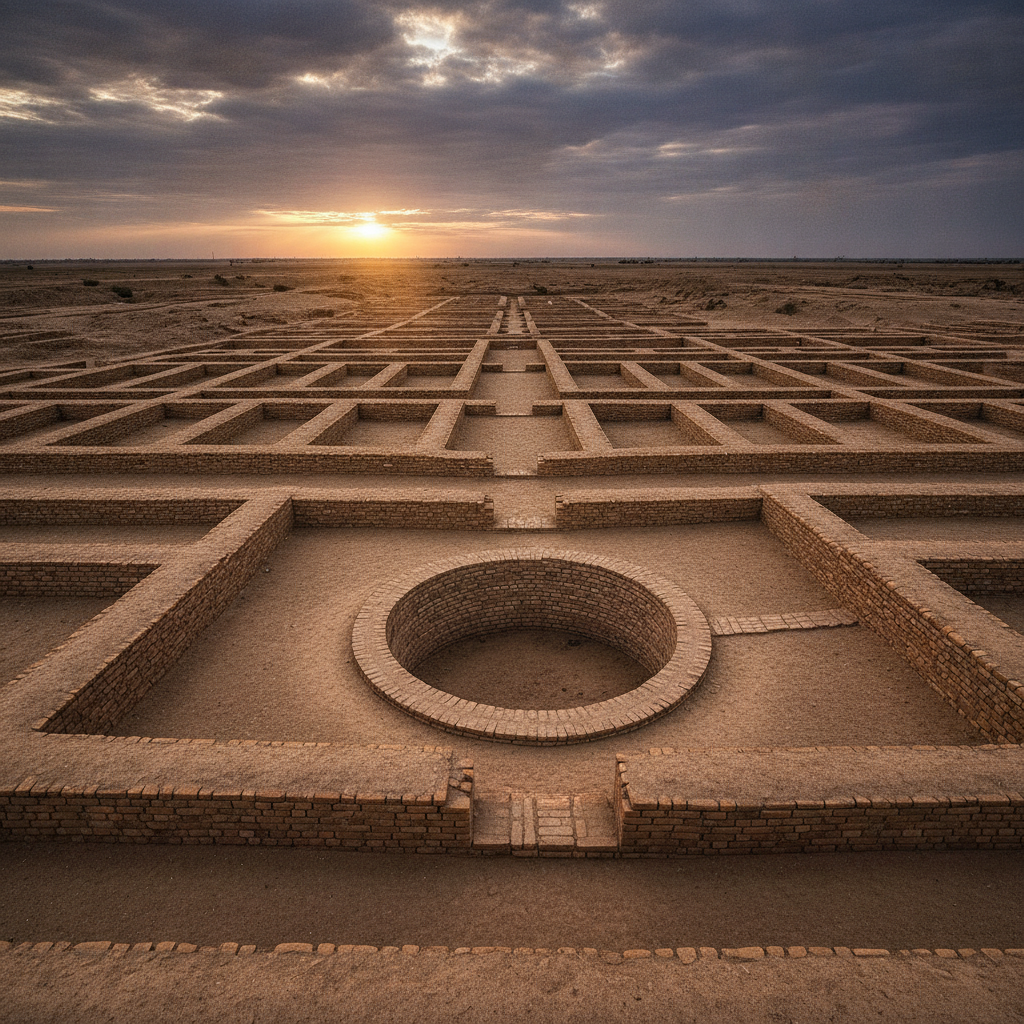
What has emerged since is one of the largest civilizations of the ancient world, spread over something like a million square kilometres of what is now Pakistan and northwestern India, at its height between roughly 2600 and 1900 BCE. Its cities were laid out on grids, with covered drains, public wells and standardised fired bricks in fixed ratios. Its merchants used cubical stone weights so consistent that the same units turn up across the entire territory, and its seals have been found in Mesopotamia, where cuneiform records refer to trade with a place called Meluhha.
And it left almost nothing to read.
The corpus consists of roughly four thousand inscribed objects: stamp seals, the clay sealings pressed by them, small copper tablets, and marks scratched on pottery. The inscriptions are astonishingly short. The most common length is four or five signs. The longest text on a single surface runs to seventeen. There is no tomb inscription, no royal proclamation, no treaty, no letter, no accounts tablet of the kind that Mesopotamia produced by the tens of thousands. Every sequence is shorter than this sentence.
Iravatham Mahadevan, the Indian epigraphist who spent much of his life on the problem, compiled a concordance in 1977 counting 417 distinct signs. The number is itself a clue and a problem. It is far too many for an alphabet, which needs a few dozen, and far too few for a purely word-based system, which needs thousands. It sits in the range typical of logo-syllabic scripts, where signs stand sometimes for words and sometimes for sounds, as in Egyptian, Sumerian and Chinese. That is a reasonable inference. It is not a reading.
Some structure is visible without any decipherment. The script generally runs right to left, established from the way signs are cramped or overlapped when a carver ran out of room at the left edge. Certain signs appear overwhelmingly at the beginning of sequences and others at the end. A sign resembling a jar is the most common terminal element. Some pairs of signs occur together far more often than chance allows. Whatever the sequences are, they are not random.
There is one apparent exception. At Dholavira, a city in Gujarat, excavators found ten signs far larger than any others known, made of gypsum inlay, evidently mounted on a board, probably above a gateway. It is the closest thing to a public inscription the civilization left, and it is ten signs long.
The central obstacle is easy to state. Egyptian hieroglyphs fell to Champollion because the Rosetta Stone carried the same text in Greek. Linear B fell to Ventris because he guessed correctly that the language behind it was early Greek. For the Indus script there is no bilingual text and no known language. Both unknowns have to be solved at once, using a corpus whose average message is five characters long.
That has not stopped people trying. More than a hundred decipherments have been published, and none is accepted.
The most sustained scholarly attempt is that of Asko Parpola of the University of Helsinki, who has argued for decades that the language behind the script was Dravidian, the family that includes Tamil and survives today mainly in southern India, with one isolated outlier, Brahui, spoken in Balochistan. Parpola's method is the rebus principle, which is genuinely how early scripts work: a sign for a concrete object is borrowed for its sound. His best known example is the fish sign. In most Dravidian languages the word for fish, min, also means star. A fish sign, on this reading, could write not fish but a celestial term, and Parpola has proposed readings for several such combinations as names of planets and stars.
The competing linguistic view holds that the language was an early Indo-Aryan one, ancestral to Sanskrit. This position has a chronological difficulty, since the Indo-Aryan languages are generally dated later than the mature Indus cities, and it has been damaged by episodes in which the evidence did not survive scrutiny.
Then, in 2004, Steve Farmer, Richard Sproat and Michael Witzel published a paper with a deliberately provocative title: The Collapse of the Indus-Script Thesis: The Myth of a Literate Harappan Civilization. Their argument was not that the script had been misread but that it had never been a script. Real writing systems, they contended, do not behave like this. They produce long texts, on durable media as well as perishable ones; they leave scribal equipment and scribal errors; they do not have large numbers of signs that appear exactly once. The Indus signs, on their reading, were non-linguistic symbols closer to heraldry than to sentences, marking ownership, clan, deity or commodity. The authors offered a cash prize to anyone who could produce a single Indus text of substantial length. It has not been claimed.
In 2009 the argument acquired a statistical front. Rajesh Rao, a computer scientist at the University of Washington, working with Mahadevan and others, published a short paper in Science measuring conditional entropy in the Indus sequences: essentially, how predictable the next sign is given the current one. Using 1,548 lines from Mahadevan's concordance, some seven thousand sign occurrences, they reported that the Indus figures fell close to those of known linguistic systems such as Sumerian and Old Tamil, and away from non-linguistic symbol sets. Sproat replied that the comparison sets had been chosen in a way that made the outcome inevitable, and that conditional entropy cannot distinguish a language from any other structured sequence. Rao replied to the reply. The exchange has not been resolved, and specialists still disagree about whether the object under study is writing.
The question has also become political, since whether the Indus cities spoke a Dravidian or an Indo-Aryan language bears on modern arguments in India about origins and priority. In January 2025, at a Chennai conference marking a century since the civilization was announced, the chief minister of Tamil Nadu, M. K. Stalin, offered a million-dollar prize to anyone who deciphers the script and announced an endowed chair in Mahadevan's name. At the same conference the researchers K. Rajan and R. Sivananthan reported that more than fourteen thousand inscribed potsherds from Tamil Nadu showed a substantial overlap of signs with the Indus corpus.
Conclusions and Open Questions
The Dravidian hypothesis remains the most developed linguistic proposal. Its strength is that its method is the correct one: rebus writing is how early scripts actually function, Dravidian is spoken in the subcontinent, Brahui survives near the old Indus territory, and words in the oldest Sanskrit texts appear to come from a non-Indo-Aryan source. Its weakness is that it cannot be tested. A proposed reading of a five-sign sequence produces no independent confirmation, no second text that becomes intelligible as a result, no prediction that can fail.
The Indo-Aryan hypothesis has the advantage of continuity with the later literate culture of the region. Its weaknesses are the dating, which places the attested Indo-Aryan languages after the mature Indus period, and a record of claims that have not held up under examination.
The non-linguistic thesis is the strongest sceptical position and its central observation is hard to dismiss: in a century of excavation across hundreds of sites, nothing long has ever been found. Its weakness is that absence of evidence is doing most of the work, and the entropy results, whatever their limitations, point the other way.
Between these sits a quieter possibility that several researchers find plausible: that the signs did encode language, but only for a narrow bureaucratic purpose, recording names, titles, commodities, quantities or tax obligations on goods in transit. This fits the archaeology, since the sealings were pressed onto bales and containers. Its weakness is that it explains the shortness without explaining the total absence of anything else.
The last theory is that the long texts existed and are gone, written on palm leaf, cloth or birch bark and destroyed by a monsoon climate. This is possible. Against it stands the observation that literate cultures in wet climates still tend to leave long inscriptions on stone and metal, and that no styli, inkwells or other scribal apparatus have been identified at Indus sites.
What is unexplained is substantial. Nobody knows what language, if any, lies behind the signs. Nobody knows why an administratively sophisticated society with a thousand-kilometre reach never produced a text longer than seventeen characters on anything that survives. Nobody knows how the sign inventory stayed so stable across that distance and centuries without a teaching apparatus that left any trace. And nobody knows why, when the cities were abandoned after about 1900 BCE, the signs vanished with them, leaving no descendant script and no tradition that remembered what they meant.