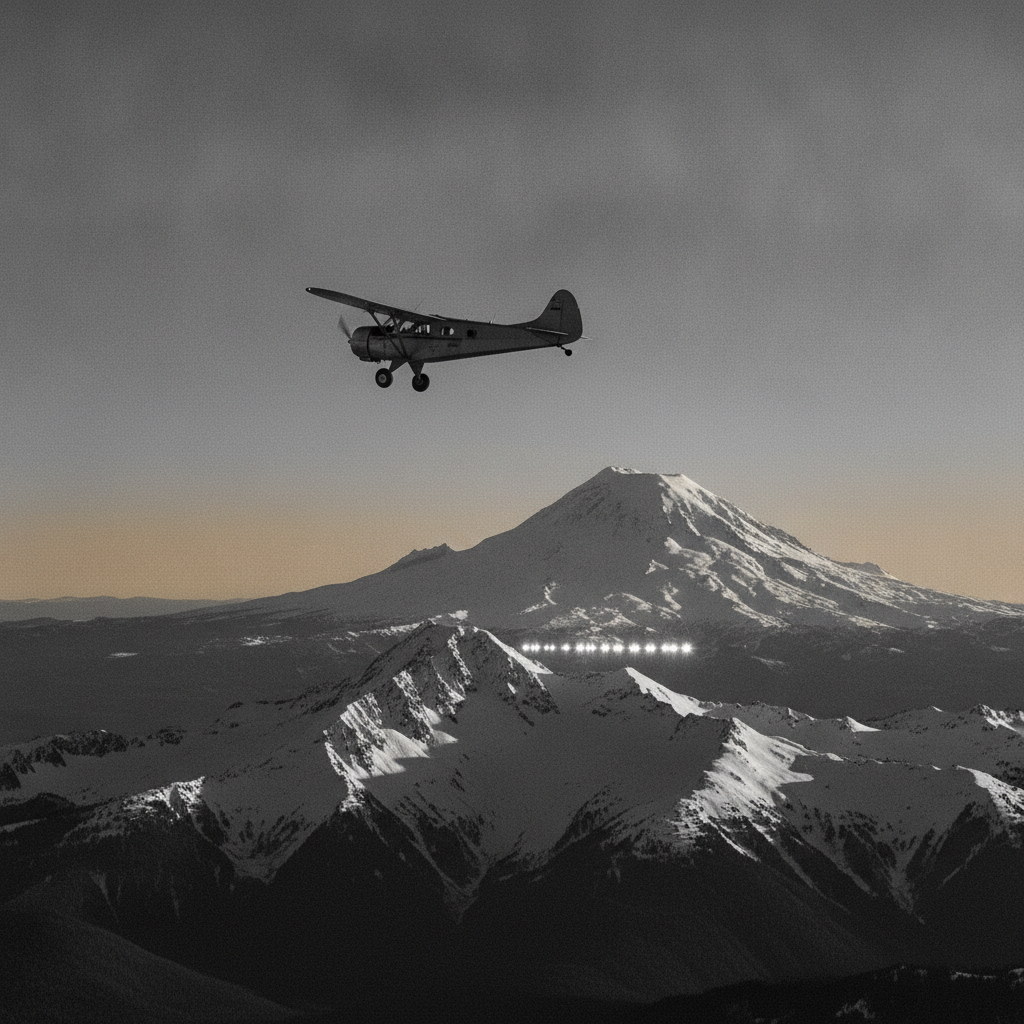
The Kenneth Arnold Sighting: Nine Flashes Over Mount Rainier and the Birth of the "Flying Saucer"
It is 24 June 1947, a few minutes before 3 in the afternoon.
A small single-engine plane is flying at about 2,800 m over the Cascade mountains, in Washington state, in the north-west corner of the United States. The sky is clear. The wind is light.
The pilot is alone. He has spent part of the afternoon circling the slopes of Mount Rainier, the great snow-covered volcano that rises above the whole region. A Marine Corps transport plane had crashed somewhere on the mountain, and a reward of $5,000 had been offered to whoever found it.
He has found nothing. He gives up and turns east, towards his next stop.
Then a bright flash hits his eyes, like sunlight thrown off a mirror.
What this case is
The pilot was Kenneth Arnold, a 32-year-old businessman from Idaho and an experienced mountain flier.
What he reported next became the Kenneth Arnold sighting: 9 shining objects flying in a line past Mount Rainier at a speed no aircraft of the time could reach. Within days, newspapers across the world were writing about "flying saucers". The modern idea of the UFO starts here.
The US Air Force later filed the case under one word: mirage. Arnold never accepted that. What exactly he saw that afternoon has never been established.
Nine flashes over the mountain
Arnold's first thought was that he had nearly flown into another plane.
He looked around. The only aircraft he could see was a large 4-engine airliner, about 24 km to his left and behind him. It was not the source of the flash.
About 30 seconds later the flashes came again, a whole series of them, off to his left, north of Mount Rainier. He judged them to be 32 to 40 km away.
He was careful. He wanted to be sure he was not seeing a reflection in his own window. He rocked the plane. He took off his glasses. He opened the side window. The flashes were still there.
Now he could count them. There were 9 objects, flying in a long chain.
At first he thought of geese. Then of a new kind of jet. He looked for tails and wings and could not see any.
As they crossed in front of the snowfields of Mount Rainier, they looked dark against the white. Every so often one would flip, catch the sun, and flash. At moments they were so thin and flat that they almost disappeared.
They did not fly like aircraft. Arnold later said they weaved like the tail of a Chinese kite, darting between the peaks and flipping together. He said the sight gave him an eerie feeling. His first guess was that he was watching a secret American military plane.
He timed them with the clock
Arnold did something few witnesses ever do. He measured.
He turned south on a course parallel to theirs and used the clock on his instrument panel. He timed the objects from the moment they passed Mount Rainier to the moment they passed Mount Adams, the next big volcano to the south.
It took 1 minute and 42 seconds.
The two peaks are about 76 km apart, measured summit to summit. That works out to more than 2,600 km/h. Arnold himself calculated over 2,700 km/h, and then, to be cautious, reported at least 1,900 km/h.
In June 1947, no aircraft had yet flown faster than sound. The first supersonic flight would come 4 months later, in October 1947.
He also tried to judge their size. He used a small metal fastener on his engine cover as a measuring mark, and compared the objects with the distant airliner. He put them at slightly smaller than the airliner's span between its outer engines, about 18 m. Later he said he thought they were more than 30 m long.
The whole sighting, according to the Air Force record card, lasted between 2.3 and 3 minutes.
The words that went around the world
Arnold landed at his next stop, a small airfield in Washington state, and told the other pilots there. They suggested guided missiles, or a secret Army plane.
He refuelled and flew on to an air show in a small town in Oregon, the neighbouring state to the south.
There, on 25 June, two reporters from the local newspaper interviewed him. Their first story the same day described "saucer-like" aircraft.
Arnold's own early words for the shape varied: like a saucer, a disc, a pie pan, half a moon. He also said they moved like a saucer skipped across water. Years later he insisted that he had meant the movement, not the shape, and that he had been misquoted.
It did not matter. On 26 June a big-city newspaper ran a headline about supersonic "flying saucers". The phrase may have come from a headline writer rather than from Arnold himself. Within days it was everywhere.
Hundreds more reports
Around the same time, there were other reports from the region. A fire lookout in the mountains reported flashes at about 3 in the afternoon. A prospector on Mount Adams was reported to have seen similar objects at around the same time, and the Air Force later judged him a credible witness too.
In the weeks that followed, at least several hundred similar reports came in, from across the United States and abroad. On 4 July the crew of a passenger airliner over Idaho reported 5 to 9 disc-like objects that stayed in sight for 10 to 15 minutes.
The Army comes to visit
On 12 July 1947, two military intelligence officers from an air base in California came to interview Arnold. They took his written report with them.
Their conclusion was blunt. Arnold, they wrote, "actually saw what he stated he saw."
In public, the Army Air Forces said the objects had been a mirage.
In private, the picture was different. Military intelligence and the FBI quietly investigated the best of the new sightings. In September 1947 a senior general's written assessment stated that the phenomenon was real. At the end of that year the Air Force opened its first official study of the subject. It later became the long-running study known as Project Blue Book.
Arnold's case went into its files. The record card gives the conclusion as "Other (MIRAGE)".
A scientific adviser to the Air Force, an astronomer, later looked again at Arnold's numbers. He argued that, to be seen in such detail from 32 to 40 km away, the objects would have had to be enormous. On some estimates, roughly 800 m across. He concluded that Arnold had probably misjudged the distance. If the objects were much closer, they were also much smaller and much slower.
There was one more sad turn. On 1 August 1947, the same two intelligence officers died when their bomber crashed in Washington state. They had just been called in on another saucer story, in which Arnold had become involved. That other story was later confessed to be a hoax. The Army and the survivors of the crash said the cause was an engine fire. But the deaths fed rumours that never quite went away.
What Arnold came to believe
Arnold kept talking about what he had seen for the rest of his life.
In July 1947 he said the discs were not from a foreign country, that the Army could probably explain them, and that if it could not, they came from another planet. He added that he knew it sounded crazy.
In a 1949 magazine article he wrote that he had spent a great deal of money and time on the question. He said he had no doubt that the objects were aircraft of a strange design.
In 1950 he told a well-known radio and television journalist that he had seen 9 objects 3 more times since that first afternoon.
He died in 1984.
**Here is where what we know ends.** Everything that exists is one man's account, his timing, the interviews and a handful of other witnesses. There is no photograph, no radar trace, and no physical evidence of any kind.
Conclusions and Open Questions
Many explanations have been offered. Each one explains part of the story, and each one leaves something out.
**A mirage.** This is the official Air Force answer. Over mountains, layers of warm and cold air can bend light and create false images, and one researcher later argued for exactly this. The problem: a mirage is an image of something real. Nobody has said what real object was being reflected, or why it moved in a line for more than 100 seconds.
**Military jets.** Officials at a nearby military air base said jet fighters of the time fitted the description. Arnold himself first thought he was watching secret aircraft. The problem: the military said it had no test flights in the area that afternoon, and no aircraft of 1947 could fly at the speed Arnold measured.
**A meteor breaking up.** A well-known sceptic suggested a fireball shattering into pieces. The problem: meteors cross the sky in seconds. Arnold watched for 2 to 3 minutes.
**A flock of pelicans.** One researcher proposed American white pelicans. They fly in long lines, and their white wings can flash in the sun. The problem: it only works if Arnold, an experienced mountain pilot, misjudged the distance by a very large margin.
**Snow, clouds or water spots.** One astronomer offered 3 different explanations over the years: snow blown off the peaks, wave-shaped clouds, and drops of water on the plane's windows. The problem: Arnold had tested for window reflections. And when one expert changes his answer 3 times, it suggests that none of them fits cleanly.
**Something genuinely unknown.** This is what Arnold himself came to believe. The problem: there is not a single piece of evidence beyond the testimony.
What remains unexplained is simple to state. A careful pilot, in clear weather, saw something he could not identify, and timed it with a clock. The military officers who questioned him believed him. Nearly 80 years later, nobody can say what was flying past Mount Rainier that afternoon.