Thirty Metres of Nothing: The Space Inside the Great Pyramid Nobody Has Entered
In the winter of 2015 a small team carried flat plastic sheets into the heart of the Great Pyramid at Giza, in Egypt, about 20 km from the centre of Cairo.
They walked up the low corridor bent double, the way every visitor does, and laid the sheets on the floor of a small stone room in the middle of the monument. Then they went away and left them there for months.
The sheets were not measuring the room. They were waiting for particles from space to fall through 60 metres of solid limestone and leave tracks in them.
When the sheets were developed, there was a shape in the data that should not have been there.
Above the long sloping passage known as the Grand Gallery, in a part of the pyramid that is supposed to be nothing but stacked blocks, something was letting too many particles through.
It was at least 30 metres long. It had never been recorded, never been entered, and nobody knew what it was.
They called it the big void, because calling it a chamber would have been a claim they could not prove.
What the pyramid is, and what the mystery is
The Great Pyramid was built about 4,500 years ago as a tomb for a king of the fourth dynasty. Its base is 230 metres on a side. It was 146 metres tall when it was finished and is about 139 metres now, because the smooth outer casing is gone. It contains roughly 2.3 million blocks of stone.
For 4,500 years, people have been looking for rooms inside it. Everything known so far fits on one diagram: a corridor going down into the bedrock, a corridor going up, a room low in the structure, the Grand Gallery, which is a corridor 47 metres long with a corbelled ceiling 8.6 metres high, and above that the burial chamber with five low spaces stacked over its ceiling.
Nothing new had been found inside since the nineteenth century.
The mystery is simple to state. There is a space above the Grand Gallery, at least 30 metres long, with a cross section roughly the size of the Grand Gallery itself. Three different instruments say it is there. No human being has been inside it, no camera has looked into it, and nobody can say what it was for.
How you photograph a pyramid without touching it
Cosmic rays hit the top of the atmosphere and break into other particles. Among them are muons, which are heavy relatives of the electron. About 10,000 of them pass through every square metre of the ground every minute, day and night, everywhere on Earth.
Muons go through stone. Not all of them, which is the whole point: the thicker the stone, the more get absorbed.
Put a detector under a mountain and count the muons coming from every direction. Directions where the rock is thinner deliver more muons. Directions where it is thicker deliver fewer. Count long enough and you have an X-ray of the mountain, made entirely from particles that were already falling.
The technique has been used on volcanoes, on damaged reactors, and on a pyramid once before, in 1970, when an American physicist put a detector under a neighbouring pyramid and concluded there were no hidden chambers in the part he could see.
The project that began in October 2015 was run by a university in Cairo together with a French heritage institute. It was built on one rule: no drilling, no cutting, nothing that touches the stone.
Three instruments, three teams, one shape
The first detectors were the plastic sheets, a Japanese emulsion technology that records a particle track as a line in a chemical layer. They went into the small room low in the pyramid.
The shape that came out of them was checked by a second Japanese team using a completely different instrument, an electronic detector that counts particles as they arrive instead of recording them chemically. It was set up in the same room.
Then a French team put gas detectors outside the pyramid entirely, on the north face, looking up and in from a different angle.
Three technologies. Three independent analyses. Two viewpoints inside and one outside.
All of them saw the same excess of muons in the same place, above the Grand Gallery. The result was published in a leading science journal in November 2017.
The reaction split immediately. A British physicist who was not part of the project said the important thing was that three different detectors had seen it in three independent experiments. A Japanese archaeologist called it the discovery of the century and said nobody had imagined a space that size above the Grand Gallery.
Egypt's best known archaeologist, who chaired the committee overseeing the work, was blunt in the opposite direction. He said the paper offered nothing to Egyptology, and that physicists had found a gap between stones and called it a discovery.
**That argument has never been settled, because nobody has been inside the space to settle it.**
The corridor that proved the method works
There was a second, smaller anomaly, and it is the reason the big void is taken seriously today.
Back in 2016 the same project had picked up a heat difference on the north face of the pyramid, just above the original entrance, in an area where four huge stones lean against each other in a shape like a roof. The muon detectors pointed at that spot and reported a void behind it.
It took seven more years to look.
In March 2023 the team published the result. They had found a joint between two stones that was already open, pushed a camera 6 millimetres wide on a flexible cable through it, and switched on the light.
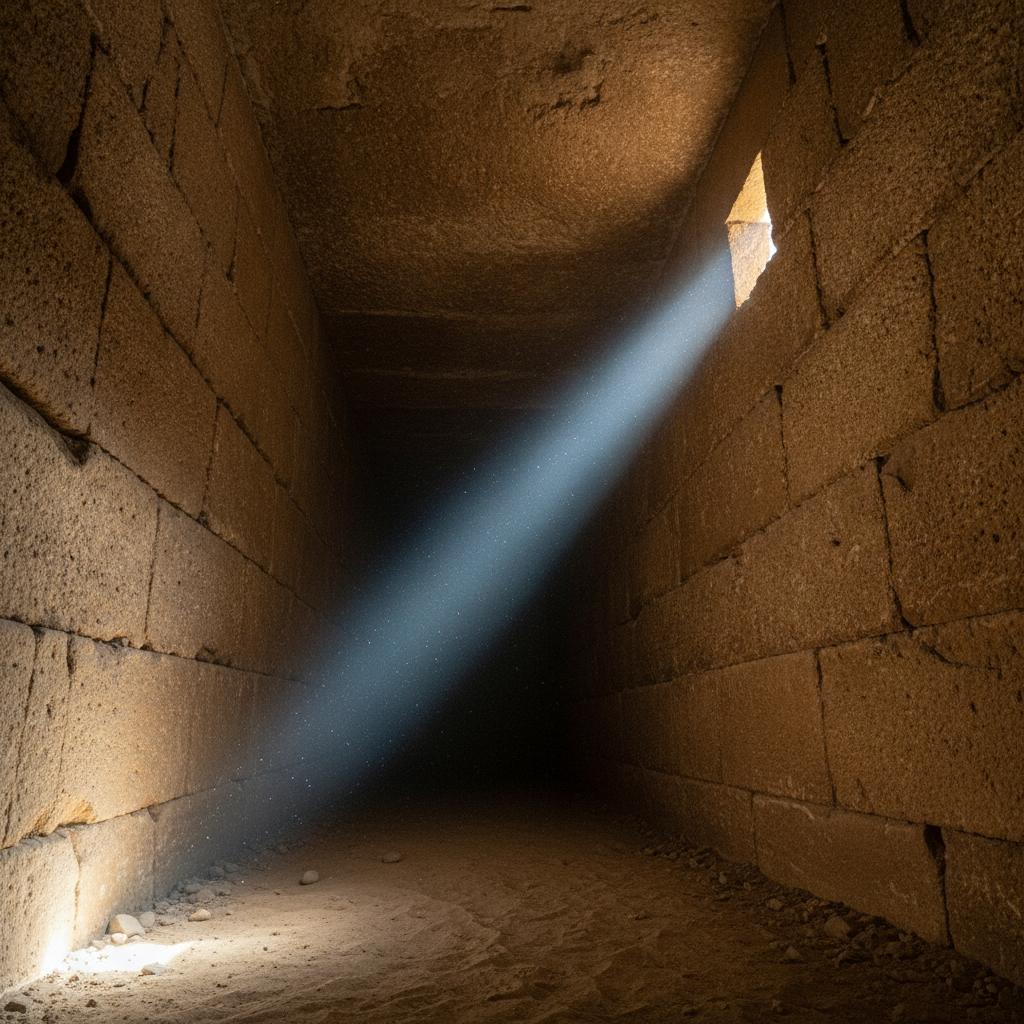
On the other side was a corridor. About 9 metres long, roughly 2 metres wide and 2 metres high, with a vaulted ceiling of stones leaning together, running back into the pyramid between 17 and 23 metres above the ground.
It was empty, and it had been sealed since the pyramid was built.
The archaeologist who had dismissed the 2017 paper now called the corridor a major discovery.
The corridor matters for a reason that has nothing to do with what is in it. The muons had said a space of a certain size was in a certain place. The camera went in and the space was there, the size the muons said, in the place the muons said. The method had been tested against reality and it had passed.
Which brings everything back to the space above the Grand Gallery, where the same method says there are 30 metres of something, and where no camera has ever been.
Where the record stops
This is what is documented: a void at least 30 metres long exists above the Grand Gallery, detected by three technologies and confirmed by three separate analyses. A second, smaller corridor 9 metres long was detected the same way and later seen with a camera, and it is real.
That is all.
Nobody knows the shape of the big void beyond a rough outline. Muography measures how much stone is in a direction, not where the walls are. The 30 metres is a minimum, not a measurement of its length. It might be one space or several close together that blur into one in the data. Nothing has been seen inside it, and as of today no images from inside it have been published.
Conclusions and Open Questions
There are four explanations, and none of them can be checked without a camera.
**It is a relieving chamber.** The burial chamber already has five stacked spaces above its ceiling, built to take the weight of the pyramid off a flat stone roof. The Grand Gallery has a high corbelled ceiling that also carries enormous load, and a void above it would do the same job. The problem: the five known relieving spaces are low and cramped, built for structure and nothing else. A space 30 metres long with the cross section of the Grand Gallery is far larger than that job requires.
**It is a construction feature.** One long standing theory says the builders used an internal ramp, spiralling up inside the pyramid, to raise the blocks. A long inclined empty space above the Grand Gallery is close to what that theory predicts. The problem: the internal ramp idea was disputed long before 2017 and remains so. One void in one place does not show a ramp, and no comparable void has been reported elsewhere in the structure.
**It is an unknown room.** The plain reading. A space that size, in a pyramid built to hold a burial, could be a chamber that was sealed and forgotten. The problem: there is no evidence for it at all beyond the size. No entrance has been found, no corridor leading to it, and the pyramid's known rooms were all reached by passages.
**It is several smaller gaps that look like one.** Muon images are blurry. A line of separate cavities in the masonry could register as a single long void. The problem: three instruments from three angles agreed on it, which is harder to explain with a scatter of small gaps than with one large space.
Three questions stay open.
Why has nothing been seen inside, nine years after the detection? The 2023 corridor was reached through a joint that was already open. Above the Grand Gallery no such opening has been found, and drilling into the pyramid is not a decision physicists get to make.
If it is structural, why is it so much bigger than the structural spaces we already know about?
And if 4,500 years of visitors, tunnellers, treasure hunters and archaeologists missed a space 30 metres long in the most examined building on Earth, what else is in there that nothing has yet been pointed at?
The instruments have done their part. The rest is waiting on a decision about a 6 millimetre hole.