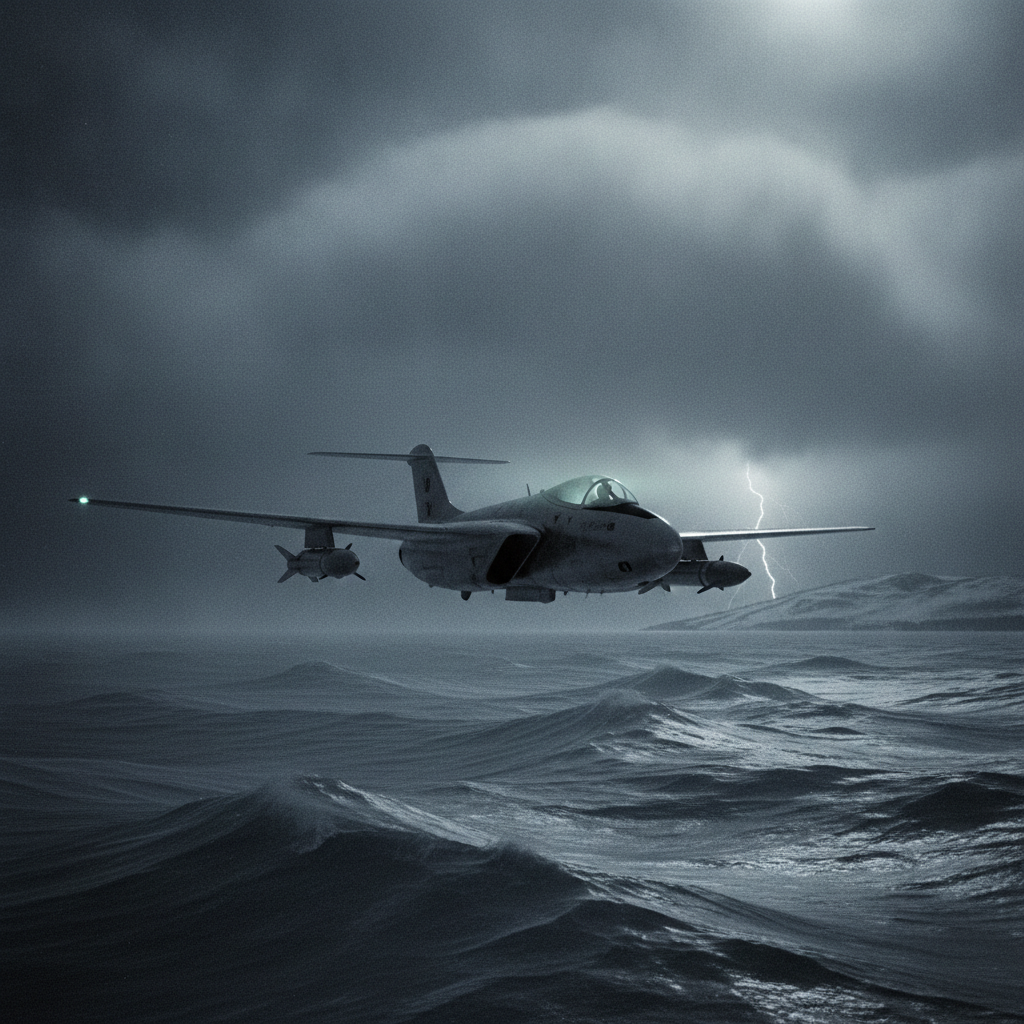
The Kinross incident: 2 dots on the radar became 1, and a jet vanished
On the evening of 23 November 1953, a radar operator sat in front of a round green screen on the shore of Lake Superior.
Lake Superior is the largest of the Great Lakes of North America. It lies on the border between the United States and Canada. It is so big that from the middle you cannot see land, and its water is up to about 400 m deep.
The radar station stood on the Keweenaw Peninsula, a finger of land in the state of Michigan, USA, that points north into the lake.
That night the weather was bad. It was a stormy night over the water.
On the screen, a dot appeared that nobody could identify. It was moving over the lake, in airspace near the Canadian border. It did not match any flight plan.
This was 1953. The Cold War was at its height, and the United States kept fighter jets on alert day and night to check every unknown aircraft.
So the radar station called for a fighter.
What the Kinross incident is
The Kinross incident, in one sentence: an American jet with 2 men on board was sent to intercept an unknown target over Lake Superior, the radar showed the 2 merging into 1, and the jet and its crew were never seen again.
No wreckage was found. No bodies were found. The air force gave more than one explanation, and the explanations did not agree with each other.
The jet and the 2 men
The fighter took off from Kinross Air Force Base, in the far east of Michigan's Upper Peninsula, near the Canadian border.
It was an F-89 Scorpion, a 2-seat jet built to hunt bombers at night and in bad weather. In front sat the pilot. Behind him sat a radar operator, whose job was to find the target on the jet's own small radar.
The pilot was First Lieutenant Felix Moncla. He had 811 flying hours, 121 of them in this type of aircraft.
The radar operator was Second Lieutenant Robert Wilson.
They took off into the storm and turned northwest, towards the target.
The chase
The radar station on the shore guided them by radio. The jet was flying at about 800 km/h.
The controllers watched both dots on their screen: the jet, and the unknown target ahead of it. The target kept changing course. According to later accounts, the radar operator in the back seat had trouble locking onto it with the jet's own radar.
The chase lasted about 30 minutes.
The controllers brought the jet down from about 7,600 m to about 2,100 m, so it could close in. The jet slowly caught up.
About 113 km off the tip of the Keweenaw Peninsula, at a height of about 2,400 m, the jet reached the target.
The moment
On the screen in the radar station, the 2 dots came together.
Then they became 1 dot.
The controllers expected the 2 dots to separate again, as they would when a fighter pulls alongside an aircraft to look at it and then turns away.
They did not separate.
Accounts differ on exactly what the screen showed next. In the version most often repeated, the single dot moved on for a short time and then disappeared from the screen. What is not in dispute is this: the jet's own dot never came back.
The controllers called the jet by radio. There was no answer.
The search
A search began that same night.
2 aircraft from an air force rescue squadron, an aircraft from the US Coast Guard and a ship set out for the area. In the following days the Canadian air force joined them.
They searched the water and the shores of the lake.
They found nothing. No wreckage, no debris, no bodies.
After 5 days the search was called off. The 2 men were listed as missing, presumed dead.
What the air force said first
In the first hours, the air force gave a statement to the American news agency Associated Press. It said the jet had been followed by radar until it merged with an object about 113 km off the Keweenaw Peninsula.
Newspapers printed it. A large Chicago newspaper ran the headline that a jet with 2 men aboard had vanished over Lake Superior.
What the air force said later
Soon the story changed.
In the new version, the radar operator on the shore had misread his screen. The jet had in fact reached the target and identified it. It was not unknown at all, the air force now said. It was a Canadian military transport plane, a C-47, flying about 48 km off its planned course.
Then, according to this version, the jet turned for home. On the way back, the pilot probably suffered from vertigo, a loss of balance in which a pilot flying in cloud can no longer tell up from down. He crashed into the lake.
The air force's own file on unexplained sightings, a project called Blue Book, repeated this. It said the jet had successfully accomplished its mission. It called the crash an accident, probably caused by vertigo. It said the strange radar picture was caused by atmospheric conditions, and that the deep water explained why nothing was found.
Except the Canadians said no
Then Canada answered.
The Canadian air force said it had no record of any of its aircraft flying over that area that night.
The plane that was supposed to explain everything could not be found in any Canadian record.
The pilot's widow later said that 2 air force officers had given her 2 different accounts. One told her the jet had crashed into the lake because it was flying too low. The other told her it had exploded at high altitude.
**Here is where what is known ends. The documents show that the jet chased a target, that the 2 dots merged on the radar screen, and that the jet was never found. What the target was, and what happened to the jet in the last seconds, is not documented anywhere.**
The years that followed
In 1955 a retired US Marine Corps aviator who wrote about flying saucers published a book called The Flying Saucer Conspiracy. He described the Kinross incident as one of the strangest cases on record, and the story spread around the world.
A civilian group that studied UFO reports later said it had found that the mission had been removed from official records. One air force office stated that it had no record of a sighting at Kinross that night.
In October 1968, newspapers reported that pieces of a military jet had been found on the eastern shore of Lake Superior. An air force officer was reported to have confirmed that they came from a military jet. Newspapers asked whether they came from the Kinross jet. Their identity was never published.
In 2006 a man claiming to represent a company called the Great Lakes Dive Company told UFO researchers that he had found the wreck of the jet on the bottom of the lake, with a strange metal object beside it. Researchers checked. The company did not exist. The whole story was a hoax.
In 2021 a group of local enthusiasts bought the old radar station on the Keweenaw Peninsula and turned it into a heritage project. In 2023, 70 years after the incident, they published the most careful timeline they could put together from the records. They said themselves that their research was not finished.
To this day, nobody has found the jet.
Conclusions and Open Questions
There are 4 main explanations. None of them closes the case.
**The jet crashed in the storm, and the radar picture was misleading.** This is the air force's final version. Flying low, at night, in snow, over black water, is exactly when vertigo kills pilots. And Lake Superior is deep and cold enough to hide a wreck. The problem: it depends on the target being a Canadian plane, and Canada said there was no Canadian plane there.
**The jet collided with the target.** If 2 dots merge and only 1 is left, the simplest reading is that 2 aircraft hit each other. The problem: if it was a plane, someone else should have gone missing that night. No other aircraft was ever reported lost.
**The target was a secret aircraft, and the confusion came from hiding it.** In 1953 both sides flew aircraft whose missions were not made public. That would explain why one office had no record and why the story changed. The problem: there is no document that shows it. It is a guess built on the gaps.
**The target was something unknown.** This is the version that made the case famous. The problem: it rests entirely on 2 dots on an old radar screen in a snowstorm, and radar in that weather could show false targets.
What remains open is simple to state. What was the dot that the jet was sent to chase? Why did the explanation change? Why did the Canadian plane never appear in a Canadian record? And where, on the bottom of Lake Superior, are the jet and its 2 men?