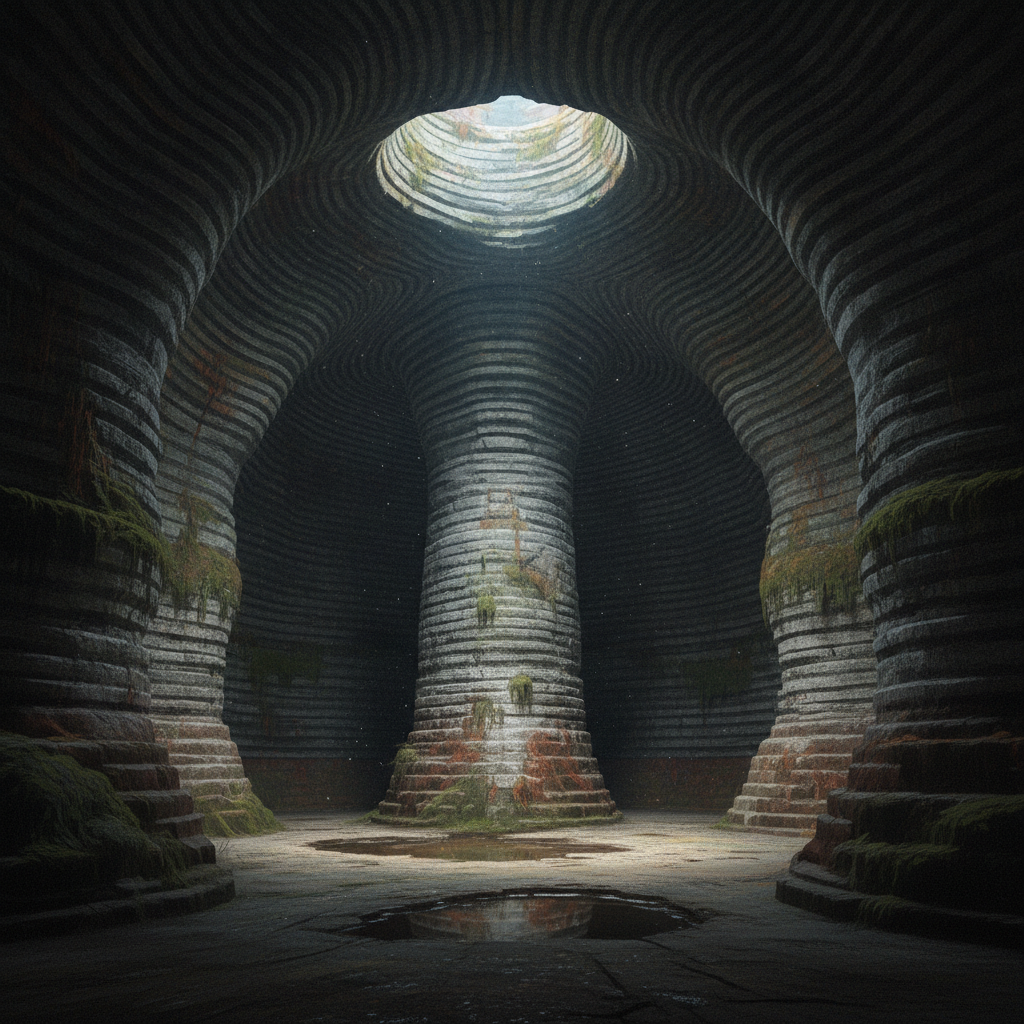
The Twenty-Four Halls Nobody Recorded: China's Longyou Grottoes
In the village of Shiyan Beicun, on the bank of the Qu River in Longyou County, Zhejiang Province, there were ponds that everybody treated as a feature of the landscape. They were dark, unusually cold, and reputed locally to be bottomless. Nobody swam in them. Nobody drained them. For as long as anyone in the village could remember they had simply been there, and no one had thought to ask what lay underneath the water.
In June 1992 four villagers decided to find out. They pooled their money, hired water pumps and began emptying one of the pools. The work went on for days, the water level dropping steadily, and what finally emerged from beneath it was not a muddy basin with a floor of silt and weed. It was a chamber cut into solid rock. The ceiling sloped away into darkness. The floor descended as a broad ramp. Every surface, from the roof to the base of the walls, was covered in tool marks. The pond had not been a pond at all. It was the flooded roof opening of a hall carved out of the hillside by human hands.
Over the following months the other pools in the area were pumped out one after another, and each produced the same result. What had looked like a scattering of small ponds along a low ridge turned out to be the skylights of an underground complex. Twenty-four separate caverns have been documented at the site so far. They are known locally as the Xiaonanhai Stone Chambers. None of them connects to any other. Each appears to have been entered, worked and abandoned through its own single opening in the roof.
The scale is what stops most visitors. The average floor area of a single cavern is over a thousand square metres, and some are considerably larger. Ceilings rise as much as thirty metres above the floor. Taken together the documented caverns cover more than thirty thousand square metres of excavated ground. Standing on the floor of the largest halls, a person is dwarfed in the way one is dwarfed inside a cathedral, except that a cathedral is built up out of blocks and these spaces were made by taking rock away.
Inside, the caverns are not rough voids. Each is supported by stone pillars left standing in place during the excavation, spaced across the floor and shaped to carry the roof. The walls lean inward, and the ceilings slope at an angle that runs roughly parallel to the ramped floor beneath them. There are cut steps, ledges, channels that carry water, small pools, and rock bridges left across gaps. The people who made these spaces were not hollowing out a hole. They were following a plan that had already decided where the stone would stay and where it would go.
Then there are the marks. Every wall, every ceiling and every pillar in every cavern is covered in the same pattern: parallel bands roughly sixty centimetres wide, each band filled with fine parallel chisel strokes set at an angle of about sixty degrees. The bands run in ordered courses across surfaces the size of a tennis court. The pattern does not change from one hall to the next, and it does not degrade in the corners or in the awkward high places where a tired workman might be expected to lose the line. Whatever else the Longyou caverns are, they are the product of a single method applied with extraordinary discipline over an enormous area.
The rock itself is an argillaceous siltstone belonging to the Upper Cretaceous Quxian Formation. It is a forgiving material to cut, soft enough to work with hand tools, and it holds a face well once exposed. It is also porous, which is why the caverns filled with groundwater in the first place, and why they stayed hidden. The caves sit close to the water table, and for centuries every one of them was a pond.
The next problem is arithmetic. Engineers who have studied the site estimate that removing the rock from the caverns meant carrying out on the order of a million cubic metres of stone. That material has to be somewhere. There is no spoil heap at Longyou, no quarry dump, no ridge of waste rock, no documented structure in the region built of Quxian siltstone on anything like that scale. A million cubic metres of stone was lifted out of the ground through narrow roof openings, taken away, and left no trace anyone has yet identified.
Then there is the silence. China keeps the longest continuous written record of any civilisation on earth. Dynastic histories, local gazetteers, tax rolls, county chronicles and temple inscriptions record canals, tombs, granaries, garrisons and public works in obsessive detail. A project on the scale of Longyou would have consumed the labour of a district for years. Estimates put the workforce needed at around a thousand people working for something like six years with hand tools. Nothing in the surviving record refers to it. No chronicle, no inscription, no memorial, no complaint about the corvee. The caverns were cut, filled with water, and forgotten so completely that the villagers living on top of them thought their ponds had no bottom.
Almost nothing has been found inside. There are no coffins, no grave goods, no household refuse, no hearths, no inscriptions cut by the workers, no abandoned tools of any consequence. The single exception is a carving on a wall of the first cavern showing a horse, a fish and a bird. It is the only decoration recorded in the entire complex, and by itself it says nothing about who cut the halls or why.
Dating rests on thin evidence. Pottery recovered from the silt inside the caverns has been dated to between 206 BCE and 23 CE, which places material in the caves during the late Qin and Western Han periods and gives the usual estimate of roughly two thousand years. The pottery dates the silt, not the cutting. The excavation could be older than the objects that later washed or fell into it. No absolute date has been established for the carving itself.
Serious engineering research has been done. A team including Li Lihui, Yang Zhifa and Yue Zhongqi published engineering geological studies of the caverns, examining their stability, their failure modes and the mechanics of the rock. Their conclusion was not that the site is impossible but that it is competent: the pillar spacing, the inclined walls and the roof geometry are consistent with a deliberate design by people who understood how this particular rock behaves under load. Two thousand years on, the ceilings have not collapsed.
Draining them, however, started a clock. Once the water was pumped out and air reached the siltstone, the surfaces began to dry, crack and flake. Several caverns have been left flooded deliberately for their own protection. A handful were opened to visitors and lit for tourism, and Longyou now markets them as a local wonder, while conservation specialists argue about how much exposure the rock can survive.
Conclusions and Open Questions
The most economical explanation is that Longyou was a quarry. Geologists and engineers have argued that the caverns are simply what a large, well organised stone extraction operation looks like when it is worked from the top down in soft rock. The weakness is finish. A quarry has no reason to leave carefully shaped support pillars, to dress its walls in a uniform decorative pattern of banded chisel strokes, or to cut ramps, steps and bridges. Nor does the quarry theory answer the central question of where a million cubic metres of building stone went, in a region with no known monument built from it.
A second line of thought, associated with early researchers at the site including Chu Liangcai of Zhejiang University, treats the complex as architecture rather than industry: an imperial mausoleum, a subterranean palace, a storehouse, or barracks for troops hidden underground. The mausoleum idea fails on evidence, since no burial, sarcophagus or grave goods have been found in any of the twenty-four halls. The storage idea struggles with water, because the caverns sit at the water table and grain rots. The barracks idea, often linked to the warring states of the lower Yangtze, has no artefacts of habitation to support it and no text that mentions such a scheme.
A compromise position holds that the site had two lives: cut first for stone, then adapted for some other use once the halls existed. It is plausible, and it is untestable with what has been recovered so far.
At the fringe, the caverns attract claims of lost technology or non-human builders, usually resting on the regularity of the chisel bands. Archaeologists reject this outright, and the physical evidence is against it. The marks are exactly what iron hand tools leave in soft siltstone, they show the irregularities of hand work when examined closely, and the engineering analyses describe a design well within the capabilities of Han-era organisation. The real anomaly at Longyou is not the tooling. It is the bookkeeping.
What remains genuinely unexplained is a short and stubborn list. Where did the excavated rock go, and why has no destination for it ever been identified? How was a project requiring years of mass labour kept out of a documentary tradition that recorded far smaller works? Why were twenty-four adjacent caverns cut without a single connecting passage between them, when linking them would have been easier than sinking each shaft separately? How were the halls lit, ventilated and surveyed accurately enough to keep the pattern of the chisel bands consistent thirty metres underground? And why was the work stopped, with the caverns left clean, empty and allowed to fill with water?
Until a firm absolute date is obtained for the cutting, or the spoil is located, the Longyou grottoes remain what they were in 1992: a very large, very careful piece of engineering with no author, no purpose and no paperwork.