The Man Who Invented the Movies — Then Vanished from a Moving Train
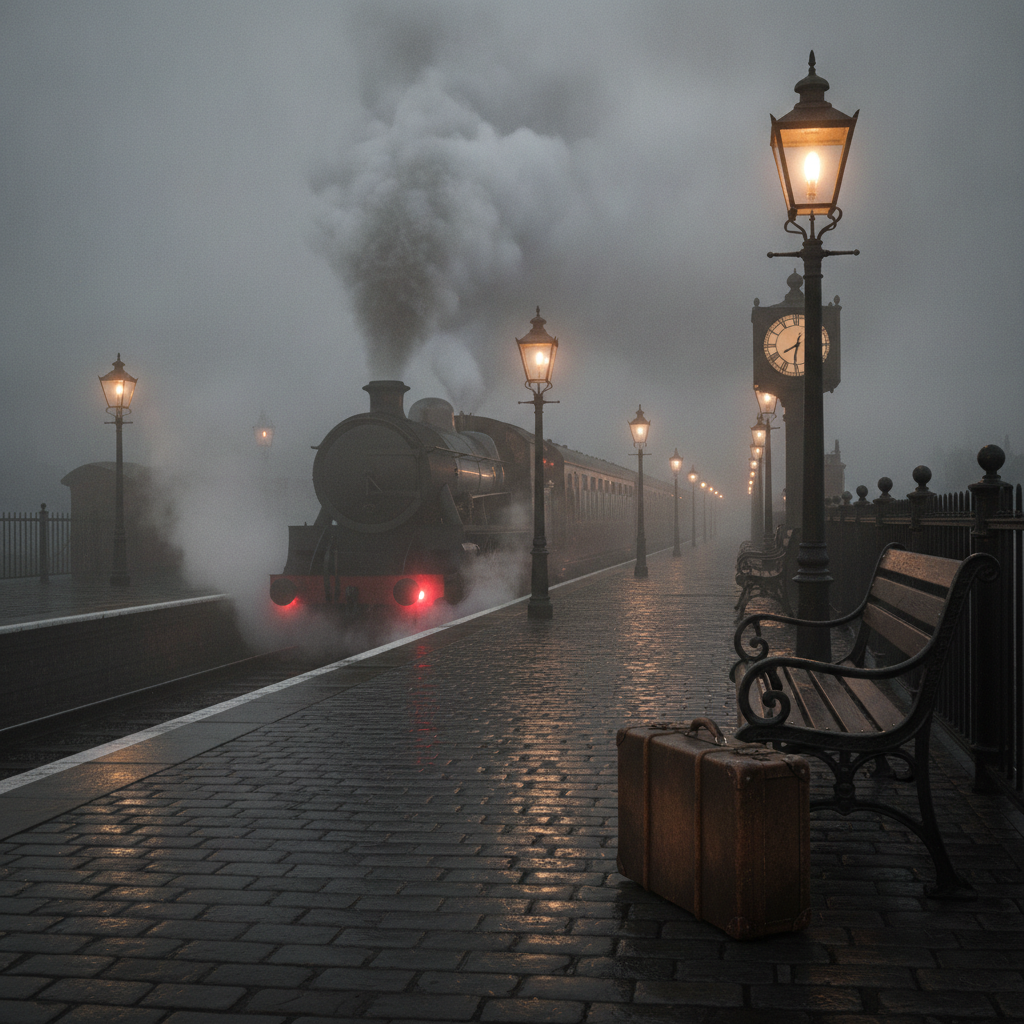
On the evening of 16 September 1890, on the railway platform at Dijon, a tall bearded Frenchman shook his brother's hand, climbed the step of the Paris express and was never seen again. Louis Le Prince was forty-nine years old, and he was traveling toward the public demonstration that he believed would secure his place in history. When the train reached Paris he was not aboard it. His body was not on it. The luggage he had carried with him was not on it. No fellow passenger could later say with any confidence that he had ever taken a seat. The man who had shot the first moving pictures in history had boarded a train in front of a witness, and along the line between one city and the next he left no trace at all.
Le Prince was born in Metz in 1841, the son of an army officer. One of his father's friends was Louis Daguerre, the pioneer of photography, and by family account it was Daguerre who gave the boy his first lessons in the chemistry of fixing an image in light. He studied painting in Paris and chemistry in Leipzig, a combination that would serve him well. In the 1860s he moved to England, and in 1869 he married Sarah Elizabeth Whitley, whose family ran a brass foundry in Leeds. He joined the family firm and built a reputation for delicate work of his own, making portraits by fusing photographic images onto metal and pottery.
The still image did not satisfy him. Through the 1880s Le Prince pursued a single ambition: to make a photograph move, to record time on a strip of sensitized material and then set it running again. He worked at a workshop at 160 Woodhouse Lane in Leeds, behind drawn curtains, with a small number of sworn assistants who machined his parts and kept his secret. The work consumed years and money he did not always have. By 1890 he was a man carrying both an achievement of enormous consequence and the debts and strain that a decade of private invention had cost him.
Earlier in 1888 he had secured patents in several countries for a machine that could both take moving pictures and project them. The British patent, number 423, described an apparatus that could be built with a single lens or with as many as sixteen. The multi-lens version was the easier one to describe on paper; the single-lens instrument was the one he actually built and used.
On 14 October 1888, in the garden of Oakwood Grange, his parents-in-law's house in the Leeds suburb of Roundhay, the camera worked. Cranking the single-lens machine of his own design, Le Prince recorded his son Adolphe, his mother-in-law Sarah Whitley and another relative walking and turning on the lawn. The sequence runs for barely two seconds. Roundhay Garden Scene survives as the oldest surviving motion picture in the world. Days later he set the same machine on the traffic crossing Leeds Bridge and captured carriages, carts and pedestrians in motion, and he filmed Adolphe playing the accordion on the front steps of Joseph Whitley's house. The camera ran at only a handful of frames per second, on strips of sensitized paper and later on Eastman film. It was slow and it was crude, and it recorded life moving.
The dates matter, because they are the reason the case is still argued. Thomas Edison did not show the Kinetoscope publicly until 1891, and the celebrated first commercial screening by Auguste and Louis Lumiere took place in Paris in 1895. By every document that survives, the quiet Frenchman working in Yorkshire had photographed moving pictures before either of them.
By the autumn of 1890 Le Prince was ready to make his claim in public. A demonstration had been arranged in New York, at the Morris-Jumel Mansion in Manhattan, and his wife Lizzie was preparing the ground there with their children. Before crossing the Atlantic he traveled to France on family business, including matters connected with his late mother's estate. He spent his last documented days with his brother Albert in Dijon. On 16 September the two men went to the station together. Le Prince boarded the express for Paris, reportedly a later train than the one he had originally intended to take. Albert watched him go. Friends waiting for him in Paris found no sign of him when the train came in.
The search that followed was one of the most thorough missing-person investigations of its time. The French police took the case, Scotland Yard became involved because Le Prince lived and worked in England, and the family hired private investigators of its own. Detectives questioned railway staff and passengers, retraced the route between Dijon and Paris, checked hotels and stations, and had rivers along the line dragged. Nothing was ever recovered. There was no body, no coat, no trunk, no travel bag, no ticket, and no witness whose account could be relied upon. Under French law the family could not have him declared dead until 1897, seven years in which they could neither bury him nor act freely on his behalf.
Those seven years were decisive for the history of cinema. Edison's Kinetoscope reached the public, the Lumiere programme conquered Europe, and the name of the man from Leeds slipped to the margins of a story he had arguably begun. He was not entirely forgotten in his adopted city. On 12 December 1930 the Lord Mayor of Leeds unveiled a bronze memorial tablet at 160 Woodhouse Lane, on the site of the workshop where the camera had been built. Outside Yorkshire, though, his name faded almost completely from the public account of how the movies began.
His family kept fighting for the record. In 1898 his son Adolphe gave evidence on his father's behalf in the great American patent case known as Equity 6928, in which the American Mutoscope Company challenged Edison's claim to have invented motion pictures. The court found for Edison at first, and the ruling was overturned only later. Three years after that testimony, in 1901, Adolphe Le Prince was found shot dead while duck-hunting on Fire Island, near New York. He was twenty-eight. The death was officially recorded as suicide, a finding his family never accepted.
Conclusions and Open Questions
Nothing about the disappearance has ever been settled, and each theory that fills the gap is strong in one place and weak in another.
The most widely repeated explanation is suicide. In this account Le Prince, weighed down by debt and afraid his invention would fail in public, left the train and drowned himself. The theory gained sudden support in 2003, when a researcher working in the archives of the Paris police found a photograph of a drowned man recovered from the Seine in 1890 who resembled him. Resemblance, however, is not identification, and it was later argued that the body in the photograph was too short. The heavier objection is one of circumstance: a man who has summoned his wife and children across the Atlantic and booked a hall for the unveiling of his life's work is an unlikely candidate for despair.
A second theory holds that he was murdered over his mother's estate, and it points at Albert, the last person known to have seen him. Its only real support is opportunity and the old suspicion that falls on whoever was last in the company of a missing man. There was no evidence, no confession and no body, and Albert was never subjected to a formal inquiry, which is itself one of the odder features of the case. The film historian Jean Mitry later asked why the brother, if he believed Louis to be suicidal, did nothing to stop him, though nobody can now establish that Albert believed any such thing.
Some argue that the disappearance was staged, and that Le Prince, insolvent or entangled in something he wanted to escape, walked away to live under another name. That accounts neatly for the absence of a body and collapses on motive: he was days from vindication and, by every surviving account, devoted to his family.
The theory his widow held until her death was that he was removed by rivals in the patent wars over moving pictures, and she directed her suspicion toward Edison's camp. It is the most dramatic reading and the least supported. Not one document links Edison or anyone connected to him to Le Prince's fate. It rests entirely on the timing, which did sweep a rival from the field at the moment it counted, and on the family's later collision with Edison in an American courtroom. A courtroom rivalry is not a motive for murder.
The least dramatic reading is that something ordinary happened. A sudden illness, a fall, an accident at a stop or an unremarked decision to get off could all have slipped through the loose record-keeping of a nineteenth-century railway. What resists that reading is the silence surrounding his property. A coat, a trunk, a ticket or the memory of one traveler should have surfaced somewhere in more than thirteen decades, and none of it ever did.
The open questions are the ones the detectives of 1890 could not answer. How does a well dressed man carrying luggage leave a moving express without a single passenger noticing? If he got off, where and why? If he stayed on, what became of him and his bags between Dijon and Paris? Why was the last man to see him never formally questioned? And was the death of his son Adolphe eleven years later the coincidence the record says it was? The honest position is that the evidence supports no verdict at all, and anyone offering a certain one is offering a story.