Documented

To the Setting Sun: The Expedition That Walked Into Australia and Never Came Out

2026-08-04 · Vanished Without a Trace · 8 min read

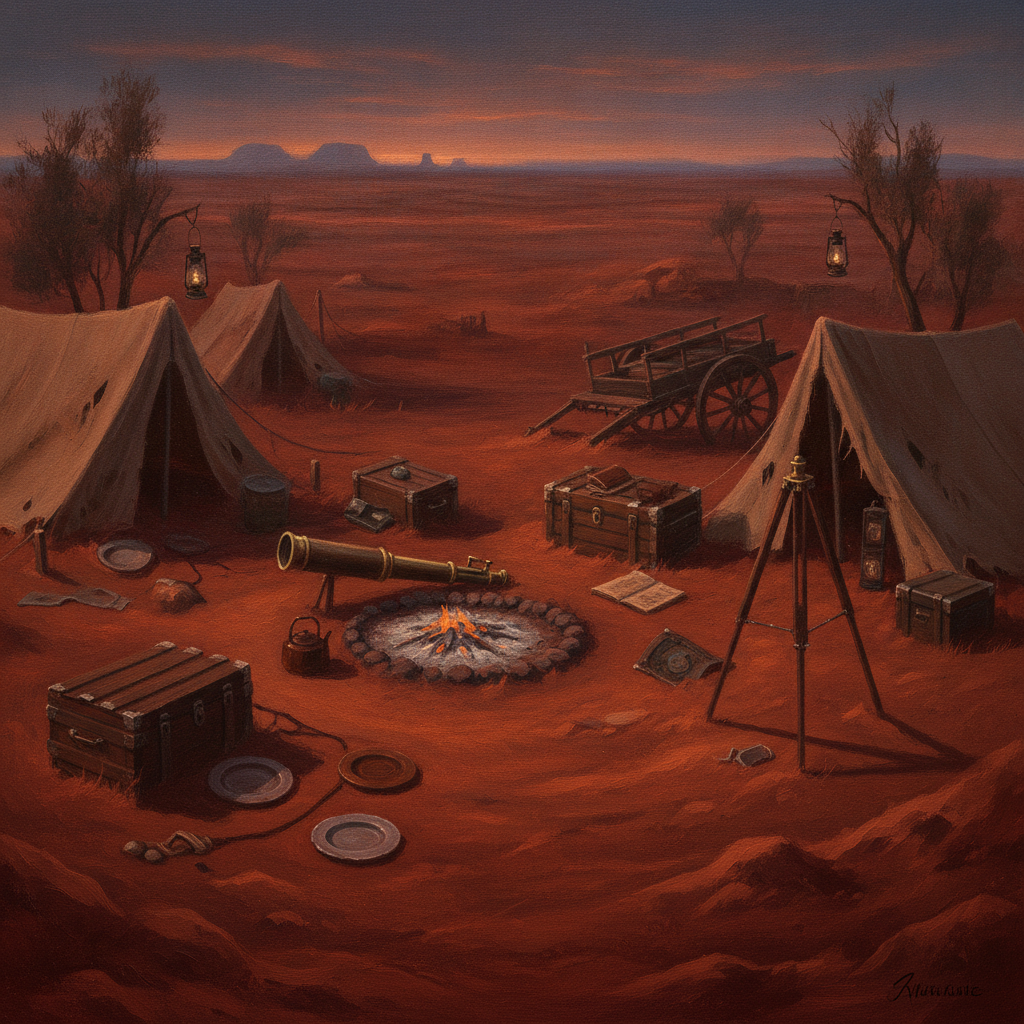
On 3 April 1848, at an outstation called Cogoon on the western edge of the Darling Downs in what is now Queensland, a party of seven men gathered their animals and rode west. With them went seven horses, twenty mules and fifty bullocks. They carried dried meat and flour for months and expected the journey to take two or three years. Their leader had crossed a continent once already and was celebrated across the Australian colonies. From that morning onward, no European ever saw any of them again, and no confirmed trace of a single man, animal or piece of equipment has been recovered in the one hundred and seventy-eight years since.

The leader was Ludwig Leichhardt, born in 1813 in the Prussian village of Trebatsch. He studied philosophy, languages and natural sciences at Berlin and Goettingen without taking a degree, then made himself into a working field naturalist through museums, private collections and long walking tours in England, France and Italy. He arrived in Sydney in February 1842 with letters of introduction, almost no money, and a plan to make his name by botanising the interior of a continent that was still blank on its own maps. He collected in the Hunter Valley and along the Queensland coast and by 1844 had persuaded Sydney merchants and squatters to fund an overland journey the colonial government had declined to pay for.

That first expedition made him famous. Leichhardt left Jimbour station on the Darling Downs on 1 October 1844 with a party of ten, heading for the small British military outpost of Port Essington on the far northern coast. The journey lasted almost fifteen months. He crossed and named a series of major rivers, among them the Dawson, the Burdekin, the Mitchell and the Roper, and brought back the first coherent description of the eastern interior and the tropical north. It was not a bloodless success. On the night of 28 June 1845, near the Mitchell River, the camp was attacked; the naturalist John Gilbert was killed by a spear and two other men, John Roper and James Calvert, were badly wounded. The survivors reached Port Essington on 17 December 1845, by which time they had long been given up for dead in Sydney. They came home by sea in March 1846 to public celebration, a purse raised by subscription, and medals from the geographical societies of London and Paris.

Success did not transfer. In December 1846 Leichhardt set out again from the Darling Downs, this time to attempt what nobody had done: a crossing of the continent from east to west, ending at the Swan River settlement near present-day Perth. Continuous rain turned the country to bog, fever ran through the party, the animals starved and the flour spoiled. The expedition turned back in mid-1847 having covered only a small part of the intended route. Several members afterwards criticised Leichhardt's leadership, his navigation and his handling of supplies. He answered by preparing to try again almost immediately.

The 1848 party was smaller and, he believed, tougher. Besides Leichhardt himself there were four Europeans: Adolph Classen, a German; Arthur Hentig; Donald Stuart; and Thomas Hands, a ticket-of-leave man who had joined at Cecil Plains station. Two Aboriginal guides from Port Stephens, Wommai and Billy Bombat, completed the party of seven. The fifty bullocks were a walking food supply, to be killed one by one across the years the crossing would take. The plan was to strike north-west from the Darling Downs, pick up the line of his earlier route, then swing south-west across the interior toward the Swan River.

The last contact was at Allan Macpherson's Cogoon run, an outlying part of Mount Abundance station west of present-day Roma. Leichhardt sent back letters from there. As the story has been retold ever since, when he was asked where he was going he answered simply that he was heading to the setting sun. Then the party rode out of the settled districts and the record stops.

For several years nobody was seriously alarmed; Leichhardt had been given up for dead once before and had walked out of the north alive. By 1852 the silence had become intolerable, and the New South Wales government sent Hovenden Hely, a member of the failed 1847 attempt, to look for him. Hely found abandoned camps he believed were Leichhardt's, but the evidence was ambiguous and was disputed almost as soon as he reported it. In 1858 the government commissioned Augustus Charles Gregory, who had already led the North Australian Exploring Expedition of 1855 and 1856. Gregory left Sydney on 12 January 1858, reached the Barcoo River in April, and there found a tree marked with the letter L and the stumps of other trees cut with an axe. He could take it no further. In the 1860s Duncan McIntyre reported marked trees and two old horses on the Flinders River, which set off a wave of public feeling and funded the Ladies' Leichhardt Search Expedition; McIntyre led it, achieved nothing, and died of fever in 1866. Rewards were offered and private searches continued into the twenty-first century, every one returning with nothing or with objects that could not be tied to Leichhardt by name.

There is one exception. Around 1900, in the Sturt Creek country between the Tanami and the Great Sandy Deserts, close to the border between Western Australia and the Northern Territory, an Aboriginal stockman named Jackie, working with the stockman and prospector Charles Harding, found a partly burnt firearm wedged in a boab tree. Attached to the stock was a small brass nameplate stamped LUDWIG LEICHHARDT 1848. Harding discarded the ruined gun and kept the plate. Around 1917, in Laura in South Australia, he gave it to a teenager named Reg Bristow-Smith who had befriended him. The plate then stayed in private hands for most of the twentieth century, known to researchers but never tested.

In 2006 the National Museum of Australia acquired it and put it through a formal authenticity examination led by the conservator David Hallam. The analysis found a brass composition consistent with nineteenth-century manufacture, residues consistent with gunpowder, and physical evidence of fire damage. Taken together with the documented chain of custody from Harding to Bristow-Smith, the museum concluded that both the nameplate and the account of where it was found were genuine. It is the only relic of the 1848 expedition with corroborated provenance.

Ad

What the plate establishes is geographical, not human. Sturt Creek lies roughly two-thirds of the way across the continent from the Darling Downs. If the gun was found where the record says, then Leichhardt and his men got far deeper into Australia than any nineteenth-century searcher could demonstrate. The plate says nothing about when they arrived, whether all seven were still alive, or how the story ended. There is no grave, no body, no journal, no marked camp that can be dated, and no equipment beyond a burnt gun that somebody threw away.

Conclusions and Open Questions

The most widely accepted reconstruction is also the bleakest. The historian Darrell Lewis, who spent years assembling and weighing the surviving evidence, argues that the party pushed on past Sturt Creek and died of thirst and starvation in the desert country beyond it. The reconstruction fits the plate, the season and the terrain. Its weakness is the silence of the ground. Seven men with seventy large animals leave iron, bone, glass and leather behind them, and the arid interior preserves such things for a very long time. Nothing of the kind has ever been found and identified.

A second explanation, argued since the 1850s, is that the party was killed in conflict with Aboriginal groups whose country they were crossing. The risk was real and documented: Gilbert died that way in 1845. The weakness here is evidential rather than logical. No verified oral testimony and no physical evidence has ever been produced for the 1848 party, and in the colonial period the theory was frequently asserted with no evidence at all, which has made later researchers cautious about it.

Some argue for disaster much earlier in the journey, in the flooded channel country of the interior rivers, where a party could be drowned or scattered in a single night. That would explain the total absence of remains further west. Its weakness is the nameplate: if the Sturt Creek find is authentic, the expedition travelled roughly two thousand kilometres beyond the rivers where this theory places its end.

One theory holds that the party broke apart from within. Its most persistent form comes from Andrew Hume, a convict who claimed in the 1870s to have met a white survivor named Classen living with Aboriginal people in the interior. Hume raised backing on that story and died in the desert in 1874 while trying to reach the man again. The weakness is Hume himself: he had a documented record of deception, and no part of his account was ever corroborated by anyone else.

Finally, some argue the nameplate is not what it appears to be, either a later fabrication or a genuine object carried far from where it was lost. The 2006 testing weighs heavily against outright forgery, since the metal, the powder residue and the fire damage all fit an 1848 firearm. What no laboratory can test is the location. The boab tree rests on a chain of memory a century old, and despite repeated attempts the tree itself has never been relocated.

The open questions are therefore concrete rather than mystical. Where exactly was that tree, and does anything remain at its foot? Why has no dated camp been found along a route thousands of kilometres long? Why did the far better equipped searches of the twentieth century find less than a stockman found by accident in 1900? And could systematic aerial and satellite survey of the Sturt Creek country, combined with careful work alongside the traditional owners of that land, still locate the place where the expedition stopped?

Seven men left Cogoon in April 1848. Families waited for them for decades. None of the seven has a grave, and that, rather than any theory, is what has kept the search alive.


Share this story:

Reader comments (0)
Only active subscribers with verified payment can post comments. Subscribe — first month free