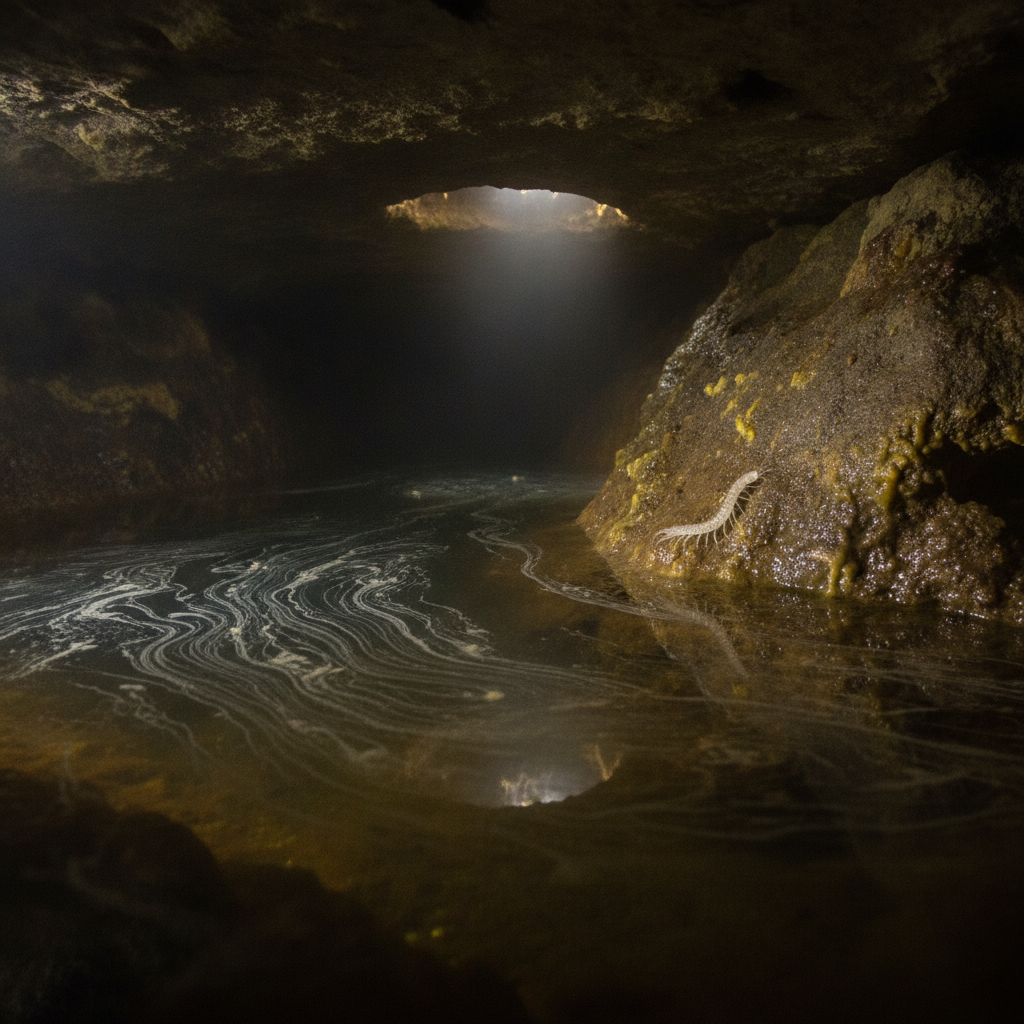
Movile Cave: The Sealed Cave in Romania Where Life Runs Without the Sun
In 1986, near a small town on the Black Sea coast of Romania, a crew was digging a shaft straight down into the ground.
They were not looking for a cave. At a depth of about 18 metres, the shaft broke into an empty space.
A Romanian geologist and cave explorer, Cristian Lascu, climbed down into the dark.
The air below smelled of rotten eggs. It was warm and wet, a steady 21 degrees. There was no light and no breeze.
And yet the place was full of life. Spiders, leeches, centipedes.
This is Movile Cave. It is a small cave, about 200 metres of passages, buried under layers of clay and limestone. Its animals live in air that would make a person sick, and their food does not come from sunlight, not even indirectly. How they eat is now explained. What is still unknown is how they got in, and how long they have been shut off from the world. On that second question, the sources do not agree, and this article will show you where they differ.
Where it is, and how it was found
The cave lies near the town of Mangalia, in the far southeast of Romania, close to the border with Bulgaria. It is a few kilometres from the sea.
The story of the shaft is told 3 ways.
A research group that studies the cave says the shaft was dug "for geological investigations". A British wildlife magazine says the workers were drilling to check the ground for a power plant. A 1996 report in an American newspaper says the crews were digging wells for nearby towns.
All 3 agree: it was 1986, and the cave was found by accident.
One source gives the length of the passages as about 200 metres. Another says about 240 metres. Either way, it is small.
A cave you cannot simply walk into
Getting in is hard, and it was meant to stay hard.
The 1996 report describes the route: down a cable ladder, through narrow muddy passages, and then a dive into an underground lake.
The warm water in the lower part of the cave rises from deep below. In several places the rock ceiling comes down almost to the surface of the water. Between the water and the rock there are small pockets of trapped air. The scientists call them "air bells".
The research group says the top of the shaft is now closed with an airtight gate. Only a few researchers are allowed in each year, for short visits, with special equipment.
Every visitor brings in outside air and bacteria, so visits are kept rare.
Air that would make you sick
Normal air is 21% oxygen. In Movile Cave it is 7 to 10%. In the air bells, measurements range from 7 to 16%.
Normal air holds about 0.04% carbon dioxide. In the cave it is 2 to 3.5%. A wildlife magazine puts it simply: about 100 times more carbon dioxide than the air outside.
There is also 1 to 2% methane.
Both the air and the water carry high levels of hydrogen sulfide, the gas that smells of rotten eggs, and of ammonia.
The humidity is close to 100%. No air movement can be detected.
In the water, oxygen almost disappears just 3 or 4 centimetres below the surface. Deeper still, there is none at all.
A long pause, and then the work
A Romanian biologist, Serban Sarbu, began exploring the cave in 1986, the year it was found.
Then the work stopped. At that time Romania was a communist dictatorship. The biologist left the country, and for several years nobody studied the cave.
In 1990, after the regime fell, he came back. This time he worked with scientists from the University of Cincinnati in the United States, and with money from the American National Science Foundation and the National Geographic Society.
What they found in the dark
On the surface of the warm water floated thin white patches. In one of the air bells, the rock was covered with a yellowish slime up to 2 centimetres thick.
These are colonies of bacteria, packed together into living mats.
Around the mats lived the animals: pill bugs, spiders, leeches, snails, centipedes.
One of them is a water scorpion, an insect that hunts in water. Its scientific name, Nepa anophthalma, means "the one without eyes". It is the only water scorpion in the world known to be adapted to life in a cave.
At the top of the food chain is a centipede. Scientists described it as a new species in 2020 and named it Cryptops speleorex. In Latin and Greek, the name means "king of the cave".
The question of food
On the surface of the Earth, almost every food chain starts with sunlight: plants use light to grow, and animals eat the plants.
Even in an ordinary dark cave, the food still comes from the sun: leaves and other remains wash down from the surface.
In Movile Cave, almost nothing comes down from above. The thick layer of clay over the cave blocks it.
The food comes from the bacteria in the mats. They do not need light. They take their energy from chemicals in the water, mainly hydrogen sulfide and methane. With that energy, they turn carbon dioxide into living matter, the same way plants do with sunlight.
This is called chemosynthesis. Small animals graze on the mats, and bigger animals eat the small ones.
How the scientists proved it
The team used a method called stable isotope analysis. The atoms of carbon and nitrogen come in lighter and heavier forms. Food made from sunlight on the surface carries one mix of these forms. Food made by the cave bacteria carries a different mix.
The researchers measured the animals of Movile Cave. Their bodies carried the mix of the cave bacteria, not the mix of the surface. Creatures from other caves and from a nearby well, measured for comparison, were different.
The results were published in the journal Science on 28 June 1996. The paper counted 48 species living off this food chain. 33 of them were found nowhere else on Earth.
An American biologist on the team said Movile was "the only cave system known that is chemoautotrophically based", meaning a cave where the whole food chain starts from chemistry instead of light.
Since then the count has grown. Today the list stands at 57 animal species, 37 of them found only in this cave. Researchers have also found 123 species of microscopic fungi there, and 96 of them have not been found anywhere else.
A cousin in Israel
In 2006, in a quarry near the town of Ramla in Israel, quarry work opened another closed cave, the Ayalon Cave.
Researchers found 8 new species of small animals there, and a food chain also built on bacteria that feed on chemicals.
So Movile is no longer alone, but it was the first.
Here is where what we know ends
This much is solid: the animals eat what the bacteria make from chemicals. That part is measured and published.
**The question of how and when the animals got into Movile Cave, and how long the cave has been sealed, has no agreed answer.**
The most quoted figure is that life in the cave has been cut off from the outside for about 5.5 million years.
The research group gives a different picture. It says the cave began to form about 5.5 million years ago, but was sealed off from the surface only about 2.5 million years ago.
The 1996 newspaper report, based on the scientists of that time, told a third version. About 10 million years ago, as the climate dried, animals took refuge underground. About 5 million years later, deposits sealed the cave. And only about 100,000 years ago did the layers above become thick enough that water reached the cave only from deep below. One of the American biologists said that much of the animals' evolution probably happened in that last 100,000 years.
The animals themselves give different dates. Comparisons of their DNA in the same report suggested that a relative of the pill bugs has been in the dark for about 1 million years, and the water scorpion for between 2 and 5 million years. The cave's snail has been there for a little more than 2 million years.
So the animals did not all arrive at once.
What we know: how the cave's life feeds itself. What we do not know: when it was closed, and how its animals came in.
Conclusions and Open Questions
There are 3 main ways to read the evidence. None of them answers everything.
**The animals came in long ago, and then the cave was sealed.** This is the 1996 picture: a dry climate drove animals underground, and later deposits locked them in. The problem: the DNA dates of the animals spread over millions of years. If they all walked in together before one sealing, their dates should be closer.
**There was never one sealing. The animals came in waves.** Different arrival times fit the different DNA dates, including the snail. The problem: if there was a way in for so long, one would expect more food from the surface to reach it. The isotope tests found that the cave receives little, if any, food from above.
**The real isolation is much younger than "5.5 million years".** The research group's 2.5 million years, and the 100,000 years in the 1996 report, both point this way. The problem: these numbers come from different methods and years, and no one has directly measured when the cave was closed.
Are there more hidden pockets like this under the same area?
Could life like this exist under the surface of other planets? One of the American biologists asked exactly that in 1996, about Mars: "Is there heating from the Martian core? Can you detect hydrogen sulfide?"
For now, the gate on the shaft stays shut, and the cave keeps its oldest secret: not how its animals live, but how long they have been down there alone.