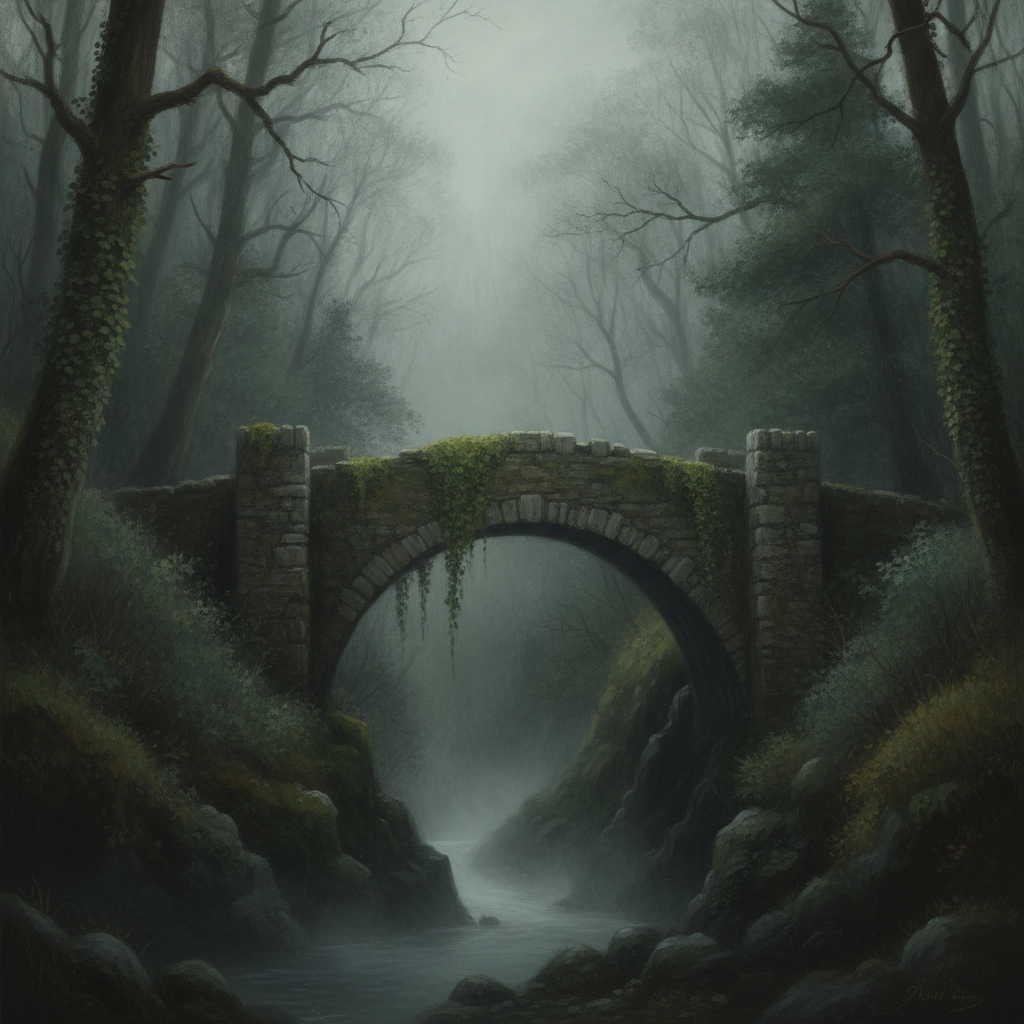
The Bridge That Takes Dogs: Seventy Years of Jumps at Overtoun
Overtoun Bridge is not a famous piece of engineering. It is a short, handsome, three-arched stone crossing in Milton, just outside Dumbarton in West Dunbartonshire, carrying a private driveway over a wooded ravine. Most people who cross it are on their way somewhere else. Only at the middle, looking over, do visitors understand why anyone would travel from the other side of the world to stand on it.
The bridge was completed in June 1895 to a design by Henry Ernest Milner, a landscape architect and civil engineer, as part of the approach to Overtoun House. The estate had been bought in 1859 by James White, a Glasgow chemical manufacturer, and the baronial mansion was built in 1862. In 1884 it passed to his son, John Campbell White, later the 1st Baron Overtoun. The ravine cut across the line the new driveway needed, so Milner spanned it in rough-faced ashlar stone. Below the parapet, the ground falls away roughly fifty feet, about fifteen metres, to the rocks and the Overtoun Burn.
Somewhere in the 1950s and 1960s, people began to notice that dogs were going over the side.
The counting has never been rigorous, and this matters. Nobody kept a register. The figures that circulate come from press reports, from the families involved, and from the recollections of long-standing residents. The most cited estimates are that at least three hundred dogs have jumped since the 1950s and around fifty have died. Some newspaper accounts have put the total closer to six hundred. What is not in dispute locally is that it keeps happening, and in a very particular way.
The pattern is the strangest part. The dogs almost always go over the same short stretch: between the last two parapets on the right-hand side as you walk away from Overtoun House. They almost always go on clear, dry, still days rather than in wind or rain. And they are almost always long-nosed breeds, what veterinarians call dolichocephalic types, meaning collies, labradors, retrievers and spaniels rather than flat-faced dogs. Owners describe the same sequence again and again: the dog walks normally, then stiffens, fixes on something to the right, and goes up and over the parapet without hesitation. Some dogs, having survived, returned to the same spot and jumped again.
Individual cases surface in the local press with grim regularity. In 2004 a golden retriever went over and survived the fall. In 2005 five dogs jumped within six months, which finally pushed the story out of local news and into the national papers. In 2014 a springer spaniel called Cassie went over and was recovered from the burn below.
The physical setting explains part of it. The parapets are solid stone, about eighteen inches thick, and they stand more than three feet high. That is above the eye line of even a large dog, which cannot see over the wall, cannot see the burn, and has no visual information at all suggesting that the ground ends. On the far side of the ravine the bank rises again and the tree canopy comes up close to the level of the parapet. If a dog gets its front paws onto the coping stone and looks out, it sees not a fifty-foot drop but what appears to be continuous green ground a short leap away. The bridge is a near-perfect visual trap for an animal whose eyes sit low and whose depth perception at that angle is poor.
But that explains only why a dog that jumps does not know better, not why it jumps.
In 2005 the Scottish Society for the Prevention of Cruelty to Animals became involved, and the question was put to two specialists who agreed to examine the bridge from a dog's point of view. One was David Sexton, an animal habitat expert. The other was David Sands, a canine psychologist. They went over the structure and the gorge beneath it in detail, working with a documentary crew and starting from the assumption that whatever drew the dogs must be something a dog could detect and a person could not.
Sexton worked the undergrowth and stonework below the bridge and found what was living there. There were nests and signs of mice and squirrels, and there was American mink. Mink are not native to Britain. They escaped and were released from fur farms and spread through Scottish waterways from the mid twentieth century onward, placing their arrival in the district uncomfortably close to the point at which the jumps began to be noticed. Crucially, the signs were concentrated on the side the dogs jump from.
Male mink mark territory with an anal secretion that is among the most powerful scents produced by any British mammal, a dense musk that carries and lingers. To a human standing on the bridge it is undetectable. To an animal descended from predators, with a long nose packed with olfactory receptors, it is close to overwhelming.
Sands tested the response directly. Dogs were presented with a choice of scents: mink, squirrel and mouse. The great majority went straight to the mink and showed intense, focused investigative behaviour. The reported result was around seven out of ten, and the effect was strongest in exactly the long-nosed breeds that dominate the jump reports.
He also worked through the alternatives on site, examining whether there was anything unusual to see or hear at the jump point and concluding there was not. Acoustics specialists checked the area for unusual frequencies, including any from the naval facilities on the nearby Clyde, and found nothing abnormal.
The explanation from the 2005 work is therefore a chain rather than a single cause. On a still, dry, clear day the scent from the gorge rises and pools along the right-hand parapet instead of being dispersed by wind or washed out by rain. A long-nosed dog locks onto it. In that state of intense olfactory focus the dog's other senses narrow. It goes up onto the wall it cannot see over, sees what looks like ground, and jumps.
The SSPCA's own formal conclusion was that the findings were inconclusive.
Overtoun House itself has had a happier second life. In 2001 Bob and Melissa Hill took a lease on the mansion from West Dunbartonshire Council. Restoration was carried out largely by volunteers and funded by roughly three and a half million pounds in donations. The reconstruction was completed in 2015 and the house opened in 2017 as a centre supporting women in crisis. Since 2017 warning signs at the bridge have advised visitors that it is dangerous and asked them to keep dogs on a lead.
One human tragedy is attached to the bridge, and it deserves brief record and then quiet. In October 1994 a man in the grip of severe mental illness threw his infant son from the parapet and then attempted to take his own life. He survived and was committed to psychiatric care after being found not responsible by reason of his illness. It was a catastrophe in one family, not evidence about a bridge.
Conclusions and Open Questions
The mink hypothesis put forward by David Sexton and David Sands remains the most serious explanation anyone has produced, and it has the great merit of matching several independent features of the case at once: the timing of the mink invasion, the one side of the bridge, the clear still weather, and the long-nosed breeds. It is not, however, watertight, and its critics have identified real problems.
The first is generality. Mink live under a great many Scottish bridges across the country, and dogs are walked over those bridges every day without incident. If mink scent alone were sufficient, Overtoun should not be unique. The second is the precision of the location. The dogs jump from a stretch a few metres long, a narrower target than a diffuse scent pooling would predict. The third is a straightforward challenge to the evidence: John Joyce, a local countryman with long experience of the ground, has disputed that mink were present there at all.
An alternative account puts the weight on geometry rather than smell. Some argue that the dogs are not jumping to their deaths in any meaningful sense but simply running at what their eyes tell them is level ground, and that the extraordinary thing about Overtoun is the architecture rather than the animals: a parapet exactly tall enough to hide the drop, coping wide enough to climb, and a far bank of foliage that reads as continuous surface. The weakness is that it explains the outcome without explaining the trigger, and still does not explain why one side and one short stretch.
There is also a data problem no theory can fix retrospectively. The three hundred and six hundred figures are estimates built from recollection and press coverage, not from any register. Some argue the effect is much smaller than the numbers suggest, that a genuine but modest cluster of accidents at a hazardous parapet has been amplified by a story too good for journalists to leave alone, and that many of the reported jumps are ordinary dogs chasing wildlife over an unusually deceptive wall.
At the far end of the spectrum a folk explanation persists, repeated by some residents and visitors: that the site is what Celtic tradition calls a thin place, and that dogs sense something people do not. There is no evidence for this whatsoever. It survives because the bridge is Victorian, gothic and set in dripping woodland, which describes a mood rather than a mechanism.
What remains unexplained is that no controlled study has ever been published. In more than seventy years nobody has camera-monitored the parapet across a full cycle of seasons, logged jumps against wind direction, humidity and temperature, or surveyed mink activity in the gorge in parallel with the incidents. The open questions are small and testable. Does the scent really pool at that specific stretch of parapet, and can it be measured? Does mink density below the bridge rise and fall with the jump rate? And why, of all the bridges in Scotland with mink beneath them and dogs above them, does this one keep taking them?