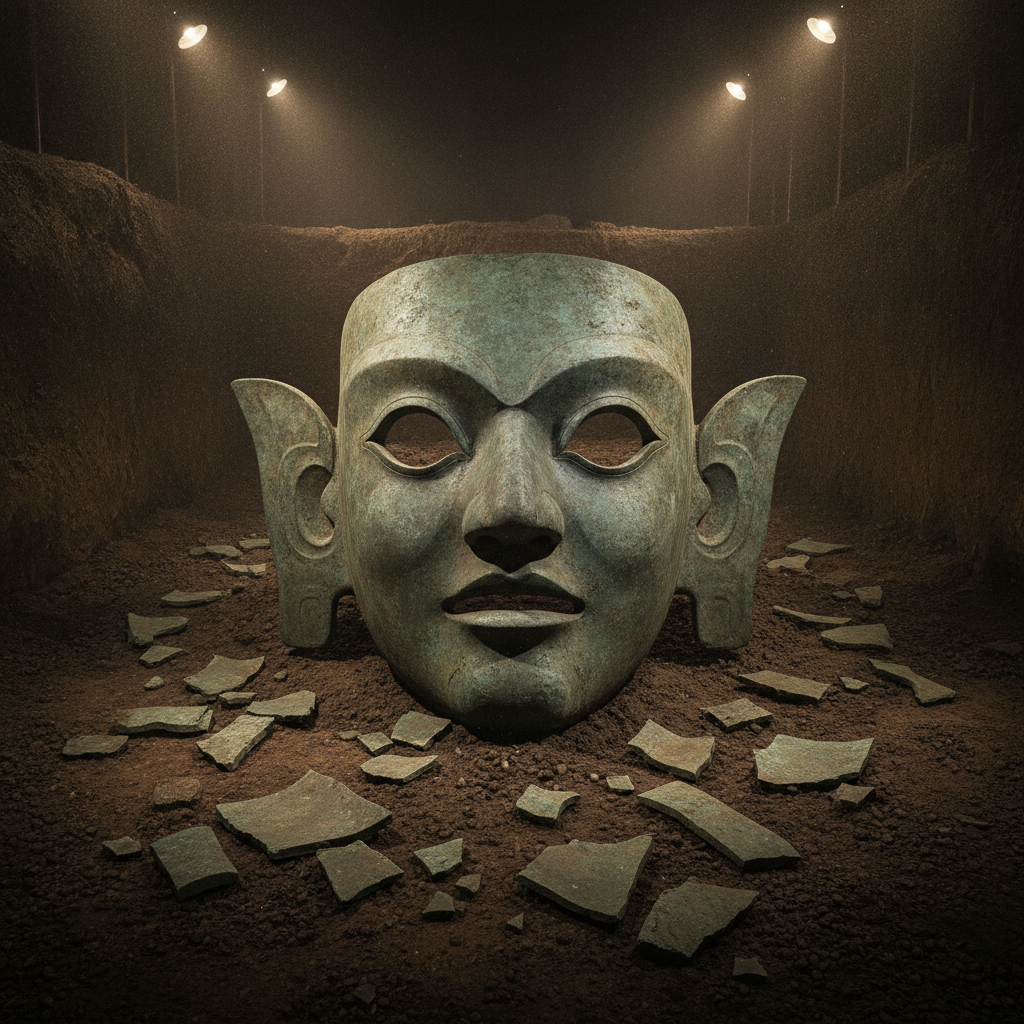
The City That Smashed Its Own Gods: The Eight Pits of Sanxingdui
In the summer of 1986, workers at a brickyard outside the town of Guanghan, on the Chengdu plain in Sichuan, were digging clay. The ground there is soft and yellow and had been dug for years without incident. Then a spade went through into a cavity, and the man holding it found himself looking at a jade blade.
Word reached the provincial archaeologists, who arrived and opened what turned out to be a rectangular pit cut into the earth. What came out of it, and out of a second pit found weeks later a few metres away, did not fit into anything anyone knew about Bronze Age China. There were bronze heads with square jaws and flat noses, some of them wearing gold foil over the face. There were elephant tusks, dozens of them, stacked in layers. There were jades, cowrie shells brought from the sea hundreds of kilometres away, and a standing bronze figure two and a half metres tall on a plinth, its enormous ringed hands held out as if holding something that was no longer there. There was a bronze mask so wide that a modern man cannot span it with both arms, with eyes that project from the face on stalks like the eyepieces of a telescope. And there was a bronze tree, close to four metres of it, with birds on its branches.
Almost every object had been broken before it went into the ground. Not damaged by the soil, not crushed by the weight of the earth: broken deliberately. Many pieces had also been burned. Then the fragments had been laid in the pit in order, ivory on top, and the pit had been filled in.
Nothing in the Chinese historical record described the people who did this. The Bronze Age of the Yellow River valley, the Shang dynasty and its capital at Anyang, was known in detail, partly because the Shang wrote. They inscribed questions on ox bones and turtle shells and kept the answers. At Guanghan, in a settlement now called Sanxingdui, there was no writing at all. Not on the bronzes, not on the jades, not on anything.
The site had been giving up hints for far longer than anyone had noticed. In 1927 a farmer named Yan Daocheng, digging an irrigation ditch beside his house, had struck a cache of jade discs and blades. Some were sold, some circulated among collectors, and in 1934 an American-trained team from the West China Union University museum, led by David Crockett Graham, dug a short season at the spot and published the finds. Then war came, and the site waited. In the 1980s Chinese archaeologists traced earthen walls around it and established that Sanxingdui was not a shrine in a field but a walled city of about 3.6 square kilometres, with a palatial quarter, workshops, residential ground and a ceremonial area to the south where all the pits lie.
Radiocarbon dates and the style of the bronzes place the material at roughly 1300 to 1100 BC, contemporary with the late Shang far to the north-east. The metal itself tells a complicated story. The alloying and the piece-mould casting technique are Chinese, part of the same technological world as Anyang. The shapes are not. Nobody in the Yellow River valley was casting two-metre human figures or masks with protruding eyes. The Shang cast vessels for offerings of food and wine. Sanxingdui cast faces.
For a long time it was thought that the two pits of 1986 were all there was. Then, between 2019 and 2022, a Chinese team working with a level of care that older excavations could not afford opened six more pits in the same ceremonial area, working inside climate-controlled enclosures in protective suits. The six yielded thousands more objects. There was a gold mask, more bronze figures, more ivory, and something no one had expected: traces of silk, decayed almost to nothing but chemically identifiable, including residue near the eye of the great mask. It was the first silk of that age recovered in Sichuan, and it suggested that these objects had been wrapped or dressed before they were destroyed.
The new pits also broke the neat picture. Radiocarbon samples showed that they were not all filled at the same moment. Most cluster in the twelfth and eleventh centuries BC, but at least two appear to be later, closer to the early Western Zhou period. Whatever happened at Sanxingdui was not one night of destruction. It was a practice, repeated.
Then the city was left. Sometime around 1100 to 1000 BC the population of Sanxingdui thinned and the centre of gravity moved. In 2001, forty kilometres away in a suburb of modern Chengdu, construction workers cut into a site now called Jinsha and found gold, jade and bronze in the same visual language: the same protruding eyes, the same sun-and-bird motifs, made a little later and a little smaller. The people did not disappear. They moved, or their successors did.
What they called themselves is unknown. Chinese texts written more than a thousand years afterwards, above all the fourth-century Chronicles of Huayang, describe a kingdom of Shu in Sichuan and list a line of early rulers, among them one named Cancong who is said to have had protruding eyes. Whether that is a memory of the masks, an explanation invented after somebody saw one, or a coincidence, nobody can show.
Conclusions and Open Questions
The oldest and still most widely held interpretation is that the pits are sacrificial deposits: offerings made to a god or to ancestors, in which the objects were killed by fire and breakage so that they could pass out of the world of the living. Its strength is the treatment of the material, which is systematic rather than violent, and the presence of ivory, cowries and gold, which represent enormous wealth given away permanently. Its weakness is that no comparable rite is documented anywhere else in Bronze Age China, and that the objects were not offered whole, which is what sacrifice elsewhere normally requires.
A second reading, argued by a number of Chinese archaeologists, is that these are temple clearance deposits. On this view the bronzes stood in a sanctuary for generations, and when the sanctuary was rebuilt, moved or renewed, its old furnishings were ritually decommissioned and buried together rather than reused as metal. The strength of this idea grew considerably with the 2019 to 2022 excavations, because it accounts for pits of different dates and for mixed groups of objects of different ages inside a single pit. Its weakness is the fire. Clearing out a temple does not obviously require burning its contents, and the burning at Sanxingdui was intense.
A third theory reads the pits politically: the objects were smashed by an enemy, or by a new dynasty inside Shu itself, as an act of desacralisation, destroying not the metal but the power the faces held. It has the advantage of explaining why heads and masks, the parts that represent a being, were treated most harshly. Against it stands the archaeology of the city. No destruction layer corresponding to a sack has been identified in the settlement, and a conquering enemy who burned the temple would be expected to take the gold rather than bury it.
A fourth line looks for a natural cause behind the abandonment. Studies of the Minjiang river system have proposed that an earthquake or a landslide-dammed flood in the late second millennium BC altered the water supply of the plain and forced the population to move, with the pits representing an emergency closure of the sanctuary before departure. The strength here is that Jinsha exists and is close by and later, so a relocation clearly did occur. The weakness is that the dating of the geological events is not precise enough to demonstrate cause, and correlation over a century or two proves little.
Two harder questions sit under all of this. The first is the writing. Sanxingdui produced a large, organised, wealthy society with monumental metalwork and long-distance trade, and left not one inscription. A few scholars argue that certain repeated marks on jades and pottery are the beginning of a script; most hold that the Shu simply did not write, or wrote on something that has not survived. The second is the dead. Eight pits, thousands of objects, and no cemetery for the people who commissioned them. The elite burials of Sanxingdui have never been found.
Two claims should be set aside. The suggestion, popular online since photographs of the masks began circulating, that the objects are evidence of extraterrestrial contact, has no evidentiary basis of any kind: the alloys, the moulds and the casting seams are those of a local Bronze Age workshop, and the resemblance rests entirely on modern expectations about what an alien face looks like. Equally, the identification of the masks with the legendary king Cancong is a literary association made in a text written some fifteen centuries later, not a finding.
What is left is a city that built enormous faces, destroyed them on purpose, buried them with wealth it could have kept, and never wrote a word about why. The excavation of the ceremonial area is not finished, and the current Chinese programme continues. For the moment, Sanxingdui remains the largest body of Bronze Age art in East Asia that nobody can read the meaning of, in the strict sense that its makers left nothing to read.