The Intruder Who Stayed: Twenty-Five Years of the Setagaya Murders
At twenty minutes to eleven on the morning of 31 December 2000, an elderly woman let herself into the house next door in Setagaya Ward, Tokyo. The two homes stood side by side on a block that the city had already bought for the expansion of Soshigaya Park, and most of the neighbours had moved out. She had heard a noise in the night and thought nothing much of it. Inside, she found her daughter's family.
Mikio Miyazawa was forty-four. His wife Yasuko was forty-one. Their daughter Niina was eight years old and their son Rei was six. All four had been killed sometime between about half past eleven the previous night and five minutes past midnight. Three had been stabbed. The little boy had been strangled in his bed.
What the Tokyo Metropolitan Police walked into over the following hours was, on paper, the easiest homicide investigation they would ever conduct. It has now been open for twenty-five years.
The intruder had entered through a small window on the second floor, one that had been left unlocked. He had brought a knife with him, a sashimi blade, and it broke inside Mikio Miyazawa's head during the attack. He then took a santoku knife from the family's own kitchen and used that. Both knives, investigators later established, had been sold in Kanagawa Prefecture.
And then, instead of running, he stayed.
He stayed for somewhere between two and ten hours. He opened the refrigerator and ate four ice creams and a melon and drank four bottles of barley tea. He went through the family's first aid supplies and sanitary products and used them to bandage his own hands, which he had cut on his own blade. He used the lavatory and did not flush it. He pulled open drawers and scattered papers, dropping some of them into the bathtub and the toilet. He took a little over a hundred thousand yen in cash and left a larger sum untouched a short distance away. At some point he appears to have lain down on the sofa in the second-floor living room. And at eighteen minutes past one in the morning, with four bodies in the house, he switched on the family computer and connected to the internet. He stayed online for five minutes. What he did in those five minutes has never been made public in any detail.
Then he took off some of his clothes, left them where they fell, and went out into the dark.
The evidence he left is almost absurd in its abundance. More than 12,500 individual items were eventually catalogued. He left blood, sweat, fingerprints and palm prints all over the house. He left a jacket, a hat, gloves, a scarf and a shirt. He left a hip bag. He left his shoes, made in South Korea and marketed by a British sporting brand. He left two handkerchiefs, one of which had been folded around the knife handle in a way that at least one investigator argued was a habit found in particular communities in the northern Philippines.
The shirt was the kind of lead detectives dream about. Only around 130 of them had ever been produced. Police traced twelve buyers. None of them was the man they were looking for.
The hip bag was tested for trace material and returned sand. Reports of the finding have varied in the retelling, but the analysis was understood to point to desert soil from the vicinity of a United States air force base and, separately, to sand from a Japanese skate park. Neither trail led anywhere.
The blood gave them the man himself, or as close to him as forensic science of the time could come. He was male, blood type A, and his DNA matched no one in any Japanese criminal database. His Y chromosome belonged to haplogroup O-M122, which is one of the most widespread paternal lineages in East Asia, carried by roughly one Korean man in four or five, one Chinese man in ten and one Japanese man in thirteen. His maternal line was the surprise: analysts placed it in Europe, most likely around the Mediterranean or the Adriatic, and reporting in 2025 suggested the Caucasus as a possibility. Physically the police described a man of about 170 centimetres, thin, right-handed, and injured.
His age has been the least stable fact in the entire file. The original estimate was a range so wide as to be almost useless, fifteen to forty. In 2018 investigators narrowed it dramatically to fifteen to twenty-two. By 2025 the reported estimate had swung the other way, to a man who was at least in his thirties at the time of the killings.
The scale of the hunt is difficult to convey. Officers were assigned to the case on more than 246,000 separate occasions. A neighbourhood fingerprinting campaign, known internally as Operation Roller, collected prints from residents across the district. Full-time squads remained attached to the case for decades, forty officers in 2015 and thirty-five in 2019. A reward of twenty million yen, roughly two hundred thousand dollars, stood as of December 2021. In that same month police finally identified the person who had bought a knife identical to the murder weapon, tested their DNA, and eliminated them.
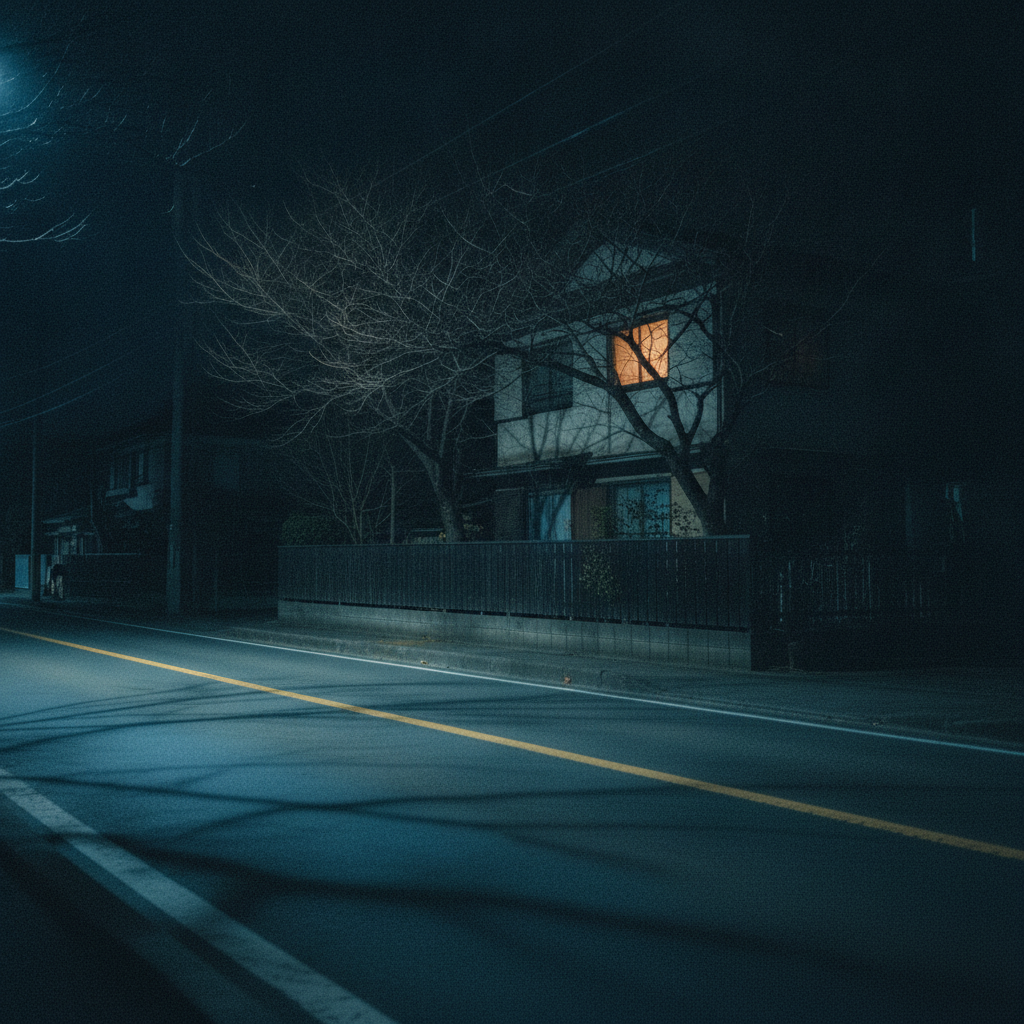
The house is still standing. It was preserved as evidence and has barely changed since 2000. Flowers still appear at the fence. A plan to demolish it has been contested by the family. In May 2026 two men were arrested on suspicion of burglary at the empty property; police stated the incident had no connection to the murders.
Conclusions and Open Questions
The Setagaya case broke something in Japanese law. Under the rules then in force, a murder prosecution expired after a fixed number of years, and the prospect of this particular case simply timing out became a national argument. In 2010 Japan abolished the statute of limitations for crimes carrying the death penalty. The Miyazawa file can now stay open forever, which is both the victory the campaigners wanted and a description of the problem.
Four explanations have circulated since 2001, and none of them survives contact with the whole of the evidence.
The first is that this was a burglary that went catastrophically wrong. Its strength is the obvious one: drawers were emptied, papers were scattered, cash was taken. Its weakness is everything else. A burglar surprised into violence runs. This man ate, slept, treated his wounds and browsed the internet with the family lying dead around him, and he left behind more money than he carried away.
The second is that the family was targeted. One theory holds that the killer came with a grudge, which would explain both the ferocity of the attack and the hours he spent afterwards in a house he was in no hurry to leave. Its weakness is that a quarter of a century of investigation into the family's contacts, work and finances has produced no such person. The idea is also legally delicate: when a television documentary in 2015 built a profile around a resentment motive, it drew a formal complaint that the programme had misrepresented the case. No one has ever been charged, and no living person should be treated as a suspect on the strength of a theory.
The third is that the killer was a foreign national who left Japan soon afterwards. Researchers have pointed to the mixed ancestry in the DNA, to the imported clothing, to the handkerchief folded in an unfamiliar manner, and above all to the simple fact that one of the most exhaustive fingerprint sweeps in Japanese history found no match. The weakness is that every strand is circumstantial. O-M122 is carried by millions of Japanese men. Foreign-brand clothing is sold in Tokyo. A folded handkerchief is not a passport.
The fourth is the least satisfying and the hardest to dismiss: that the intruder was severely disturbed, acted without a plan, and behaved afterwards in a way that will never make sense because it never made sense to begin with. It fits the evidence better than any of the others. It also predicts nothing, points at no one, and cannot be tested.
The investigators' remaining hope is technical. Forensic DNA phenotyping, used by laboratories such as Parabon NanoLabs in the United States since 2015 and credited with contributing to more than two hundred cases, attempts to reconstruct a face from genetic material. Japan has no legal framework for using DNA in that way, only for matching a sample to a named suspect, and the science itself is not yet where it needs to be. Professor Nori Imanishi of Tokai University, who works on the method, has reference data on roughly three hundred people and estimates current accuracy at around ten per cent. Thousands to tens of thousands of reference profiles would be needed for a reliable reconstruction.
Setsuko Miyazawa, mother of one of the victims, told reporters that news of an old case solved decades late had given her renewed hope of reaching the truth. Superintendent Yoshimasa Kujirai of the Tokyo Metropolitan Police said the force would keep investigating in order to break through the barriers that the years had built up.
What remains unexplained is not the identity of the killer, which is simply unknown. It is his behaviour. Why a man who had just killed four people, and who was bleeding from his own hands, chose to spend the night in their house. Why he sat down at their computer at one in the morning. Why he undressed before he left. And why, with his blood and his fingerprints and his clothes and his shoes in the hands of one of the most methodical police forces in the world, twenty-five years have produced no name at all.