Fifty Lines Nobody Could Read: The Singapore Stone
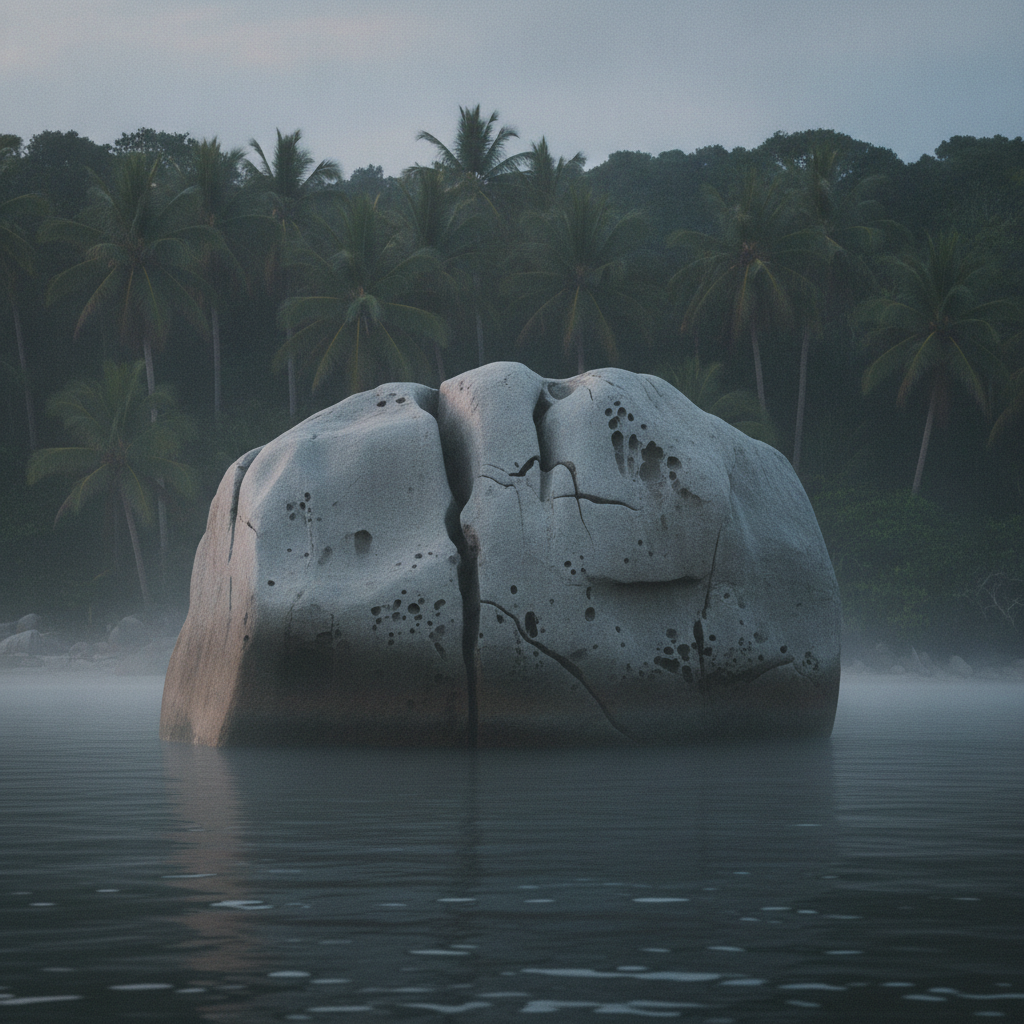
The labourers hacking through the undergrowth at the mouth of the Singapore River in June 1819 had been hired to clear ground, not to make discoveries. Sir Stamford Raffles had come ashore only months earlier, and the East India Company was busy turning a sparsely settled island into a port. Somewhere on the promontory the British would come to call Rocky Point, the clearing party reached a sandstone slab standing above the water, roughly three metres high and almost as wide, split down the middle into two leaning halves.
One face of it was covered in writing.
The account that has come down to us says the men who found it were frightened by what they saw, refused to go on, and had to be replaced by other workers hired at unusually high wages. It is one of the few human details that survives from that morning, and it is the beginning of the strangest documentary case in Singapore's history: a text that thousands of people looked at, that several serious scholars studied at close range, and that nobody has ever read.
The inscription covered something like three square metres of rock. Contemporaries counted about fifty lines, though nobody agreed on the exact number, and the letters were small, roughly two centimetres across, rounded in shape and eaten by more than a century of salt air. John Crawfurd, who became Resident of Singapore, examined the stone and described the carving as rude and much worn. Everybody who saw it agreed on one thing: whatever the writing was, it was not Malay, not Chinese, not Arabic, and not anything the local population or the colonial officials could name.
The Malay world already had a story attached to the place. The Sejarah Melayu, the Malay Annals, tell of Badang, a strongman of old Singapura who won a contest of strength against a champion from the Indian coast by hurling an enormous boulder to the mouth of the Singapore River. When Badang died, the annals say, a raja sent two stone pillars to be raised over his grave at the point of the straits. In 1834 the officer Peter James Begbie linked the inscribed slab to that story and to a ruler he dated to the thirteenth century. It made for an elegant fit, and it has coloured discussion of the stone ever since. It is also a legend, written down centuries after the events it describes, and it proves nothing about the writing on the rock.
The serious attempts to read the inscription began in the 1830s and they were remarkably inventive. In 1837 Dr William Bland, a naval surgeon on HMS Wolf, spent hours in front of the stone trying to force the worn characters into legibility. He pressed soft dough into the grooves to take impressions, and he learned to work in the late afternoon, because as the sun descended in the west it threw a shadow into each carved letter and made the shapes readable that daylight had flattened. His facsimiles went to the Journal of the Asiatic Society of Bengal, where the great epigraphist James Prinsep, the man who had cracked the Brahmi script of the Ashokan pillars, examined them. Prinsep thought the characters resembled Pali and warned that nothing definite could be concluded from copies alone.
He was right to be careful, and he was running out of time. In about January 1843 the acting settlement engineer, Captain D. H. Stevenson, ordered the slab blown up. The reason was the ordinary one: the passage at the river mouth had to be widened, and space was needed for Fort Fullerton and the quarters of its commander. Lieutenant-Colonel James Low, an East India Company officer with a scholarly interest in the region's antiquities, petitioned to have the stone spared. He was ignored. The charge went in, and the only copy of the text was reduced to rubble.
What happened to the pieces is its own small tragedy. A large inscribed block was dumped on Government Hill and left there until convicts broke it up for road gravel. Another fragment ended up in the compound of the Treasury, where sepoys used it as a bench, and the writing on it was nearly rubbed away before anyone realised what they were sitting on. Low salvaged what he could of the most legible fragments. Colonel William John Butterworth found one lying in the verandah of the Treasury and had it sent away for safekeeping. Around 1848 the surviving pieces travelled to the museum of the Royal Asiatic Society in Calcutta.
There they were studied by J. W. Laidlay, who tried a different trick from Bland's. He dusted the surfaces with finely powdered animal charcoal and swept it out of the flat areas with feathers, so that the black powder stayed in the incised strokes. What emerged, he concluded, bore no resemblance whatsoever to Pali. The characters looked to him like Kawi, the Indic-derived script used in Java, Bali and Lombok, and that identification has held up better than any of the alternatives, without ever being confirmed.
In 1918 the Raffles Museum in Singapore, the institution that would become the National Museum of Singapore, asked Calcutta to send the fragments home. One piece came back. The rest did not, and the archaeologist John Miksic has noted the obvious inference that they are presumably still in Calcutta, if they survive at all. That single returned fragment, a rough grey block carrying a few damaged lines out of the original fifty, is what remains of the whole monument. In January 2006 the National Museum designated it one of Singapore's eleven national treasures.
Conclusions and Open Questions
The candidates for the script have been on the table for nearly two centuries and none of them has closed. Bland and Prinsep favoured Pali, the old Ceylonese liturgical language, on the strength of letter shapes. The strength of their case is that they were the last people to study the intact stone with their own eyes; its weakness is that Prinsep himself declined to commit, and Laidlay, working directly on salvaged fragments a decade later, rejected the Pali reading outright. Begbie proposed an obsolete dialect of Tamil, reasoning that a ruler from the Indian coast would have brought his own sculptor. The strength of that argument is historical plausibility, since Tamil trading and military contact with the region is well documented; its weakness is that Begbie was arguing from the Badang legend backwards, and no Tamil reading of the characters has ever worked.
Laidlay's Kawi identification remains the mainstream position, and later epigraphists refined rather than replaced it. The Dutch scholar Johan Hendrik Caspar Kern isolated words he believed he could decipher and proposed a date around 1230. J. G. de Casparis argued on the basis of letter forms for the tenth or eleventh century. The Indonesian epigraphist Boechari concluded the writing was no later than the twelfth century and, importantly, that its style pointed to Sumatra rather than Java, possibly recording a text in Sanskrit. Miksic has taken the same view of the cultural direction, arguing that a Sumatran origin fits the distribution of the region's languages better than a Javanese one, while also giving the bleakest assessment of the whole enterprise: that the script probably never will be fully deciphered. More recently the researcher Iain Sinclair has identified what may be Sanskrit loanword fragments and has argued for an eleventh-century context connected to the Chola presence in Southeast Asia.
The reason none of this converges is that the evidence base is a ruin. Decipherment normally needs volume, repetition and a known language somewhere in the picture. Here the volume is gone, blown up in 1843; what survives is one fragment plus nineteenth-century facsimiles made by different men using different methods, whose drawings do not fully agree with each other. The script itself appears nowhere else in the world in the form it takes on this rock, and the language it was written to record is unknown. Two unknowns multiplied together is not a puzzle so much as a wall.
Current work is trying to attack the wall from the side. A team led by Francesco Perono Cacciafoco at Xi'an Jiaotong-Liverpool University, working with I-Shiang Lee, has been building a computational system, nicknamed Read-y Grammarian, intended to learn the surviving characters and generate reconstructions of the missing text without importing a human researcher's assumptions about what it ought to say. Their comparison of the Singapore Stone with the Calcutta Stone, an inscribed monument of the Javanese tradition, found genuine similarities alongside a noticeable difference in the use of diacritics, which supports the broad Kawi family connection while complicating any precise attribution. Nobody involved claims a reading. The stated aim is to recover enough plausible text for pattern analysis to become possible at all.
So the open questions are unusually concrete. What language was carved on that rock. Whether the monument commemorated a king, a victory, a treaty, a founding, or the grave of a strongman who may never have existed. Whether the other fragments Low sent to Calcutta are sitting in a store room in Kolkata today, unrecognised. And behind all of it the most uncomfortable question of the case, which is not about the ancient world at all: what a nineteenth-century harbour widening actually cost. The stone at the river mouth had stood for something like eight hundred years and had been read by nobody in living memory. It took an afternoon and a charge of powder to make certain that nobody ever would.