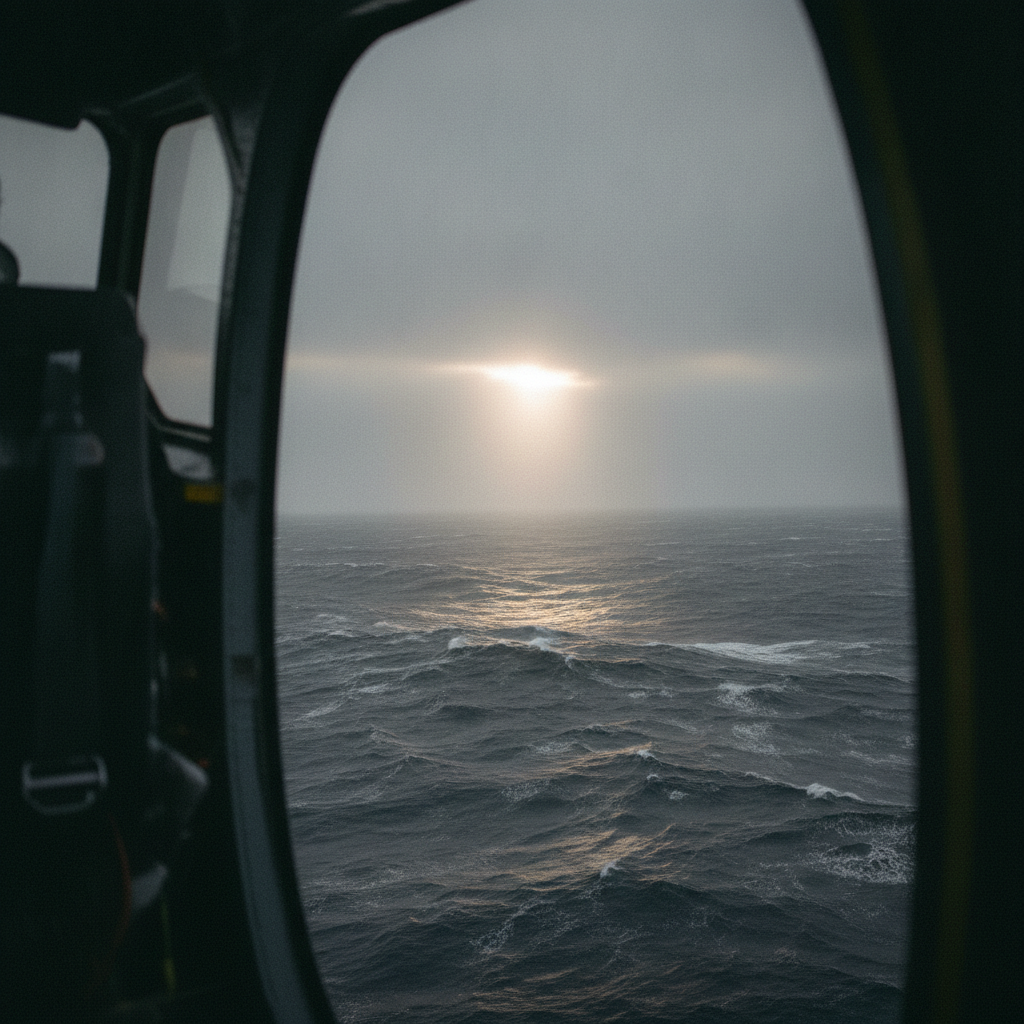
Thirty-Four Men and 13,500 Tonnes of Corn: The Ship Nobody Looked For
On the afternoon of 24 October 1980 a freighter finished loading corn at a grain terminal in Philadelphia, in the United States, and turned down the river towards the sea.
In her holds were 13,500 tonnes of yellow corn. On board were 34 men.
The voyage was an ordinary one. Across the Atlantic, through the Mediterranean, and into Port Said in Egypt, about 8,000 km away. Three weeks, more or less.
She left the pier at about 13:30.
At 21:00 that evening she reported her position by radio. She was off Cape Henlopen, at the mouth of Delaware Bay, on her course, at her speed, and everything on board was in order.
A few hours later, close to midnight, one of the officers picked up the ship to shore radio and telephoned his wife at home. It was a short, ordinary call. He was the third mate, and his father was a retired officer of the United States Coast Guard.
That telephone call is the last thing anyone ever heard from the ship.
No distress signal was received. No lifeboat was found, no life ring, no oil slick, no floating cargo, no body. A vessel 159 metres long left the coast of the United States with 34 men on board and never arrived anywhere.
And then there is the part that turned a shipwreck into a scandal.
Nobody went looking for her for 15 days.
A ship older than most of the men on her
She had been built in 1944, in California, as a troop transport for the last year of the Second World War. She was 159 metres long and about 11,400 gross tonnes.
When the war ended she was laid up, then sold, then sold again. Over 36 years she carried three different names before the last one. By 1980 she was a bulk carrier owned by a small American company, and she was moving grain.
Ships of that age still work. They are also, by then, a list of repairs that somebody has decided to postpone.
This matters later, because it is one of the few things about her end that investigators could argue about with evidence in their hands.
The weather
A storm was crossing her track that night.
The official finding put the winds at 35 to 50 knots, which is roughly 65 to 90 km/h, and the seas at 3.5 to 7 metres. Some accounts, including ones repeated by the families, describe waves closer to 9 metres.
The sources disagree on that number and the disagreement has never been settled, because there was no one left to measure it.
What is not in dispute is that other ships were out in the same weather that night. They came through it. Their crews described the conditions as severe, and none of them described conditions that should sink a loaded freighter without a single radio word.
Ten days of silence
The ship was supposed to report to her owner by radio. She did not.
She did not report the next day either, or the day after that, or for 10 days.
On 3 November the owner finally telephoned the Coast Guard rescue centre in New York and said that the ship had not been heard from since she left the coast.
The Coast Guard did not launch a search. It launched a communications check. For 5 more days operators called, listened, queried other vessels and asked ports along the route whether anyone had seen her.
The air and sea search finally began on 8 November. By then the ship had been silent for 15 days.
**That is the last hard fact in the story. Everything after it is a search for something that was no longer there.**
The search
It was not a small search.
Aircraft flew for 10 days. At the peak there were 7 of them. The search covered more than 767,000 square kilometres of the North Atlantic, running east from the American coast along the route she should have taken.
They found nothing.
Not a raft. Not a hatch cover. Not a life ring with a name on it. Corn floats, at least for a while, and no corn was seen. The ocean where she was presumed lost, roughly 900 km east of Delaware Bay, was empty.
The search was suspended on 17 November.
What the investigation could and could not say
Two official bodies examined the case, and a committee of the United States Congress held hearings in June 1981.
The national transport investigators wrote the plainest sentence in the whole file: they were unable to determine the probable cause, because no distress signal was ever heard and no trace of the ship or her crew was ever found.
They did offer one calculation. Using the estimated sea state, the ship's speed and her heading, they found that she could have fallen into synchronous rolling.
Synchronous rolling is what happens when a ship's natural roll happens to match the rhythm of the waves hitting her. Each wave arrives exactly in time to push the roll a little further. A vessel that was rolling safely can, within a few minutes, roll past the point of return and go over.
If that is what happened, there would have been no time to send anything. That is the strength of the theory and it is also its weakness: it explains the silence by being unfalsifiable.
The investigators also wrote that the delay in reporting the ship missing may have contributed to the loss of life.
At the congressional hearing the owner testified that she had capsized suddenly and without warning. He was asked why he had waited 10 days, and answered that he had been confident in the ship. The chairman of the committee called the disappearance unheard of in modern times. The hearing had been requested by a retired Coast Guard captain, the father of the third mate who had made that last telephone call.
A senior Coast Guard officer testified that the system had worked efficiently and correctly. He said he had personally learned of the communication failure on 7 November and ordered the air search the following day, against the recommendation of his own staff.
Both of those statements are in the record. They do not fit together comfortably.
What is known, and what is not
This is what is documented: a 36 year old freighter loaded with grain left Philadelphia, reported her position normally at 21:00, was heard from once more around midnight by a crewman calling home, and was never heard from again. A storm crossed her track. Her owner said nothing for 10 days. The search began on day 15 and found nothing at all, and no wreck has ever been located.
Everything else is inference.
In Philadelphia there is a bronze plaque for the 34 men. It carries an old sailors' prayer: "O God thy sea is so great and my boat is so small."
Conclusions and Open Questions
There are four explanations on the table. None of them is complete.
**She capsized in a few seconds from synchronous rolling.** The official calculation supports it, and it is the only theory that explains why nothing at all was sent. The problem: it is built on an assumed sea state, an assumed speed and an assumed heading. Not one of those three numbers was actually measured that night.
**An old hull failed.** She was 36 years old, converted from a wartime troop carrier, and grain ships of that generation were known to suffer cracking in heavy weather. A hull that splits in a seaway can flood a hold faster than a crew can react. The problem: there is no wreck. Without the steel, no one can show a fracture, and the theory stays an opinion about her age.
**The cargo moved, or got wet.** Bulk grain can shift in a roll and leave a ship leaning. Corn that takes on water swells with real force, enough to strain a structure from inside. The problem: this needs water in the hold before the ship was lost, and there is no evidence of flooding, only the possibility of it.
**She did not sink at all.** In the years afterwards two stories circulated: that criminals had taken her, and that she was part of a political arms deal involving the hostages then held in Iran. The problem: 34 men would have had to stay silent for 46 years, and a 159 metre ship would have had to be hidden or scrapped without a single document surfacing. Nothing has ever supported either version.
Three questions remain open.
Why did a ship in company with other vessels in the same storm, all of which survived, send nothing at all? Even a failing ship usually gets out one word.
Why did 10 days pass before her owner told anyone she was silent?
And how does a vessel 159 metres long, carrying grain that floats, sink in the North Atlantic and leave not one object on the surface for 7 aircraft to find?
The file is still open. It has been open since 1980, and unless somebody finds the wreck on the sea floor, it will stay that way.