The Tarim Mummies: European-Looking Faces in a Chinese Desert, and the DNA That Rewrote Their Story
Sometime around 1910, a local hunter crossing the desert in far northwest China came upon something strange.
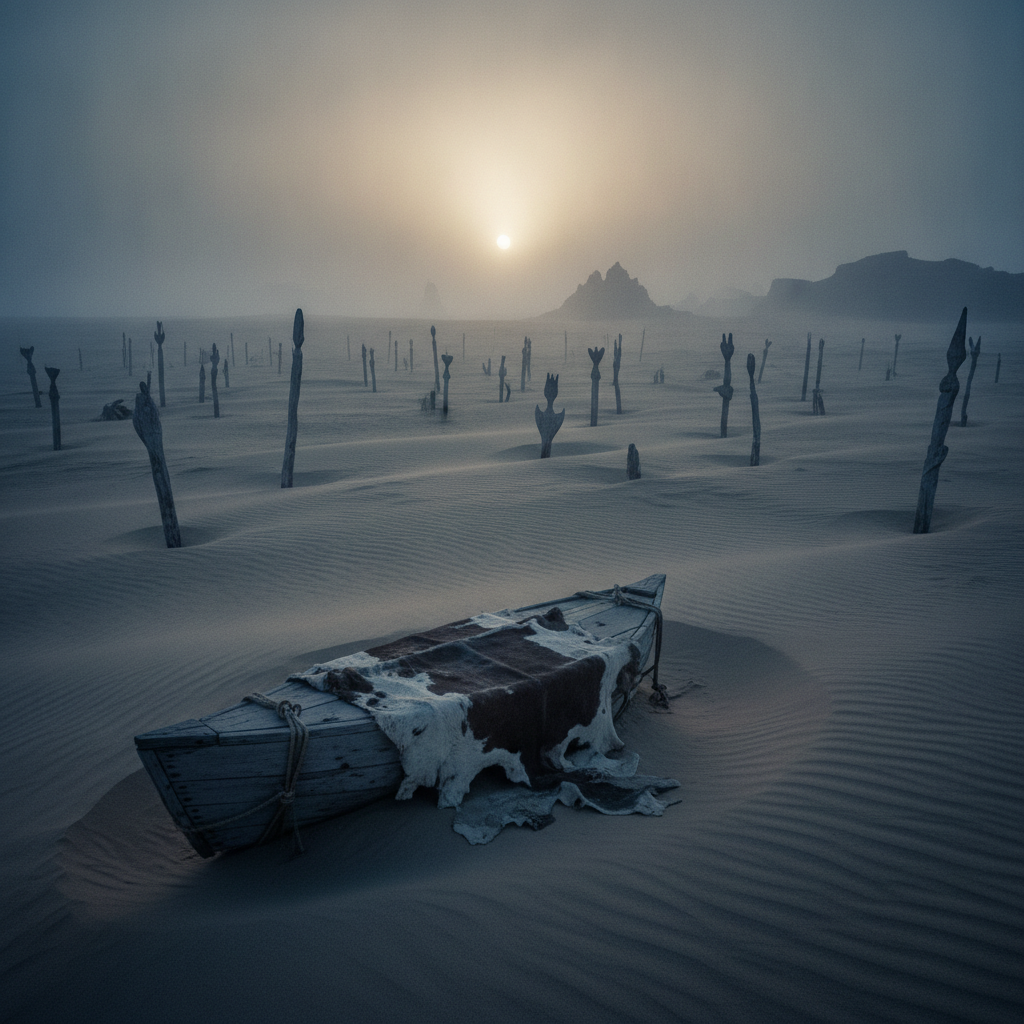
On top of a low, oblong dune stood a forest of wooden posts. Dozens of them, grey and dry, sticking out of the sand. Under them lay the dead.
In 1934 a Swedish archaeologist went looking for the place. The hunter told him how to find it. Some accounts say the hunter came along with him. Others say he only gave directions and refused to go back.
The archaeologist found the dune. He named it Xiaohe, which means "little river" in Chinese, after a small stream nearby.
He opened 12 graves. The coffins were made of wooden planks fitted together over the body. They looked like small boats turned upside down. Each one had been covered with cowhide and buried in the sand.
Beside the dead lay woven straw baskets holding wheat and other grain. Wooden posts shaped like oars stood over the graves. Carved wooden human figures lay scattered across the site.
He took about 200 objects back to Sweden. Then the world went to war. For almost 70 years, nobody came back to the dune.
Xiaohe is one of many ancient burial grounds in the Tarim Basin, a vast desert basin in the Xinjiang region of western China, on the border with Central Asia. The dry, salty sand there preserved hundreds of bodies naturally, with skin, hair and clothing intact. They are known as the Tarim mummies.
The mystery can be put in one sentence. Some of the oldest Tarim mummies did not look like the people anyone expected to find in western China 4,000 years ago - so who were they, and where did they come from?
The faces that did not fit
The question became famous in the summer of 1988.
An American professor of Chinese languages was leading a tour group through the museum in the regional capital. In a back room, behind curtains, he found a display of mummies that had only just gone on show.
What stopped him was their faces. To him, they looked remarkably like Europeans, not Chinese.
One of the best known is a man found in 1985 in another cemetery of the basin, from a later period. He has red hair and a full beard. Today he lies in the same museum.
The professor had long suspected that people from the west had travelled east very early in history. Now he believed he was looking at them.
A theory with a language attached
The idea that grew out of this had a second part, and it was about language.
Much later in history, people in the same basin wrote texts in a language called Tocharian. It belonged to the Indo-European family, the large family that includes most of the languages of Europe. But it was spoken at the far eastern edge of that family's world, a very long way from Europe.
So the theory went like this. Perhaps the mummies were the ancestors of the Tocharian speakers. Perhaps they had walked in from the west, and brought their language with them.
Scholars proposed 3 places they might have come from.
The first was the grassy steppes to the north and west, home to cattle herders whom archaeologists call the Afanasievo culture.
The second was the oasis towns of Central Asia, far to the west, where people farmed with irrigation.
The third was the mountain ranges of inner Asia, where herders moved with their animals between high and low pastures.
The dune is opened again
At the end of 2002, a team from the regional archaeology institute in Xinjiang returned to Xiaohe. Full excavation began in October 2003.
What they found was a damaged site. The dune held about 330 tombs. Roughly 160 of them had been looted before any research began.
The team uncovered 167 graves, on top of the 12 opened in 1934.
Each grave had a post of poplar wood standing above it. The posts were not all alike. Over the women stood posts shaped like a phallus. Over the men stood posts shaped like an oar. Bows and arrows were buried with the men.
Ox skulls or horns hung on some of the posts. Small masks, wooden figures and twigs of ephedra, a desert shrub, lay with some of the dead.
In 2006 the diggers opened a boat-shaped coffin wrapped in ox hide. Inside lay a young woman, remarkably intact after some 3,800 years.
Some of the dead had been buried with lumps of a pale substance. Researchers later identified it as cheese, of a kind similar to kefir. The burials with cheese were dated to between 1650 and 1450 BC.
Across the cemeteries of the basin, the graves told of a mixed way of life. These people kept cattle, sheep and goats. They grew wheat, barley and millet. They preferred woven baskets to pottery. Their crops and animals had come to them from far away, and from different directions.
The oldest layers were dated with radiocarbon. At one cemetery in the basin, the earliest burials went back to 2135-1939 BC. At Xiaohe, the earliest went back to 1884-1736 BC.
The first DNA answers
Between 2009 and 2015, scientists analysed the remains of 92 individuals from Xiaohe.
They did not read the whole genetic code. They read only 2 small parts of it: the part a mother passes to her children, and the part a father passes to his sons.
The mothers' lines turned out to be mixed. Some came from east Asia, some from west Eurasia.
The fathers' lines were almost all the same. 11 of the 12 that were examined belonged to a single lineage, known to geneticists as R1a1.
To many, this looked like support for the migration story: a people with roots in the west, mixing with the east.
2021: the whole genome
In October 2021, an international team published a study in the scientific journal Nature.
They examined 33 ancient individuals, and obtained readable genomes from 18.
13 of them came from the earliest Tarim burials, dated to about 2100-1700 BC. The other 5 came from the Dzungarian Basin, the region just to the north, and were older still, dated to about 3000-2800 BC.
This time the scientists read the whole genome, not just the 2 small parts.
The result surprised them.
The Tarim people showed no sign of having mixed with any neighbours. Their ancestry was entirely local.
They descended mostly from a population that had lived in northern Asia during the last Ice Age, which geneticists call the Ancient North Eurasians. About 72% of their ancestry came from that ancient group. About 28% came from people who lived near Lake Baikal, in Siberia, in the early Bronze Age.
Their genes also showed that they had been a small, closed population for a long time.
The team suggested that this Ice Age ancestry was the likely reason for the "western" look that had caught attention back in 1988.
The 5 northern individuals from the Dzungarian Basin were a different story. They carried mostly the ancestry of the Afanasievo steppe herders - the very people the first theory had named.
There was one more finding. The scientists looked at the hardened plaque on the teeth of 7 people buried at Xiaohe. All 7 carried milk proteins from cattle, sheep or goats. These people had been dairy herders since the cemetery was founded.
And yet none of the Tarim individuals carried the genetic change that lets adults digest milk easily.
The 2 genetic studies do not tell exactly the same story. The earlier one, reading only the mother and father lines, found western traces. The later one, reading the whole genome, found no mixing with western peoples at all. The sources differ, and the reader should know it.
**This is where the documented record stops: the earliest Tarim mummies were a local, isolated people, not migrants from the west. What language they spoke, nobody knows.**
Conclusions and Open Questions
Here are the explanations that have been offered, with what supports each one and where it runs into trouble.
**They came from the steppes, and brought Tocharian with them.** For: the western-looking faces, the cattle and the wheat, and an Indo-European language in the same basin much later. The problem: the 2021 genomes show no steppe ancestry in the Tarim people. That ancestry appeared only in the north, in the Dzungarian Basin. The 2021 team suggested that this is where Tocharian may have entered the region - not through the people buried at Xiaohe.
**They were farmers from the oasis towns of Central Asia.** For: irrigation farming and crops that also grew in those towns. The problem: the genomes show no trace of that ancestry either.
**They were herders who came down the mountain corridors of inner Asia.** For: their mixed life of herding and farming fits that world. The problem: the same - the genomes do not support it.
**They were locals who borrowed everything except genes.** For: this is what the 2021 study found. A closed local population with a remarkably international culture - wheat from one direction, millet from another, dairy herding, cheese. The problem: it explains the bodies, not the culture. How did a people that did not mix with its neighbours learn so much from them? The study shows that it happened. It does not show how.
What remains open is plain.
Nobody knows what language the people of Xiaohe spoke. The authors of the 2021 study left that question unanswered.
Nobody knows exactly why a desert people buried their dead in boats. A 2025 study argued that the boat burials reflect a deep cultural link to water, and an idea of the afterlife as a mirror of the world of the living. That is an interpretation, not a proven fact.
And nobody knows how a small, isolated group, living on a dune in one of the driest places on earth, became a crossroads of ideas from half of Asia.
The faces that started the mystery in 1988 now have an answer. The voices of the people behind them do not.