The Empty Boat in the Middle of the Atlantic: The Last Voyage of Donald Crowhurst
On the morning of 10 July 1969 a British cargo ship is crossing the Atlantic, roughly halfway between Europe and the Caribbean. A lookout sees something low in the water ahead.
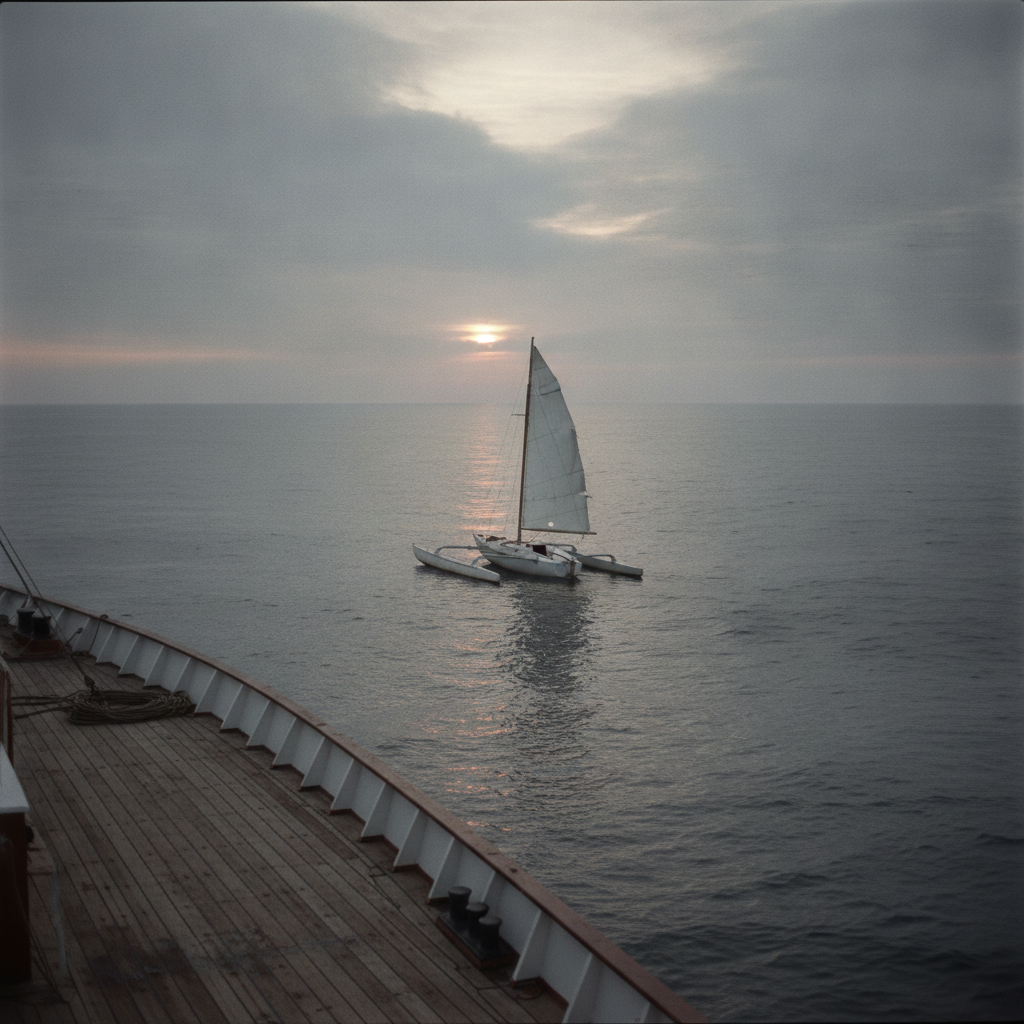
It is a small yacht. It has 3 hulls. One sail is still up. It is moving slowly with the wind, going nowhere.
The crew hail it. Nobody answers. They lower a boat and climb aboard.
The cabin is untidy but undamaged. The life raft is still lashed down on deck, which means nobody abandoned ship. On the chart table there are 3 logbooks, and next to them the case of the ship's chronometer, open and empty.
The boat is called Teignmouth Electron. It left England 8 months earlier carrying one man, a 36-year-old businessman named Donald Crowhurst, who was trying to sail alone around the world.
The boat is here. The man is not, and he never was found.
What happened to him in the last hours is still argued about 57 years later. Almost everything else is known in extraordinary detail, because he wrote it down himself.
The race anyone could enter
In 1968 a British newspaper announced a race. Sail alone around the world, without stopping anywhere and without help, and come back to the port you left from.
There were 2 prizes. A trophy for the first person to finish, and 5,000 pounds for the fastest voyage. That sum was the price of a house.
There was no qualification requirement of any kind. You simply had to start from a British port between 1 June and 31 October 1968, and tell the organisers you were in.
9 men set out. 1 finished.
The man and the boat that was not ready
Crowhurst was a weekend sailor with a small electronics business that was failing. He had designed a handheld radio direction finder for small boats, and it was not selling.
He had never sailed an ocean alone.
To get a boat he found a local businessman to pay for one. The terms were brutal. If he pulled out of the race, he had to buy the boat back himself. To cover that he mortgaged both his company and his family home.
The boat was a 12-metre trimaran, a 3-hulled design that was fast but could capsize and could not right itself. He planned to solve that with a system of his own design, an inflatable bag at the top of the mast that would stop the boat turning right over.
The bag was never built. Neither was most of the rest. He was still loading when the deadline arrived.
He sailed on 31 October 1968, the last legal day, with equipment still stacked on the quay behind him. Among the things left ashore was a length of hose he needed to pump out the hulls.
One experienced officer who had sailed the boat with him a fortnight earlier said afterwards that it was fast, but that its navigation arrangements struck him as careless.
The first decision
The trouble started at once. Seawater came in through the deck hatches and would not stop. Without the hose he could not pump the hulls dry properly. The self-steering gear worked loose.
Within a few weeks he was making less than half the daily distance he had planned.
That mattered more than it sounds. Ahead of him lay the Southern Ocean, where the waves run for thousands of kilometres without meeting land, in a boat that leaked, could not right itself and had no safety system.
He had 3 choices, and he wrote about all of them. Go on, and probably not survive. Turn round, and lose the business, the house and his reputation in a small town. Or something else.
On 6 December 1968 he chose the something else. He began reporting positions that were not true.
Seven months in the wrong ocean
He never went near the Southern Ocean. He never left the Atlantic.
For about 7 months he sailed slowly up and down the south Atlantic, keeping out of shipping lanes, using his radio rarely and vaguely. Meanwhile he sent back claimed positions that showed a boat crossing the world at record speed.
By Christmas, newspapers at home were calling him the likely winner of the speed prize.
To keep it up he had to do something extremely difficult. A real navigator measures the sun and works out where he is. Crowhurst had to start from a position he had invented and work backwards to the sun measurements that would have produced it, then write those into a second logbook, in order, for months. Sailors who later examined the books said the false workings were harder than the real ones.
And he kept the true log as well. He recorded where he actually was, the whole time.
On 6 March 1969 he ran aground on a sandbank near the coast of Argentina and had to be pulled off by a local fisherman. He went ashore for repairs, which under the rules disqualified him the moment he did it.
He wrote that down too, in full.
The trap closes
While he circled the Atlantic, the race decided itself around him.
One competitor finished on 22 April 1969 and took the trophy as the first man to sail alone and non-stop around the world. Another simply kept going when he reached the finish and sailed on into the Pacific instead, because he no longer wanted the race.
That left the speed prize to be fought over by 2 men. One was Crowhurst. The other was a rival in a worn-out boat who believed, from the false radio reports, that he was being caught.
So the rival pushed his boat harder than it could take. On 30 May 1969 it broke up under him and he was rescued from a life raft.
And with that, the thing Crowhurst had spent 7 months avoiding arrived. He was now going to win. And the winner's logbooks would be examined, line by line, by a committee of professional sailors.
Eight days of writing
On 24 June 1969 he stopped keeping a navigational log.
Over the following 8 days he wrote roughly 25,000 words of what he headed Philosophy. It is an argument, about mathematics, about time, about cosmic beings, about a man being able to leave the body behind by an act of will.
He timed the entries to the second.
His last radio contact was on 29 June 1969. The last written entry is dated 1 July 1969. Near the end come the lines: It is finished. It is the mercy.
The final entry is a time, followed by a sentence that stops in the middle.
**That is the end of the documented record. From here on, nobody knows what happened on that boat.**
What the ship found
9 days later the cargo ship came alongside.
The sea was calm. There was no damage of the kind a wave strike leaves. The sails were partly set. The life raft had not been touched.
3 logbooks were aboard: 2 navigational and 1 for radio. The true one was there. The fabricated one, the book that would have been produced as evidence of a voyage round the world, has never been found.
So was the chronometer. The case was there, open. The instrument was gone.
The boat was recovered and the books were read within days. By the end of July 1969 the whole country knew that the man they had been cheering had never gone anywhere.
The man who had already won the trophy gave his 5,000 pound prize to a fund for the family.
What happened afterwards
An inquest recorded that he had drowned, and the accepted account is suicide. No body was ever recovered, so no medical examination was ever possible.
The boat was sold, changed owners, and ended up abandoned on a beach on a small Caribbean island, where the remains of the 3 hulls are still slowly rotting under the trees.
Conclusions and Open Questions
**He went into the water deliberately.** The evidence: 8 days of writing that build towards leaving the body, the words it is finished, a calm sea, an untouched life raft, no sign of an accident, and a missing chronometer that reads like something taken as a weight or as a symbol. The problem: the last sentence he wrote is unfinished, and the time beside it may be the time he wrote it or a time he had set for himself. Nobody can tell which.
**He fell.** The evidence: this is what his widow always believed. He had written about going up the mast in the days before, and a man alone on a boat who goes over the side has no way back aboard. The boat sails on without him. The problem: the sea was calm, and an accidental fall does not explain the missing chronometer or the missing second logbook.
**He was ill, and had been for weeks.** The evidence: months alone, broken sleep, poor food and water, and a business collapse at home. A clinical psychologist later argued the writings show an untreated mood disorder rather than a simple breakdown. The problem: this explains the state he was in. It does not tell you what he did on 1 July, and it cannot be tested on a man who was never examined.
**He did not think he was dying.** The evidence: his son has said he believes his father saw it as a transformation rather than a death. The final pages support that reading. The problem: it cannot be proved or disproved by anything.
One part of the case is not in doubt. The hoax is proven, by his own hand, in his own books, including the parts that convicted him. He wrote down the grounding in Argentina, which no one would ever have known about. He kept the true log beside the false one for 7 months.
A man who wanted only to deceive would have burned the real book. He carried it to the end instead, and left it open on the table for whoever came aboard.