Documented

Room 3327: The Night the Government Carried Away Nikola Tesla's Life's Work

2026-08-15 · Impossible Objects · 8 min read

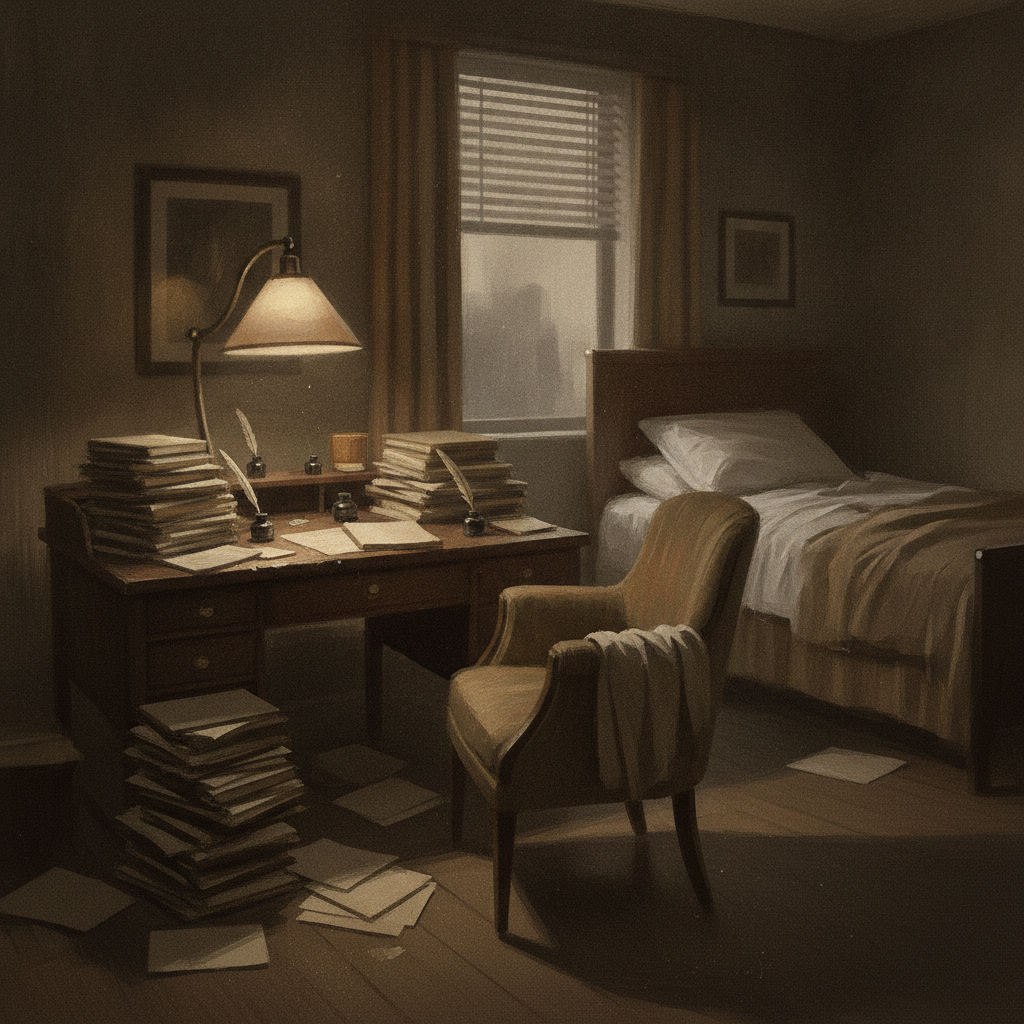
Nikola Tesla spent the last ten years of his life in a single room on the thirty third floor of the Hotel New Yorker, an art deco tower on Eighth Avenue in Manhattan. Room 3327 was small, plain and quiet. The man who lived in it was eighty six years old, painfully thin, and almost completely alone.

He had not always lived like that. Tesla arrived in the United States in 1884 and became a naturalized American citizen in 1891. He designed the alternating current system that still carries electricity into nearly every building on the planet. His induction motor turned the machinery of the industrial age. His name was attached to the first great hydroelectric project at Niagara Falls, and for a stretch of the 1890s he was one of the most famous scientific figures in the world.

By the 1920s the fame had drained away and the money went with it. His most valuable patents had expired. Wardenclyffe, the huge wireless transmission station he had built on Long Island, was mortgaged against unpaid hotel bills that reached roughly twenty thousand dollars, and the tower was eventually torn down. Tesla moved from hotel to hotel, leaving accounts behind him. In his final years he lived largely on a modest monthly stipend arranged by the government of Yugoslavia, the state that had absorbed the Serbian lands his family came from. He fed pigeons in the parks near Herald Square and carried injured birds back to his room to nurse them.

He also kept talking. Every year on his birthday Tesla held a press conference for reporters, and in 1934 he used one of them to announce a weapon. He called it teleforce. In his description it would accelerate tiny particles of matter to enormous speed inside an open ended vacuum tube and fire them in a concentrated stream. He said such a beam could bring down a fleet of ten thousand enemy aircraft at a distance of two hundred miles and make any country that possessed it impossible to invade.

The newspapers immediately called it a death ray. Tesla objected to the phrase, and his objection was technical rather than modest: rays, he argued, spread out and weaken over distance, while his device would send solid particles that stayed concentrated. Between 1934 and 1940 he tried to sell the idea to several governments. In 1935 the Soviet trading agency Amtorg paid him twenty five thousand dollars for a set of plans. Britain looked at the proposal and lost interest by 1938. No prototype was ever demonstrated in public, and no working teleforce apparatus has ever been documented. The weapon existed as Tesla's own publicly announced concept, on paper and in interviews, and nowhere else.

That was the situation on the night of 7 January 1943, when Tesla died alone in room 3327. He had hung a do not disturb sign on his door two days earlier. A maid, Alice Monaghan, finally ignored it and found the body. An assistant medical examiner ruled the cause of death coronary thrombosis. Tesla was buried after a funeral at the Cathedral of Saint John the Divine that drew a crowd of mourners including scientists, diplomats and Nobel laureates who sent tributes.

The strange part of the story began the next evening. On 8 January a small group went up to the room to look for a will: Tesla's nephew Sava Kosanovic, a Yugoslav political figure who would soon become his country's ambassador to Washington, together with the radio historian George Clark, the writer Kenneth Swezey, a technician from the Shaw Walker safe company, assistant managers of the hotel, and representatives of the Yugoslav consulate. The safe was drilled open in front of all of them. Kosanovic later said he believed papers had already been removed before he arrived, though he could not prove it.

The following day, 9 January, officials of the Office of Alien Property Custodian arrived at the Hotel New Yorker and took possession of everything. Tesla's belongings, along with material he had stored at other hotels and at a Manhattan warehouse, were sealed and carted off. Contemporary accounts describe roughly two truckloads of property. The stated reason was wartime security. With the United States at war, the government did not want the notes of a man who had publicly offered a superweapon to foreign powers ending up in the hands of a Yugoslav diplomat, or anyone else.

There was an obvious legal problem with all of this. The Office of Alien Property existed to seize enemy assets, and Tesla had been an American citizen for more than fifty years. The seizure was carried out anyway, and the question of whether it was lawful was never seriously litigated at the time.

Once the material was in federal custody, someone had to decide whether it was dangerous. The government turned to John G. Trump, an electrical engineer at the Massachusetts Institute of Technology who worked with the National Defense Research Committee and was an expert on high voltage generators. He was also, as a detail history would later find irresistible, the uncle of a future president of the United States. In late January 1943 Trump examined the seized papers together with naval officers assigned to the review.

Ad

His conclusion was blunt. Trump reported that Tesla's writings and notes from the previous fifteen years or so were primarily of a speculative, philosophical and promotional character and that he had found no new, sound, workable principles or methods for realizing the results Tesla had claimed. One episode from the review became famous. Among the effects was a sealed container that Tesla had reportedly warned would destroy anyone who opened it without knowing the secret. It was opened. Inside was a multidecade resistance box, a standard piece of laboratory measuring equipment about forty five years old. Some of the material was microfilmed before being returned to storage.

The papers then sat in a warehouse for nine years while lawyers argued over the estate. In 1951 and 1952 the material was finally released to Kosanovic as heir and shipped across the Atlantic, packed into crates, suitcases, metal trunks and barrels. It reached the port of Rijeka and then Belgrade, where the Nikola Tesla Museum opened in 1952 in a villa in the centre of the city. Its holdings today include more than one hundred and sixty thousand documents, some two thousand books and journals, and roughly twelve hundred objects and instruments. In 2003 the archive was inscribed on the UNESCO Memory of the World register.

And there the arithmetic stops working. American records from the seizure refer to something on the order of eighty trunks of Tesla material. About sixty packages arrived in Belgrade. The Federal Bureau of Investigation, which has always insisted it never seized the estate itself, released around two hundred and fifty pages of Tesla related files in 2016 after freedom of information requests, and more the following year, including an inventory of the writings. Portions are still withheld. That gap, twenty trunks wide and eighty years old, is the whole mystery.

Conclusions and Open Questions

The documented facts are not really in dispute. A citizen's property was seized by an office with no clear jurisdiction over him, examined by a government consultant who declared it worthless, held for nine years, and then handed to his heir minus, apparently, a number of containers. What that gap means is where the argument starts.

The simplest reading, and the one most historians of technology accept, is that John G. Trump was right. Tesla in his eighties was a brilliant man promoting ideas he could no longer build or test. Teleforce was announced, described and sold as plans, but never demonstrated. On this reading the missing trunks are an accounting artifact: eighty containers of furniture, clothing, correspondence and laboratory junk repacked into sixty crates for an ocean voyage, with the worthless remainder discarded. The weakness of this theory is that Trump had only a few days with an enormous and disordered collection, that his brief was narrow, and that his report is not the same thing as a full inventory.

A second theory, argued by some Tesla researchers including the biographer Marc Seifer, holds that the government kept what it wanted. Supporters point to the microfilming, to the long delay in releasing the estate, to the fact that some FBI pages remain classified after eighty years, and to documented military interest in particle beam concepts at American air force facilities in the years after the war. The weakness here is that the case rests almost entirely on absence. No document has surfaced showing a retained Tesla file, and continuing military interest in particle beams proves only that the physics was interesting, not that it came from Tesla's trunks.

A third possibility is the least dramatic and perhaps the most likely: bureaucratic entropy. Property moved between a hotel, two warehouses and a federal office during a world war, handled by people with no idea what mattered. Things get lost that way without anyone deciding to lose them.

What genuinely remains unexplained is narrower than the legend. Why was the Alien Property Custodian used against a naturalized American at all, and on whose instruction? What was microfilmed in January 1943, and where are those films now? Why do American and Yugoslav counts of the containers differ, and does any surviving shipping manifest reconcile them? What is in the FBI material still withheld, and on what grounds?

One point deserves to be stated plainly, because the legend usually blurs it. The suppressed superweapon story is a theory, not a finding. Some argue that a functioning particle beam design vanished into a classified programme in 1943. There is no evidence that such a design ever existed outside Tesla's own descriptions of it. The real puzzle is not what the government stole from a dead genius, but why a state that had just declared his papers worthless felt the need to hold on to them for nine years, and to keep some of the paperwork about them secret to this day.


Share this story:

Reader comments (0)
Only active subscribers with verified payment can post comments. Subscribe — first month free