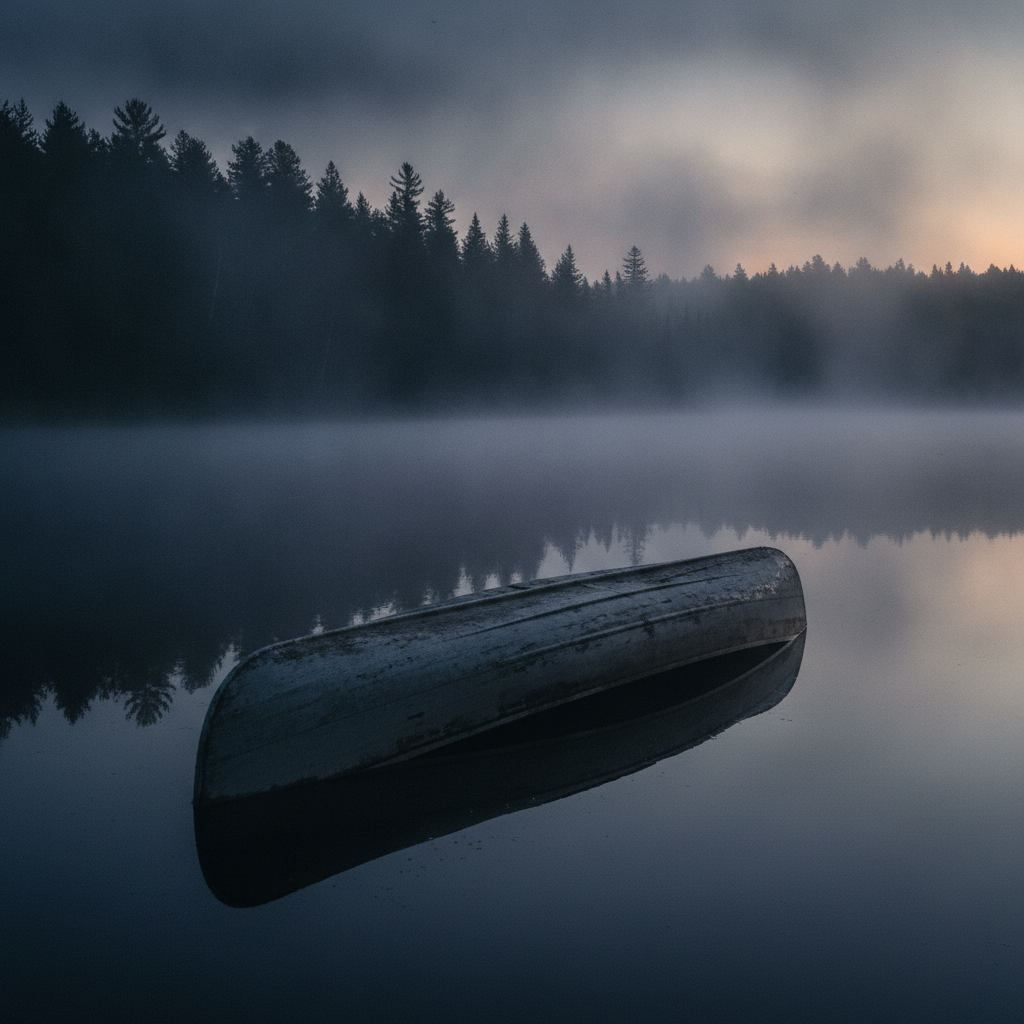
The Painter Who Drowned in a Calm Lake: The Death of Tom Thomson
On a summer day in July 1917, a man pushed his canoe off a small dock on Canoe Lake and paddled away across the water.
Canoe Lake is in Algonquin Park, a huge forest of lakes and rivers in Ontario, Canada, roughly 250 km north of Toronto. In summer it is quiet, green and still.
The man was Tom Thomson. He was 39. He was a painter, and he was also one of the best canoeists in the park. He had worked there as a guide and a fire ranger. He knew the lake the way other people know their own kitchen.
Later that day, his canoe was seen floating upside down on the lake.
8 days later, his body came to the surface.
This is the story of how the most important painter in Canada died in water he knew perfectly, of the fishing line found wrapped around his ankle, and of the 2 graves that still argue with each other. In one sentence: the official verdict was an accidental drowning, but the evidence was handled so badly that nobody can prove it, and nobody can prove anything else either.
The painter of the north
To understand why this death still matters, you need to know who he was.
Tom Thomson grew up on a farm in Ontario. He came late to painting, and worked for years as a commercial artist in Toronto. Then, from about 1912, he began spending his springs, summers and autumns in Algonquin Park.
He painted hundreds of small sketches in oil on wooden boards, sitting in his canoe or on a rock by the water. In the winters he turned some of them into large canvases. 2 of them, a lonely pine tree against a lake and a windswept tree on a rocky shore, became among the best-known paintings in Canada.
A group of his painter friends would later form a movement that changed Canadian art. He never saw it. He was dead 3 years before it began.
The last day
On 8 July 1917, Tom Thomson was staying at a small lodge on Canoe Lake.
That morning he was seen talking with the owner of the lodge. According to the diary of a park ranger, he left the lodge dock some time after half past 12, going to fish, and possibly heading for one of the nearby lakes or a dam where he sometimes spent the night.
He was alone in his grey canoe.
Nobody is recorded as seeing him again alive.
His canoe was found floating upside down. Here the sources already disagree. Some say it was spotted later the same afternoon. Others say it was found the next day. Several accounts say that his paddle was never found.
For an expert canoeist on a calm summer lake, an overturned canoe was very strange. But many people at the lake assumed he was simply off somewhere, camping, and would turn up.
He did not. The search began.
The body in the lake
On the morning of 16 July, 8 days after he disappeared, his body was found floating in the shallows of Canoe Lake. One later account says it was spotted by a visitor fishing on the lake. Another gives the date as 15 July, not 16 July.
The body had been in warm summer water for more than a week. It was swollen and badly decomposed.
2 things were noticed.
The first was a bruise, about 10 cm long, on the side of his head, near the temple. There was some blood from one ear. Most documents place it on the right side. At least one later account places it on the left. That difference matters, as we will see.
The second thing was stranger. A length of fishing line was wrapped around one of his ankles, many times.
A hurried verdict
A doctor who was holidaying at the lake examined the body. He wrote that the cause of death was drowning, and that the bruise could have come from striking something as he fell.
Because the body was decomposing fast in the heat, and the family's instructions had not yet arrived, the body was embalmed and buried quickly in the small cemetery on a hill above the lake.
The coroner arrived by train afterwards. He held a short hearing at the lake that night. According to several accounts, he never looked at the body, which was already in the ground. The verdict was accidental drowning.
2 graves
Tom Thomson's family wanted him buried at home, in the family plot beside the church in a village called Leith, on the other side of the province, a long journey away.
So an undertaker came up from a town nearby. On the evening he arrived, he went up to the little cemetery above the lake. He insisted on working alone, at night.
By the next morning he had a sealed metal casket ready. It went out by train. On 21 July 1917 it was buried in the family plot at Leith.
People at Canoe Lake did not believe it. They pointed out that the undertaker had worked alone, in the dark, for only a few hours. Digging up a grave, opening a coffin, moving a decomposed body into a new casket and filling the grave in again was, they said, too much for one man in that time. Local stories said the casket had gone to Leith full of earth and stones, and that Tom Thomson was still in the ground above the lake.
The casket at Leith was sealed. Nobody opened it.
The skull on the hill
In October 1956, almost 40 years later, 4 men from the lake decided to find out. One of them was a local judge. They went up to the old cemetery with shovels and dug into the grave where Tom Thomson had first been buried.
They found a coffin. Inside it were human bones.
Among them was a skull, with a round hole about 2 cm across in the left side.
The remains were taken to the crime laboratory of the Ontario provincial police. The chief pathologist there examined them. His conclusion was announced by the provincial government: the bones were not Tom Thomson's. They belonged to a younger man, between 20 and 30, who was Indigenous. The hole in the skull, he said, was not from a bullet. It was from a surgical operation that removes a piece of bone.
Tom Thomson was 39, of Scottish descent, and his bruise was recorded on the right.
So, officially, an unknown Indigenous man had later been buried in the old grave, perhaps in the empty coffin left behind in 1917.
Not everyone accepted this. A doctor who was present at the dig in 1956 wrote that the skull looked like a white man of about Tom Thomson's height. In 2009, a Canadian journalist and a university anthropologist compared photographs of that skull with photographs of Tom Thomson. The anthropologist said he saw nothing in the skull to suggest it belonged to anyone else. Other researchers disagreed with that comparison. The skull itself was reburied, and no DNA test has ever been made public. Tom Thomson's family has been reluctant to open either grave.
**So this is where the documented record stops: a painter drowned in 1917, a doctor called it an accident, and nobody has ever proved beyond doubt which grave holds his body.**
Conclusions and Open Questions
There are 3 main explanations for how he died, and a fourth question about where he lies.
**It was an accident.** The doctor and the coroner said so. Some historians and writers have suggested that he stood up in his canoe, perhaps to fish or to relieve himself, lost his balance, hit his head on the side of the canoe, and drowned while stunned. That would explain the bruise and the overturned canoe. As for the fishing line, some historians say that wrapping line around a sore ankle was an old remedy for aching joints. Another writer believes the line came from the men who pulled the body out of the water. The problem: he was an expert, on a calm lake, in the middle of the day. And the evidence was never properly examined.
**It was suicide.** This has been suggested now and then, because of stories about his private life. The problem: there is no letter, no witness, and nothing in his last days that points clearly to it.
**It was murder.** Decades later, stories came out of a quarrel at a party the night before, and of an argument about money with a man at the lake. One woman said many years afterwards that the lodge owner's wife had told her that her husband struck Tom Thomson during a fight, and that he fell and hit his head. These are second-hand stories told long after the event. Nobody was ever charged with anything, and everyone named in these stories died long ago without ever being accused in any court. The problem: none of it was recorded at the time. It rests on memory and rumour.
**And which grave?** The official 1956 finding says the skull on the hill is not his, so he lies at Leith. Some researchers believe the skull is his, so he never left the lake. The problem: only a DNA test could settle it, and one has never been made public.
What remains open is almost everything that matters. How a master canoeist ended up in the water. Why the line was around his ankle. Why the paddle was never found. And whether the man whose paintings made the northern lakes famous is still lying on a hill above the lake where he died.