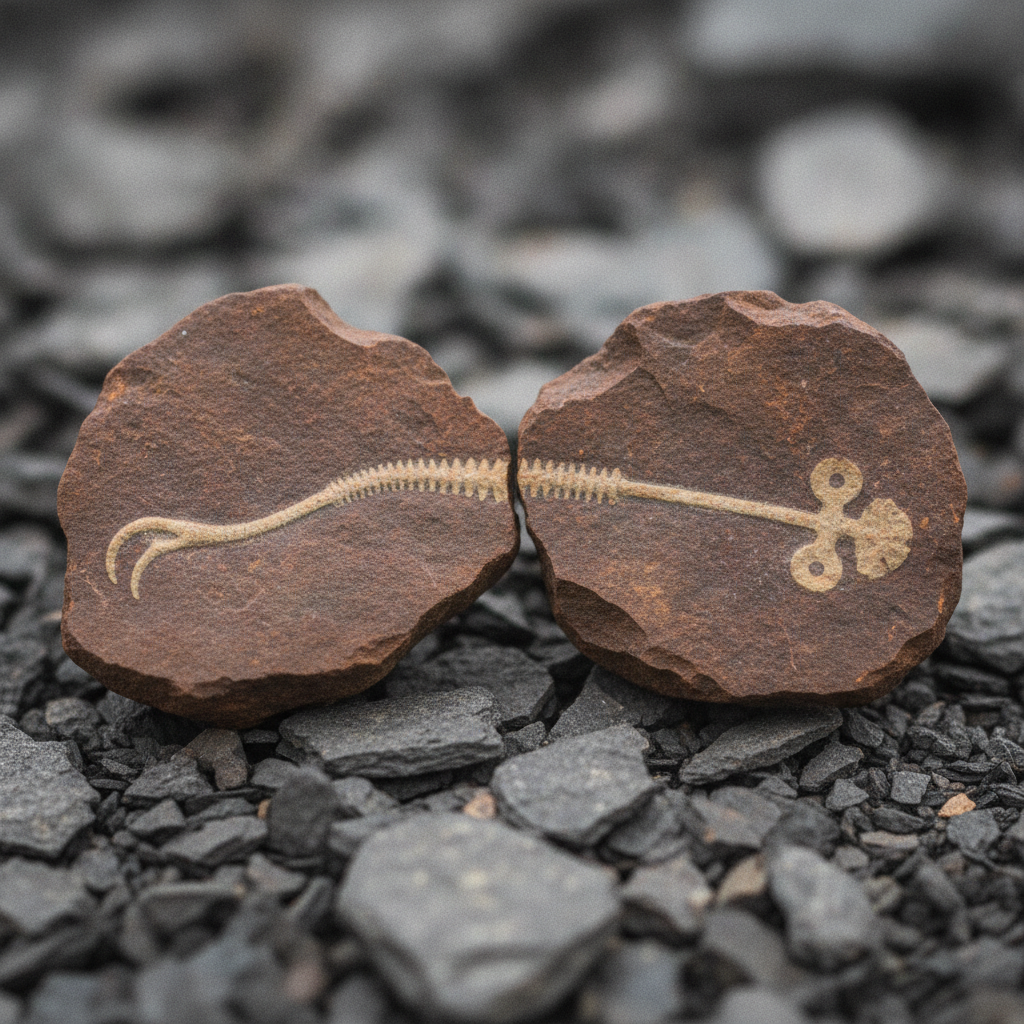
The Tully monster: 70 years later, science still cannot say what this animal was
In the 1950s, a retired pipefitter from Illinois spent his free days walking over hills of grey waste rock left behind by coal mines.
His name was Francis Tully. He was an amateur fossil collector. He was looking for small, flat, rust-brown stones, about the size of a hand.
When you split one of those stones in 2, there is sometimes a fossil inside. A fern leaf. A shrimp. A jellyfish. Sometimes nothing.
One day he split a stone and found an animal he had never seen. Nobody else had either.
What the Tully monster is
This is the story of the Tully monster, an animal that lived in a shallow sea more than 300 million years ago. Its scientific name is Tullimonstrum gregarium.
Here is the mystery in one sentence: scientists have thousands of fossils of this animal, they know exactly what it looked like, and after 70 years they still do not agree on what kind of animal it was.
Not which species. Not which family. They do not even agree whether it had a backbone.
Where the stones come from
The stones come from a place called Mazon Creek, in the state of Illinois in the United States, south-west of the city of Chicago.
About 309 million years ago, according to the standard estimate, this area was a coast. Rivers flowed into a shallow, muddy sea. Plants and animals that died there were buried very quickly by mud.
As the bodies began to rot, bacteria released gas. The gas reacted with iron in the water, and a hard shell of iron-rich mineral formed around each body. Over time the mud turned to rock, and each animal stayed sealed inside its own small stone.
In the 20th century, coal companies dug huge open pits in the area. The waste rock was piled up in long hills. Rain and frost broke the rock apart, and the stones with fossils came to the surface by the thousands.
Today, more than 320 animal species and more than 400 plant species have been identified from these stones.
The largest coal pit, known as Pit 11, is now a state nature area. Collecting fossils there is still allowed, with a permit. In 1997 the fossil beds were declared a National Historic Landmark of the United States.
A visit to the museum
The sources disagree on the year of the find. Most give 1955. Others give 1958, and the Illinois State Museum agrees with 1958.
What is certain is what Francis Tully did next. He took his stone to the Field Museum, the large natural history museum in Chicago.
In those years, collectors from Mazon Creek brought their finds to the museum's curator of fossil plants, who helped them identify what they had. Tully was different. He brought animals.
The museum's curator of fossil invertebrates became interested in his finds. He asked Tully for more specimens, and Tully brought them.
The curator showed them to his colleagues. Nobody could identify the animal.
According to the account of the local fossil club, the head of the museum's geology department saw the specimens on a table one day and asked: "Are those some more of Tully's monsters?"
The name stuck.
What it looked like
Here is what the fossils show. Everyone agrees on this part.
The adult animal was up to about 35 cm long. The smallest known specimens are about 8 cm.
The body was shaped roughly like a cigar, soft, with no bones and no shell. At the back end it had a tail with what may have been a pair of fins.
At the front, it had a long, thin snout, like a trunk. At the end of the snout was a small claw, like a pair of pliers. Inside the claw were tiny teeth, up to 8 on each side.
Most strange of all were the eyes. Across the top of the body ran a stiff bar, sticking out to both sides, like the handlebar of a bicycle. At each end of the bar was a round organ. Most scientists read these as eyes.
The body was divided into repeated sections, one behind the other.
No living animal looks anything like this.
A puzzle that would not go away
In 1966 the museum curator formally described the animal and gave it its scientific name. He Latinised "Tully's monster" into Tullimonstrum. The second word, gregarium, means "common". It was a joke aimed at his colleagues: the animal was everywhere in those stones, and nobody had noticed it.
At first it was described as some kind of worm. That did not settle anything. For 50 years, scientists compared it to almost every group of animals.
Some said it looked like a snail or squid relative, a mollusc. Others compared it to strange sea creatures from even older rocks, animals with no living descendants. Others thought of worms again.
In 1989 the state of Illinois made the Tully monster its official state fossil. It was a famous animal that nobody could place.
2016: an answer, it seemed
In 2016 the puzzle seemed to be solved. Twice, at once.
2 separate research teams published studies in the same period, and both said the same thing: the Tully monster was a vertebrate, an animal with a backbone, like a fish.
The first team, at Yale University in the United States, studied more than 1,200 specimens. They argued that a pale stripe along the body was a notochord, the flexible rod that comes before a real backbone. They saw rows of cartilage, fins and teeth made of keratin. They concluded that the animal was a jawless fish, a distant relative of today's lampreys.
The second team looked at the eyes. Inside the fossil eyes they found tiny particles of pigment, called melanosomes, in 2 different shapes. They said this pattern was known only from vertebrate eyes.
The news went around the world. The monster had a home at last.
2017: not so fast
A year later, a third team published a direct reply. Its title said it plainly: the Tully monster is not a vertebrate.
They said the pale stripe could be something else, a gut for example. They said lampreys and other jawless fish have certain features that the Tully monster does not have. And they said the 2 pigment shapes were not proof, because they are found in other animals too.
In 2019, a fourth team tested that last point. They showed that some squid and cuttlefish also have melanosomes in 2 shapes. They also measured the metals inside the fossil eyes and found that the Tully monster did not match vertebrates, and did not match a fossil squid relative from the same rocks either. Their conclusion was careful: the eyes alone cannot decide the question.
In 2020, the first team came back with a new chemical method. They shone a laser on the fossil tissue and studied the light that came back. They said the remains of the soft tissue looked like those of animals with a notochord, and not like the hard shell material of insects and crabs. In 2022, other researchers repeated similar measurements with a different instrument.
2023: the 3D scans
In 2023 a team in Japan took a different approach. They made 3D scans of 153 specimens, using X-rays to look inside the stones without breaking them.
They looked at each feature that had been used as evidence for a backbone animal: the pale stripe, the brain, the cartilage, the fins. One by one, they said, these features did not match vertebrate anatomy.
They found something else as well. The repeated body sections did not stop behind the head, as they would in a fish. They continued forward, all the way to the area in front of the eyes. That pattern is not typical of a fish.
The lead author told the press that the vertebrate idea was, in his view, no longer tenable.
But even this team did not name the animal. They said it might be a chordate without a backbone, or it might belong to the large group that includes worms, snails and insects. They could not say which.
**And that is where the record stands today: thousands of fossils, at least 6 major studies since 2016, and no agreed answer.**
Conclusions and Open Questions
Today, the formal classification of the Tully monster is "incertae sedis", Latin for "of uncertain placement". There are 3 main ideas on the table.
**It was a backbone animal, a relative of lampreys.** The evidence: the 2016 study of more than 1,200 specimens, and the 2020 chemical tests of the soft tissue. The problem: the 2023 scans showed that the key features do not look like the same features in real fish, and the body sections run in the wrong direction.
**It was a chordate, but without a real backbone.** The evidence: the 2023 study left this door open, and it could explain both the chemistry and the strange anatomy. The problem: nobody has shown which group of chordates it would belong to.
**It was an invertebrate, perhaps related to molluscs or worms.** The evidence: the 2017 critique and the 2023 scans, which found the body sections and the eye bar unlike anything in fish. The problem: no invertebrate group has been found that matches its snout, its claw and its eye bar either.
Some questions remain open on every side. Was the pale stripe a notochord or a gut? Were the round organs at the end of the bar really eyes? And why, among more than 320 animal species from Mazon Creek, is this common animal found nowhere else on Earth?
What is not in doubt is the story of the find. A retired pipefitter split a stone on a waste heap, and gave science one of its longest-running puzzles.