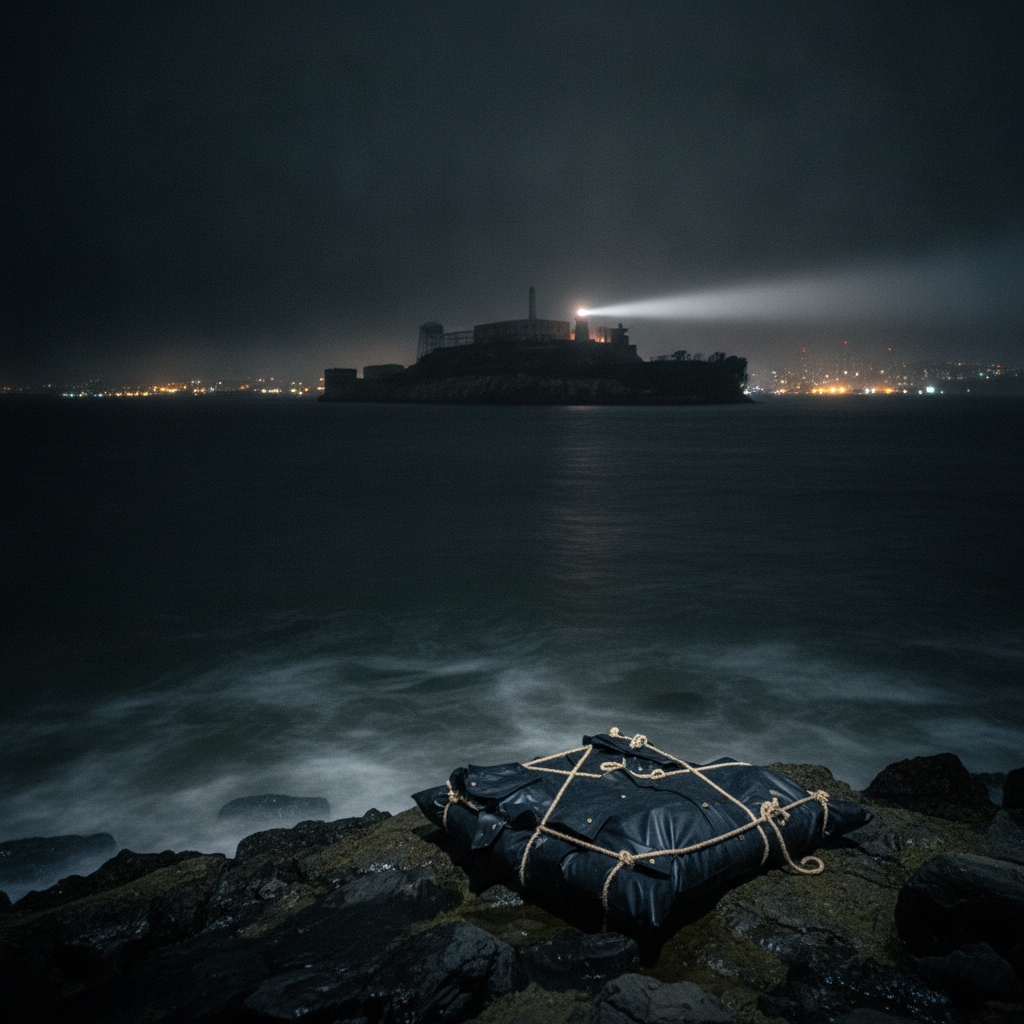
Three Men, a Raincoat Raft and a Cold Bay: The Night Alcatraz Was Beaten
The last time anyone in authority saw Frank Morris, John Anglin and Clarence Anglin, the three men were lying in their bunks on B Block with the lights going out. It was the evening of Monday 11 June 1962. What the guard walking the tier actually saw, at some point in the hours that followed, was three heads on three pillows. The heads were made of soap, toothpaste, concrete dust and toilet paper, tinted with paint from the prison art kits and finished with real hair swept up off the floor of the barbershop.
The men themselves were already in a dark utility corridor behind the wall, climbing.
Alcatraz sat a mile and a half offshore in San Francisco Bay and its reputation rested on the water rather than the walls. The federal prison held men the system had given up on, including those who had tried to escape from somewhere else. Frank Lee Morris was one of them, an orphan raised in foster homes, a career burglar and bank robber with a record of escapes and, in the prison's own assessment, unusual intelligence. He arrived on the island in January 1960. John and Clarence Anglin were brothers from a large farming family in Florida, both serving long federal terms after robbing a bank in Alabama in January 1958, and both had tried to get out of other institutions before. All three had known each other in prison on the mainland. A fourth man, Allen West, was in on the plan.
The work took about six months and it was done with the prison's own materials. At the back of each cell was a ventilation opening roughly nine inches by six, set in concrete that decades of salt air had left soft. The men enlarged the openings by scraping, using sharpened spoons taken from the mess hall, discarded saw blades found on the grounds, and a crude drill improvised from the motor of a vacuum cleaner. They worked during the music hour, when accordions and the noise of the block covered the sound. Each night the hole was hidden behind a false grille made of painted cardboard.
The openings led into an unguarded service corridor full of pipes that ran the height of the block. Above it, at the top of the cell house, was a space nobody visited. The men set up a workshop there, screened with hanging blankets, and built the equipment for a sea crossing. The raft was about six feet by fourteen, assembled from more than fifty raincoats, some stolen and some donated by other inmates, with the seams stitched by hand and vulcanised against the hot steam pipes. They made life vests the same way, and a paddle, and they took a concertina from the music programme to inflate the raft. They studied tide tables from prison library material and old copies of magazines that discussed the bay.
On the night of 11 June the three men went out through their vents, up the pipework of the corridor, and on to the roof of the cell block through a ventilator they had already loosened. Allen West did not get out with them. He had packed the crumbling concrete around his own vent with cement to keep it in place while he worked, and the cement had set. By the time he finally forced his way through, his three companions were gone.
They crossed the roof, climbed down about fifty feet of kitchen vent piping at the corner of the building, crossed two twelve-foot barbed wire fences and reached the shoreline on the north east side of the island. Somewhere around ten at night, according to the reconstruction the FBI assembled afterwards, they inflated the raft and pushed off into the dark.
The escape was discovered at the morning count on 12 June, when a guard reached through the bars to prod a man who would not get up and a head rolled off the pillow onto the floor. What followed was one of the largest manhunts of the era, with the FBI, the Coast Guard, prison launches, aircraft and military units combing the bay and the shoreline.
The search recovered objects and nothing else. On 14 June a paddle was found floating a couple of hundred yards off the southern shore of Angel Island. A sealed plastic bag was recovered containing names, addresses and photographs belonging to friends and relatives of the Anglins, the sort of package a man takes if he intends to arrive somewhere. On 21 June a life vest washed up on Cronkite Beach, outside the Golden Gate. A second vest was found in the bay. No raft was ever recovered. No body was ever recovered.
The bay in June is between ten and twelve degrees Celsius, cold enough to sap a swimmer within an hour, and the currents through the Golden Gate are strong enough to carry a small craft out to sea. That is the case for drowning, and it is the conclusion the FBI reached when it closed its file on 31 December 1979 after seventeen years of work.
The case has never actually closed. The United States Marshals Service kept the warrants alive and has continued to circulate age progressed images of all three men. The service has said the file stays open until the escapees would have reached one hundred years of age, which for Frank Morris, born in September 1926, is this month.
Fragments have surfaced over the decades, none of them verified. In 2018 the FBI confirmed that in 2013 the San Francisco police had received a letter from a writer claiming to be John Anglin, saying that he was alive, that Frank Morris had died in 2008 and Clarence Anglin in 2011, and offering to surrender in exchange for medical care and a short sentence. The bureau examined it for fingerprints and DNA and had the handwriting analysed. The results were inconclusive, which is to say the letter was neither confirmed nor disproved.
In 2015 relatives of the Anglin brothers produced a photograph they said had been taken in Brazil in 1975 by a family friend, showing two men they identified as John and Clarence. Two forensic examiners engaged for a television documentary said the men in the picture were more than likely the brothers. The Marshals Service was not persuaded, noting that the provenance of the image rested on a single person's account. Family members have also described Christmas cards and a claim that two unknown tall women attended their mother's funeral. None of it has been independently confirmed.
The most useful new evidence has come from physics rather than testimony. In 2014 researchers at Delft University of Technology in the Netherlands ran the bay's tidal flows through a hydraulic model and tested the raft's likely drift. Their result was specific. If the men entered the water at around half past eleven at night, the ebb could have carried them to land north of the Golden Gate. If they set off much earlier or much later, the same water would have taken them out to sea.
Conclusions and Open Questions
The drowning explanation is the official one and it is not weak. Three men in a hand sewn raincoat raft went into cold water in the dark, and in sixty-four years not one of them has been confirmed alive, not one has been arrested, and no crime has ever been credibly attributed to them. Two life vests and a paddle came out of the water and the raft did not. Against that stands the fact that no body was ever found, in a bay that has given up bodies before, and the recovered items are equally consistent with men who reached a shore and abandoned their gear.
The survival theory rests on the Delft calculation, which shows a real window in which the crossing works, and on the sealed bag of family addresses, which suggests men planning an arrival rather than a gamble. Its weakness is everything that did not happen afterwards. Two of the three had a large family in Florida who were watched for years, and no verified contact was ever made.
The Brazil photograph and the 2013 letter are the two pieces of evidence most often cited, and both suffer from the same defect. The photograph is supported by two examiners who compared faces, but its history depends entirely on the word of the man who produced it, and the Marshals Service rejected it. The letter contains details, but the laboratory could not tie it to any of the three men, and a hoax letter about the most famous prison break in American history would not be a surprising thing to receive.
Allen West is the last unresolved element. He was the only person who could describe the plan from inside it, and he did, at length, telling investigators the men intended to land on Angel Island, steal clothes and a car and separate. Everything known about the route and the workshop came in part from him. But he was also a man left behind by his own accomplices, being interviewed by the authorities he had tried to escape, and his account has never been tested against anything the others said, because the others were never found.
What remains is a narrow question with two clean answers and no way to choose between them. Either the tide took them out through the Golden Gate within an hour of launching, or three men walked out of the water somewhere on the north shore before dawn on 12 June 1962 and lived the rest of their lives as other people. The physical evidence stops at the waterline.