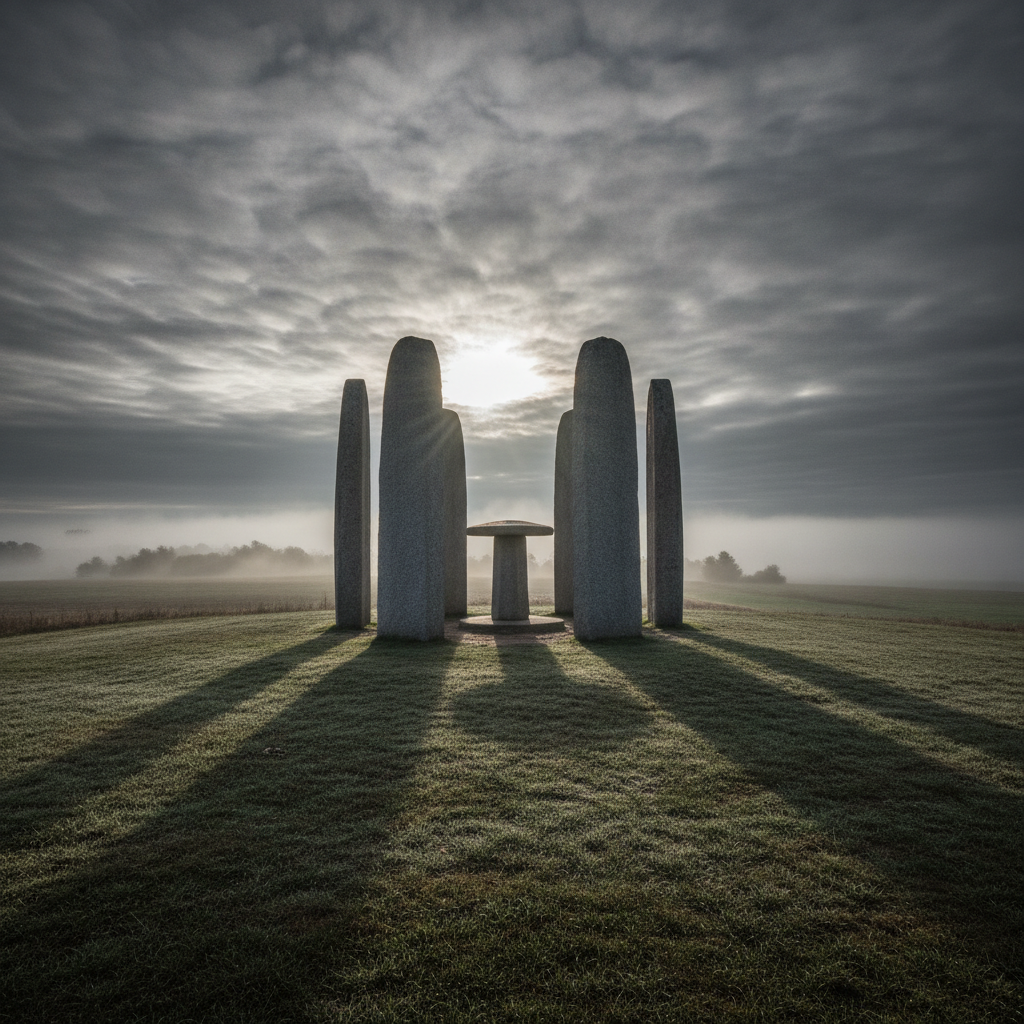
The Stranger Who Paid Cash for a Monument: Who Built the Georgia Guidestones?
In June 1979 a man in a good suit walked into the office of the Elberton Granite Finishing Company in Elbert County, Georgia, and asked the president, Joe Fendley, what it would cost to build a monument. Fendley was used to selling headstones. What the visitor described was a cluster of granite slabs almost six metres high, cut to astronomical tolerances, carrying a ten part message in eight modern languages.
Fendley concluded he was dealing with a crank and quoted a price several times what the work was worth, expecting that to end the conversation. The stranger did not blink. He said his name was Robert C. Christian, that this was not his real name, and that he represented a small group of loyal Americans who had been planning the monument for twenty years. He wanted it built in Elbert County because the granite there was good and because the climate was mild.
Fendley sent him to the local bank. Wyatt Martin, the president of the Granite City Bank, became the only person in the world who was told who the man actually was. Christian gave Martin his real name and enough personal detail to be checked out, on condition that the banker never repeat it. The money came in from banks in other states, routed so that its origin could not be traced back through the transfers. Martin handled the payments, and he kept the promise. He never disclosed the name, and the paperwork that passed through his hands has not survived in any public archive.
The client was precise about what he wanted. He supplied dimensions, an engineering specification, the astronomical features and the exact wording of the message. Five acres of hilltop farmland were bought north of the town of Elberton, on a rise with a long view over the countryside. Then the quarrymen went to work.
The job stretched the yard. The slabs had to be quarried, sawn and finished to tolerances that monument work does not normally require, because the client wanted the stones to function as instruments and not merely to look like them. The lettering had to be cut in eight alphabets, and for the languages nobody in Elberton could read the shop worked from sheets supplied by the client. When it was done, the land itself was handed over to Elbert County, so that the finished monument stood on public ground and the county became responsible for a structure whose origin it could not explain.
What they produced was unveiled on 22 March 1980 in front of a few hundred people. Four upright slabs of Pyramid Blue granite stood around a central pillar, with a capstone across the top. The whole assembly stood 5.87 metres high and weighed close to 108 tonnes. It had been engineered to work as an instrument. A slot cut through the central stone tracked the sun's travel through the year. A hole drilled through the same stone was aligned on the celestial pole, so that the North Star could be seen through it. A twenty two millimetre aperture in the capstone dropped a spot of sunlight onto the central pillar to mark noon each day.
The four outer faces carried the same ten statements, repeated in English, Spanish, Swahili, Hindi, Hebrew, Arabic, Chinese and Russian. The capstone was inscribed in Babylonian cuneiform, Classical Greek, Sanskrit and Egyptian hieroglyphs with a sentence about letting these be guidestones to an age of reason.
The ten statements themselves were the reason the monument never became just another local landmark. They called for uniting humanity with a living new language, for ruling passion, faith and tradition with tempered reason, for fair laws and just courts, for national self government with a world court for disputes between nations, for avoiding petty laws and useless officials, for balancing personal rights with social duties, for prizing truth, beauty and love, and for leaving room for nature. The first two are the ones that stuck. One asked that humanity be maintained under 500 million in perpetual balance with nature. The other asked that reproduction be guided wisely, improving fitness and diversity.
A stone tablet set into the ground nearby explained the physical features, listed the languages, and stated that a time capsule was buried six feet beneath it. The spaces on the tablet where the burial date and the opening date should have been carved were left blank. When the ground was later opened, nothing was found.
For four decades the stones sat on their hill and collected visitors, arguments and, eventually, hostility. To some readers the message was a humanist wish list written during the Cold War by people who expected a nuclear exchange and wanted survivors to have something to start from. To others the population line read as a programme rather than a hope, and the monument became a fixed point in conspiracy literature, cited as evidence of an elite plan for mass depopulation. In 2008 it was defaced with slogans about the new world order. In 2014 it was covered in graffiti again. Security cameras were installed.
At about four in the morning on 6 July 2022, one of those cameras recorded a person approaching the monument, placing an object at the base of one slab and running to a silver sedan, which drove away. The explosion that followed destroyed the slab carrying the Swahili and Hindi text and damaged the capstone. Later the same day, county authorities judged the remaining structure unsafe and had it demolished and carted away. The Georgia Bureau of Investigation released the footage. Nobody has been publicly identified, charged or arrested, and more than four years later the case remains open. In March 2026 a newspaper podcast series returned to it, without a resolution to report.
So the monument is gone, and there are now two unidentified people in the story rather than one.
Conclusions and Open Questions
The identity of R.C. Christian has attracted more theories than evidence. The most cited is linguistic. Christian Rosenkreuz is the legendary founder of the Rosicrucian order, and R.C. Christian reads as a deliberate signature pointing at that tradition, an argument advanced by the writer Jay Weidner among others. Its weakness is that the man himself gave a different explanation to the people he dealt with, saying he had picked the name because of his Christian faith. Both can be true, and neither can be checked.
A second theory names Ted Turner, the Georgia media magnate whose public statements about population and the environment overlap with parts of the text. It rests entirely on that overlap. No document, payment or witness has ever connected him to the commission, and the theory survives because it is satisfying rather than because it is supported.
A third came from a 2015 documentary, whose makers said they had identified the man through interviews with people involved in the banking arrangements. The claim has never been corroborated by records, and the one person who could confirm or deny any name was bound by a promise he chose to keep.
That promise is the centre of the whole case, and it raises the sharper question. A wealthy client spent a large sum on a monument designed to survive centuries and carry a message to strangers, then took extraordinary care to ensure the message could never be traced to him. One reading is that anonymity was the point, that a set of ideas offered without an author has to be argued with on its own terms. Another is more deflating. If the group of loyal Americans existed, it never did anything else. No organisation ever came forward, no second monument was built, and the twenty years of planning left no trace anywhere but in one banker's file.
The time capsule is a small mystery inside the larger one. The tablet says a capsule lies six feet below. The blank date fields suggest that the section was carved in advance and never completed, and the excavation found nothing. Either the burial never happened, or it happened somewhere other than where the tablet points.
The bombing has produced even less. The monument had become a political talking point in Georgia that year, which is context rather than evidence, and the investigation has named no one and offered no motive. What is documented is a figure, an object, a flash and a car leaving in the dark.
The loss is not only symbolic. The Guidestones were a working astronomical instrument, and the alignments were the strongest argument that whoever commissioned them was serious rather than theatrical. Those are now rubble. The message survives in photographs and transcriptions, which was probably always the intention. The name of the man who paid for it survives nowhere at all.