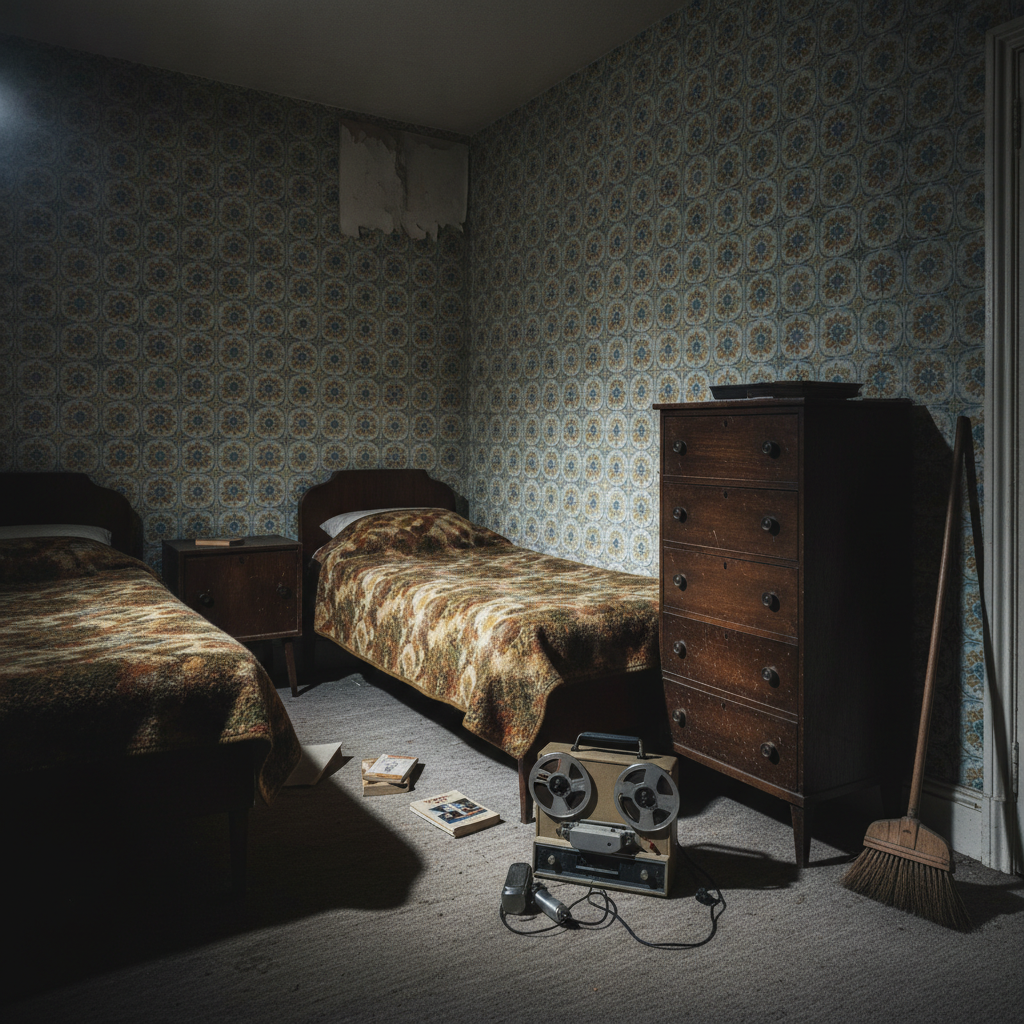
Eighteen Months at 284 Green Street: The Enfield Case Britain Never Settled
On the evening of 30 August 1977, Peggy Hodgson went upstairs in her council house at 284 Green Street in Brimsdown, on the edge of Enfield in north London, because two of her children would not settle. Janet, who was eleven, and her brother Johnny said their beds were shaking. She told them to stop messing about and went back down.
The following night it was different. Peggy was called upstairs again, and this time she said she watched a heavy chest of drawers move across the floor towards the door. She pushed it back and it moved again. There was knocking in the walls, coming from one wall and then another. She got the children out of the house and went next door for Vic Nottingham, a builder, who went through the rooms and the garden and found nothing that would account for it.
At about one in the morning the police were called. Two officers attended, and one of them, Woman Police Constable Carolyn Heeps, later gave a signed statement about what she saw. With the lights off in the living room she heard four distinct knocks travelling from one wall to another. Then, she said, a chair beside her wobbled and slid across the floor between three and four feet, without leaving the ground. She looked for wires or threads and found none, and she wrote that she could not determine the cause of the movement. The police told the family that no criminal offence appeared to have been committed and that there was nothing they could do.
That is the point at which the case stopped being a private disturbance in one house. The family contacted the press. The Daily Mirror sent the reporter Douglas Bence and the photographer Graham Morris, who spent a night at the house and said that objects flew at them in the dark, one of which struck him. The paper suggested calling the Society for Psychical Research.
The SPR sent Maurice Grosse, an inventor and businessman in his sixties who had recently joined the society and had lost a daughter in an accident the previous year. He arrived in early September 1977 and stayed, on and off, for the next eighteen months. He was soon joined by Guy Lyon Playfair, a writer who had investigated similar cases in Brazil. Between them they logged hundreds of hours of tape, interviewed the family and the neighbours, and left a body of documentation that is the reason the case is still argued about half a century later.
What they recorded, and what more than thirty people told them they had seen, followed a repeating pattern. Knocking that answered questions. Furniture that moved when nobody was looking at it. Marbles and Lego bricks flying across rooms. Bedclothes pulled off. Small fires that started and went out. The girls, Janet in particular, apparently being thrown out of bed. Graham Morris rigged remotely triggered cameras in the bedroom and produced a sequence of frames in which Janet appears to be in mid air across the room, the single most reproduced image of the case.
Then there was the voice. From late 1977 Janet began producing a deep male voice, quite unlike her own, which spoke in the first person and answered questions. It swore, it complained, and over months it told a story. It said it was called Bill, that it had gone blind, that it had died in the chair downstairs after a haemorrhage. Playfair and Grosse recorded hours of it. A former resident's family were later traced, and a man named William Charles Wilkins was found in the records as having lived at the house and died there in 1963. Neither investigator claimed the family could not have known the name, and that is one of the points on which the case turns.
The house also filled up with visitors. Journalists, neighbours, sceptics, members of the SPR, television crews and, in 1978, the American investigators Ed and Lorraine Warren, who reviewed the material and pronounced the haunting genuine. Their brief involvement is the part the public knows best, because it was dramatised in a horror film four decades later, a version that bears very little relation to what the records show.
The documentation cuts both ways, and Grosse and Playfair said so themselves. A video camera caught Janet bending spoons and trying to bend an iron bar. Grosse recorded that he had seen her banging a broom handle on the ceiling and hiding his tape recorder. The girls admitted to journalists that they had played tricks on them. In later interviews, Janet and Margaret said they had faked some events, and put the proportion at about two per cent, describing it as a test of whether the investigators were paying attention. Playfair, who never abandoned his view that a core of the case was real, described the sisters as children who loved to play tricks.
Other members of the SPR were not persuaded by any of it. Anita Gregory, who visited and later wrote a critical study, concluded that the episodes she had seen were staged and that the girls had learned to perform for an audience that rewarded them with attention. John Beloff, a former president of the society, believed Janet had taught herself to speak in the male voice. The stage magician Milbourne Christopher visited and said he saw nothing paranormal. The ventriloquist Ray Alan listened to the tapes and said the voice was a trick done with the false vocal folds, structures above the true vocal cords that can be forced to vibrate at a much lower pitch. The technique is real, it is used by singers and by some vocal performers, and it strains the throat badly, which matches the fact that the voice sessions left Janet hoarse.
The reported activity died down through 1979 and the investigation ended. The family stayed in the house. The tapes went into the SPR archive, where they remain, and where they have been re-examined by every generation of researchers since.
Conclusions and Open Questions
The hoax explanation is the strongest single account and it explains most of the file. Two adolescent girls in a stressed household, recently separated from their father, found that knocking on walls produced adults, cameras and national newspapers. Some of the trickery is not disputed, because it was filmed and because they later described it themselves. The psychologist Chris French set out five grounds for reading the whole affair as a hoax, among them the admitted deceptions, the fact that the levitation photographs are equally consistent with a girl jumping off a bed, and the reliability of excited witnesses in a dark room. Joe Nickell added that the phenomena tended to occur when nobody was watching directly, which is the signature of a trick rather than of an unexplained force.
What the hoax account handles least well is the first night. Carolyn Heeps was a serving police officer with no interest in the family, who described in a signed statement a chair moving several feet in front of her before the press, the investigators or any audience existed. Nothing about attention seeking explains a witness who was there before there was anything to seek. Either she was mistaken about what she saw in a badly lit room, which is possible and which she could not rule out herself, or something moved that chair.
The voice is the second stubborn item. That it was physically produced by Janet is not really in dispute, and the false vocal fold explanation covers the sound. What it does not cover is the content. A child sustained an invented character for months, in front of investigators trying to catch her out, and attached to it a man's name and a manner of death that matched a real former occupant. The sceptical answer is that in a small terraced street the story of a man who died in the front room would have been ordinary local knowledge, and that is a reasonable answer. It has never been tested, because nobody established what the Hodgson children knew before the voice began.
The role of the investigators is the third open question, and the least comfortable one. Grosse had lost his own daughter a year before he arrived. He spent eighteen months in the house, and the family came to depend on him. Anita Gregory argued that the presence of two men who wanted the phenomena to be real shaped what the children produced, and there is force in that. It also runs the other way. Grosse and Playfair recorded and published the instances of cheating they caught, which is not what investigators do when they are only building a case.
What survives is a large, honest and contradictory archive, and a question that the archive cannot close. Nothing in it demonstrates that anything supernatural occurred at 284 Green Street. Nothing in it demonstrates that two children fooled a police officer, a photographer, thirty neighbours and two investigators for a year and a half without once being caught doing the thing that mattered.