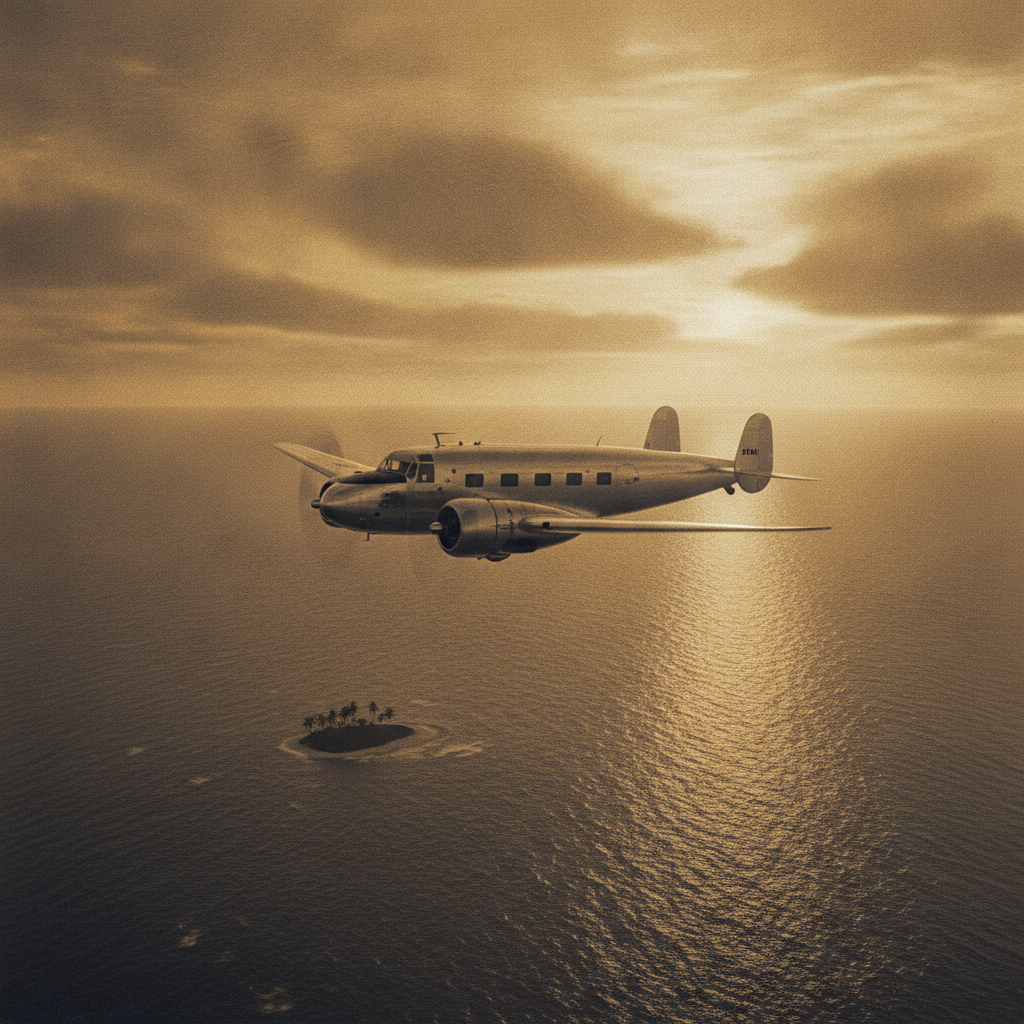
Vanished Over the Pacific: Why Amelia Earhart Still Hasn't Been Found
At 8:43 on the morning of July 2, 1937, a radioman aboard the United States Coast Guard cutter Itasca, holding station off Howland Island, heard a woman's voice cut through the static, loud and hurried, rated strength five, the maximum on the scale. "We are on the line 157 337," Amelia Earhart said. "We are running on line north and south." The signal was so strong that crewmen stepped onto the deck, certain her silver Lockheed would drop out of the clouds at any second. For an hour the cutter had poured black smoke from its boilers to serve as a beacon. The horizon stayed empty. No one ever verifiably heard from the most famous aviator in the world again.
Earhart was the most celebrated flier of her age, the first woman to cross the Atlantic solo by air, and this circuit of the globe along the equator was meant to be the crowning flight of her career. She and her navigator Fred Noonan had lifted off from Lae, in New Guinea, roughly twenty hours earlier in a twin-engined Lockheed Model 10-E Electra, registration NR16020, bound for Howland, a strip of sand and coral barely two kilometers long some 4,000 kilometers away across open Pacific. It was the most dangerous leg of the journey, with about 35,000 kilometers already behind them and only 11,000 ahead. Noonan, one of the finest aerial navigators of his generation, was steering by sextant and dead reckoning toward a target that rose barely six meters above the swell and could vanish behind a single low cloud; an error of a few kilometers in four thousand was enough to miss it completely.
The Itasca had been stationed at Howland for a single purpose: to talk the Electra in by radio direction-finding, the era's most reliable way to home on a fixed point. The log records what happened instead. Earhart transmitted at least seven times that morning; the Itasca answered again and again, in voice and in code; she gave no sign of hearing a single word in return. At one point she asked the cutter to send signals on a frequency her direction-finding loop could not take a bearing on. Two stations lay close enough for a strength-five signal, yet they never once managed a two-way exchange.
The final message named a line, 157-337 degrees, a navigational sun line running northwest to southeast through Howland. Flown one way it leads only to open water; flown the other, roughly 650 kilometers on, it reaches Gardner Island, today called Nikumaroro.
When Earhart failed to arrive, the United States mounted the costliest search in its history to that point: sixteen days, roughly four million dollars in 1937 money, the battleship Colorado and the aircraft carrier Lexington sweeping some 650,000 square kilometers of ocean. They found nothing, not an oil slick, not a seat cushion, not a scrap of aluminum. On July 9, Navy floatplanes flew low over Gardner Island, reported signs of recent habitation, and flew on, assuming islanders lived below; the island was uninhabited. In January 1939, Earhart was declared legally dead, and the case seemed closed.
The physical trail picked up three years later. In 1940 a British colonial officer named Gerald Gallagher found a partial human skeleton on Nikumaroro, along with a sextant box, part of a woman's shoe, and the traces of small fires. A physician in Fiji examined the bones in 1941 and pronounced them those of a stocky, middle-aged man; the bones were then lost and have never been found. Over years of digging at the same southeastern corner of the island, the research group TIGHAR recovered fragments of a cosmetic jar of a kind used for freckle cream in the 1930s, part of a compact mirror, a zipper, and the bones of birds and fish around an old hearth.
There was also a burst of radio traffic. In the days after the disappearance, listeners scattered across the Pacific and beyond reported more than a hundred faint distress calls on Earhart's frequencies. In St. Petersburg, Florida, a fifteen-year-old named Betty Klenck wrote down over several evenings, in a school notebook, snatches of a woman's frightened voice she caught on her family's shortwave set.
Decades of searching followed, most of it fruitless. Deep-sea sonar campaigns run by the Nauticos company in 2002, 2006 and 2017 swept vast tracts of seabed near Howland without raising a single bolt of the aircraft. In 2017 the History Channel aired a photograph it said showed Earhart on a dock in the Marshall Islands; within days a researcher found the same image in a Japanese travel book published in 1935, two years before she vanished. In January 2024 Tony Romeo, a former Air Force intelligence officer who had sold his real-estate holdings to fund an eleven-million-dollar search, released a sonar image of a plane-shaped object on the seabed about 160 kilometers from Howland; in November 2024 his submersible reached the target and photographed a natural rock formation. His company has since swept more than 20,000 square kilometers of ocean floor.
The newest lead sits in a lagoon. The Taraia Object, an anomaly roughly 12 to 14 meters long, close to the Electra's own dimensions, was first noticed in satellite imagery of Nikumaroro's shallow lagoon in 2020 and, researchers say, can be traced in aerial photographs of the island as far back as 1938. The Archaeological Legacy Institute, backed by the Purdue Research Foundation, whose university Earhart had advised and whose money helped buy her Electra in the first place, announced a search on July 2, 2025, eighty-eight years to the day after she vanished. The plan is to sail from Majuro, in the Marshall Islands, on July 28, 2026, spend five days probing the site, and, if it proves to be the aircraft, return in 2027 or 2028 to recover it. The expedition had first been set for late 2025 and was pushed back a year while the team awaited clearance from the government of Kiribati and kinder Pacific weather.
Conclusions and Open Questions
Three theories have competed for almost nine decades. The official one, crashed and sank, argued most rigorously by the veteran pilot and researcher Elgen Long, holds that the tanks ran dry within minutes of the final call and the Electra went down near Howland in water close to 5,000 meters deep. Its strength is its economy: it needs no extra assumptions, and the rising strength of those last transmissions fits a plane closing on the island rather than flying away. Its weakness is that a quarter-century of deep-sea sonar has swept the likely seabed and produced nothing.
The rival theory belongs to TIGHAR and its longtime director Ric Gillespie: Earhart followed the line southeast, landed on the flat coral reef of Nikumaroro at low tide, and died there as a castaway. In 2018 the forensic anthropologist Richard Jantz re-ran Gallagher's surviving bone measurements with modern methods and concluded they matched Earhart more closely than 99 percent of the population; critics answer that century-old measurements cannot bear that weight, and with the bones lost no DNA test can settle it. TIGHAR also reads a shape at the reef's edge in a 1937 photograph by Eric Bevington as a Lockheed landing-gear fork, where others see only coral or rock, and it interprets the excavated jar, mirror and zipper as a castaway's kit that skeptics dismiss as ordinary island refuse.
The torn-antenna hypothesis, drawn from film of the Lae takeoff, offers a tidy explanation for why Earhart could transmit but never seem to receive; it has never been proven. The distress calls cut both ways: if even one of the hundred-plus was genuine, the plane was on land, upright, with an engine still turning a generator, which points away from the open sea, yet skeptics call the calls hoaxes and the freak long-distance propagation of the era's radios.
A third theory, capture by Japanese forces, recast the flight as espionage. It has endured in books and documentaries for decades but has never produced a document, a grave, or a body, and its best-known exhibit collapsed once that 1935 travel book surfaced.
The sharpest doubt about the newest lead comes from the most uncomfortable source imaginable: Gillespie, who has spent thirty-five years insisting Earhart died on Nikumaroro, suspects the Taraia Object is nothing more than a coconut palm uprooted and dumped in the lagoon by a storm. What no one can explain is how the evidence pulls two ways at once. If the plane lies in a shallow lagoon photographed from the air since 1938, how did a dozen expeditions pass over it? If it sank at sea within minutes, who transmitted on her frequencies for days, and were a hundred separate listeners deceived at once? The deep-water sonar and the distress-call record cannot both be right, and no single theory has ever comfortably held both. One body of evidence is misleading us, and no one yet knows which. This summer a vessel sails once more to test a shadow in a lagoon, and it will return either with the greatest find in the history of aviation or with one more proof of how well the ocean keeps the secrets it decides to keep.