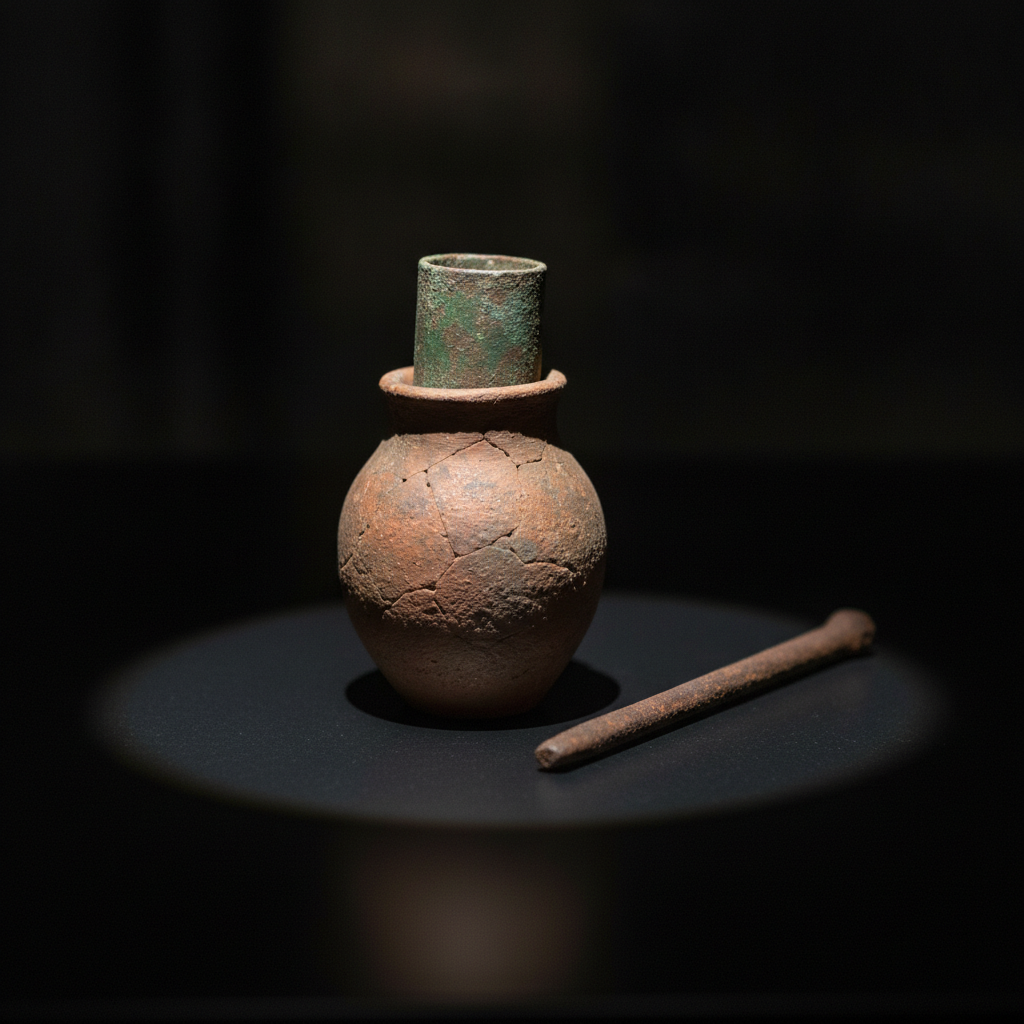
The Baghdad Battery: A Jar That Might Have Sparked, or Just Stored Scrolls
In 1936, laborers of the Iraq State Railway were sinking a foundation trench at Khujut Rabu, a village on the edge of Baghdad not far from the ruins of Ctesiphon, when their digging broke into an old grave. Inside lay a cluster of small clay jars. As odd finds usually do, they made their way to the Iraq Museum in Baghdad and into the storerooms of the man who ran its laboratory.
Two years later, in 1938, that man - an Austrian researcher named Wilhelm Konig - turned one of the jars over in his hands. It was small and unremarkable to look at: about thirteen centimetres of pale, unglazed pottery, its narrow mouth once closed with a plug of black bitumen. When he looked inside he found something more unusual. A cylinder of copper had been rolled and slipped into the jar, and within that cylinder stood a badly corroded rod of iron. The whole assembly was fixed in place by the same black bitumen that sealed the top.
Museum storerooms are full of strange jars, but Konig decided this one was not merely strange. In a paper he published that same year, he proposed that the object was a galvanic cell - a working electric battery, assembled roughly two thousand years before Alessandro Volta stacked his famous pile in 1800. The logic was simple and, on its face, hard to argue with. A battery needs only two dissimilar metals and an acidic liquid between them to generate a current, and the jar supplied the metals without question: iron and copper, the classic pairing.
What convinced Konig above all was the state of the metal. The iron rod had been eaten through, and the copper was stained and pitted in a pattern he read as the signature of an acid that had once filled the space between them. An acid held inside a vessel of two different metals is, by definition, the makings of a cell. To Konig the corrosion was not damage but evidence.
The dating placed the jar deep in the ancient world. Konig assigned it to the Parthian era, somewhere between the third century BC and the third century AD. Later scholars, judging by the style of the pottery, leaned instead toward the Sassanid period that followed. On either reckoning the object was well over a thousand years older than any battery Europe would knowingly build, and older than any written mention of electricity anywhere.
The chemistry, when tested, cooperated handsomely. In the 1940s Willard F. M. Gray, an engineer at the General Electric High Voltage Laboratory in Pittsfield, Massachusetts, built a replica of the jar, filled it with a copper-sulphate solution, and drew about half a volt from it. Later experimenters reached for liquids the ancients actually possessed - vinegar, grape juice, other weak household acids - and reported readings ranging from 0.87 to roughly two volts. In 2005 the television programme MythBusters wired ten replica cells together in series and produced some four volts, enough to drive a faint whisper of electroplating and to raise a slight tingle against the skin. That a jar built to this design can produce a measurable electric current has never seriously been in doubt.
Konig himself offered two guesses about what the current might have been for: gilding jewellery by electroplating, or some mild form of medical electrotherapy. The electroplating idea became the famous one, and in time it gained a showpiece. In 1978 Arne Eggebrecht, then the director of the Roemer and Pelizaeus Museum in Hildesheim, reportedly wired up a row of replica jars and used them to deposit a thin film of gold onto a small silver statuette. The demonstration was described and re-described in books and television programmes for decades.
As the battery story spread, however, archaeologists elsewhere in the region kept turning up jars that looked remarkably like it - and those jars plainly held documents, not acid. At Seleucia, on the far bank of the Tigris, an expedition led by Leroy Waterman found in 1930 comparable vessels containing bronze cylinders with rolled papyrus tucked inside them. At Ctesiphon in 1931 the archaeologist Ernst Kuhnel uncovered six more, three of them still sealed, holding one, three and ten wrapped bronze rolls; inside those rolls lay the badly decomposed remains of cellulose fibre - the ghost of papyrus or parchment. In vessels of exactly this construction, an iron rod serves as a spindle for a scroll, a copper sleeve as its protective casing, and a plug of bitumen as a seal against damp.
For decades the Baghdad jar itself sat where the argument could always return to it, waiting for the modern instruments that might have settled its purpose for good. Those tests were never carried out to a rigorous standard, and now they may be impossible. The object is reported to have vanished when the Iraq Museum was looted in the chaos of 2003, and its whereabouts remain unknown to this day. The single most famous artefact in the entire debate is now, itself, a missing person.
Conclusions and Open Questions
The physical facts are not really in dispute; the disagreement is entirely about purpose. If the jar was a battery, what was the current for - and why has nothing else survived to go with it?
The electroplating theory, the most popular by far, runs into hard numbers. In 1993 Paul Keyser of the University of Alberta calculated that with the weak electrolytes actually available in antiquity, the cell would have been far too feeble to lay down a useful layer of metal. The region's goldsmiths, moreover, already had a proven method - fire-gilding with mercury, the very technique found on gilded objects of the period - so the battery would have solved a problem nobody had. Not one electroplated artefact from that world has ever been identified, and the celebrated 1978 gilding demonstration turns out to be unverifiable: when Bettina Schmitz, a researcher at the same Hildesheim museum, later searched for records of it, she found no notes, no photographs and no laboratory results.
Konig's second idea, mild electrotherapy, is more modest. Ancient physicians did press the electric torpedo fish against the body to numb gout and headache, and a jar that merely stings the hand needs far less current than one that gilds metal. Its weakness is that nothing supports it: no text, image or medical account ties these particular jars to healing. A third reading, argued by Gerhard Eggert and others, is that the jars were magical or votive - a charm or a sacred name sealed inside copper and iron and consigned to a grave for symbolic rather than electrical reasons. That fits the sealing and the burial neatly, but magic leaves even less of a written trail than medicine.
The mainstream explanation is duller and far better supported: the jar was a container for a scroll. The close parallels at Seleucia and Ctesiphon are documents in exactly such vessels, and there is a quiet twist that ties the two stories together. Parchment or papyrus left to rot inside a sealed copper tube for centuries decays into a faintly acidic organic residue - which means a scroll jar, entirely by accident, ends up holding the exact ingredients of a weak cell. The electricity the replicas keep producing may be a by-product of decay rather than a design. The chemist Gerhard Eggert judged the storage explanation far more probable than the battery, and in 2012 the archaeologist Elizabeth Stone said she knew no colleague who believed the jars were batteries.
Two problems keep the question open. The jar was never lifted in a controlled excavation - it came out of the ground in the hands of railway workers, with no stratigraphy and no recorded context - so every later claim rests on an object already torn from its setting. And from the 1970s the writer Erich von Daniken and a shelf of ancient-astronaut books enlisted the jar as proof of lost super-science, drowning out the ordinary reading beneath the sensational one.
One possibility is rarely spelled out. Suppose the jar really was a scroll case, and suppose that once, filled with wine or vinegar for some ritual or cleaning, it delivered a sting to the hand that touched the rod. Did someone in ancient Mesopotamia brush against electricity more than a thousand years early, feel the strange bite, and walk on - because no framework existed in which the sensation could mean anything? Nothing documented supports this; it is a question, not a claim. But with the jar itself now lost, it is a question we may never be able to close.