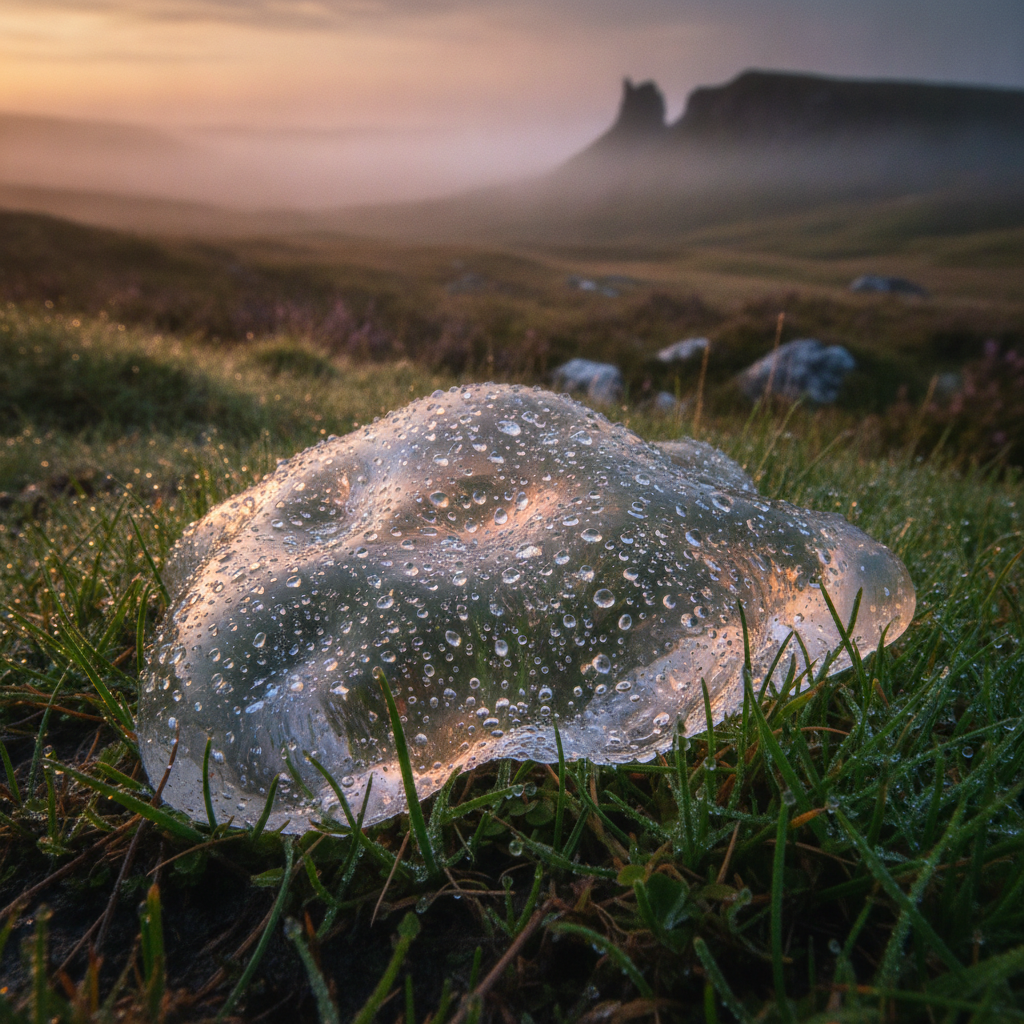
Star Jelly: The Sky Slime That Science Keeps Failing to Name
On a raw autumn morning in 2009, a hillwalker crossing the moors of the Scottish Highlands stopped at something that did not belong. Scattered across the wet grass lay clumps of a pale, translucent jelly, cool to the touch and quivering faintly when nudged, holding no shape of their own and belonging to no plant or animal he could name. There had been shooting stars in the night sky. He did what people in that position have done for the better part of seven centuries. He looked up, and assumed that a fragment of the heavens had fallen in the dark.
The assumption is old enough to carry a medieval name. The English physician John of Gaddesden, who lived from around 1280 to 1361 and served the court of Edward II, described in his writings a mucilaginous substance found lying upon the ground, which the Latin of his day called stella terrae, the star of the earth, and which he recommended as a treatment for abscesses. The Welsh had their own word, pwdre ser, which translates bluntly as the rot of the stars. An English-Latin dictionary from around 1440 lists sterre slyme. The name changed from tongue to tongue, but the idea beneath it held steady: that the jelly and the meteors were one and the same, and that what burned overhead at night could be found cold and formless on the grass at dawn.
You have used your free reads for this month.
Unlock all 208 documented mysteries - in 8 languages, ad-free.
Get full access