Disputed

The Beale Ciphers: Three Pages of Numbers, One Buried Fortune — or One Brilliant Hoax

2026-06-30 · Unsolved Ciphers · 7 min read

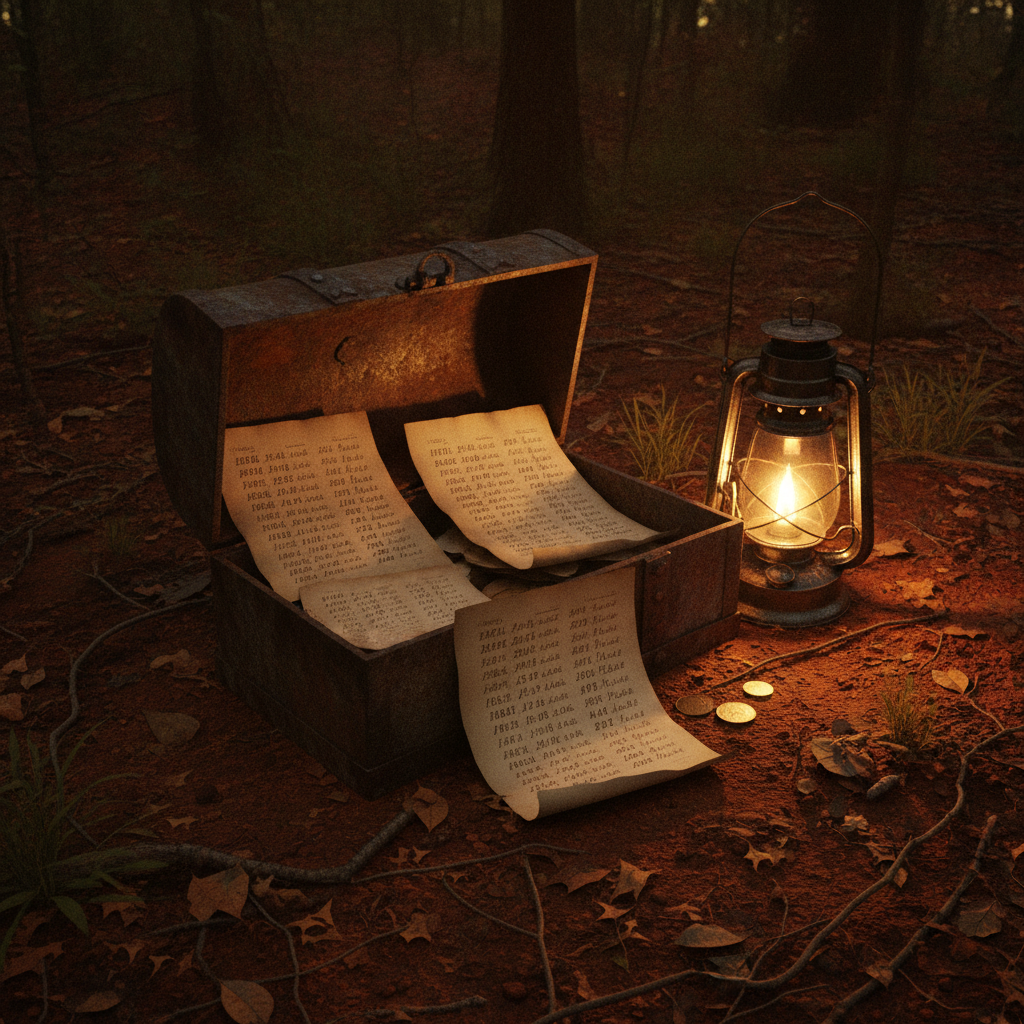
In the spring of 1845, an aging Lynchburg innkeeper named Robert Morriss finally broke the lock on an iron box that had sat in his keeping for twenty-three years. The man who left it, a Virginian named Thomas J. Beale, had ridden off in 1822 and never come back. Beale had asked him to hold the box safe, promised a letter with the key by mail, and vanished into the winter roads. The letter never came. Inside the box, when Morriss at last forced it open, were two plainly written letters and three sheets covered edge to edge with numbers: 520 figures on the first page, 763 on the second, 618 on the third. According to the letters, those numbers guarded a fortune in gold and silver buried in the hills of nearby Bedford County. Morriss would die without reading a single line of them. Nearly a century and a half later, so has almost everyone else - except, perhaps, one man.

Beale had first walked into Morriss's establishment, the Washington Hotel, on a January evening in 1820: a tall, dark-complexioned man of about thirty, strikingly handsome, who spent the winter charming Lynchburg society before riding west again. He came back two years later, lodged briefly, and left the locked box in Morriss's care with a few quiet words about its importance. Then he rode off for the last time. One letter did reach Morriss, mailed from St. Louis in the spring of 1822, promising that a friend would forward the all-important key from a distant point after ten years had passed. No friend, and no key, ever came. Without that key, the box was three pages of numbers and a story no one could check.

The story reached the public in 1885, when a slim pamphlet titled The Beale Papers went on sale in Lynchburg, Virginia, for fifty cents, distributed by an agent named James B. Ward. Its anonymous author claimed that Morriss had entrusted him with the papers in 1862, shortly before his death; the author had then spent twenty years on them, ruining his own affairs in the process, until at last he gave up and put the whole affair in print. He claimed one breakthrough. The second sheet, he wrote, was a book cipher keyed to the Declaration of Independence: number every word of the document in sequence, then read each cipher figure as a pointer to a word and take that word's first letter, and the message assembles itself. The first figure of cipher two is 115; the 115th word of the Declaration is "instituted"; the letter is I. Word by word, the plaintext emerged.

What it said was an inventory. Beale wrote that he and a company of thirty adventurers, hunting buffalo and grizzly somewhere north of Santa Fe around 1817, had stumbled on gold in a rocky cleft. They mined it for eighteen months. The haul was carried east in two loads and buried near Buford's tavern in Bedford County, "about four miles from Buford's, in an excavation or vault, six feet below the surface of the ground." The first deposit, made in November 1819, held 1,014 pounds of gold and 3,812 pounds of silver. The second, in December 1821, added 1,907 pounds of gold and 1,288 pounds of silver, plus jewels bought in St. Louis for about thirteen thousand dollars, taken in exchange for silver to save the trouble of transport. In today's metal alone the two deposits would be worth tens of millions of dollars. Paper number one, the decoded text promised, gave the vault's exact location; paper number three named the thirty men and their next of kin, so the shares could be paid out if none of them returned. Neither paper one nor paper three has ever been read.

The pursuit that followed consumed lives with remarkable efficiency. The brothers George and Clayton Hart worked the ciphers for decades; Clayton gave up around 1912, George held on until 1952. In 1968 devotees founded the Beale Cypher Association to pool their efforts. The problem drew serious minds as well as dreamers: Carl Hammer, a computing pioneer at Sperry UNIVAC, ran the numbers through mainframes in the 1960s and 1970s and concluded they behaved like genuinely encoded text rather than random scribble, estimating that over the years the puzzle had absorbed something like a tenth of the country's most capable cryptanalytic effort. By any measure, the three sheets of numbers had outlasted every professional and amateur who took them on.

Ad

The ground itself has never been left in peace. For generations the landowners of Bedford County have found fresh holes on their property, and treasure hunters have been caught excavating by night; in one episode believers even sought permission to dig in a local cemetery. The numbers, meanwhile, have kept their silence.

Conclusions and Open Questions

The closer one reads, the stranger the story becomes, and the doubts begin with arithmetic. The third cipher holds only 618 numbers, yet it supposedly names thirty men together with their next of kin and their residences; even at one letter per number, that is barely enough for a name, let alone a relative and a town. There is a subtler crack in the one cipher that supposedly works: to make the second sheet decode into clean English, the solver must adopt a particular flawed printing of the Declaration and then quietly correct it further. Defenders read these adjustments as the honest slips of an amateur working by candlelight; skeptics read them as the seams of a forgery. And there are questions of behaviour the story never answers: why encrypt the names of one's partners' heirs, whose whole purpose is to be found, and then send the only key by a mail that never arrived?

The case for a hoax rests on more than suspicion. In 1980 the cryptologist James Gillogly applied the same Declaration key to the first cipher and found long, nearly alphabetical runs of letters buried in the output, including the sequence ABFDEFGHIIJKLMMNOHPP, which random numbers do not produce. His reading was that cipher one carries no message at all, and the promise of a location is empty. Two years later the investigator Joe Nickell attacked the story's foundations: no independent record of Thomas J. Beale has ever been confirmed, the letters use words such as "stampeding" and "improvised" that language scholars date to a later era, and his stylistic analysis pointed to a single author behind both the letters and the pamphlet - plausibly Ward himself.

He was not alone. In the journal Cryptologia the cryptographer Louis Kruh compared the vocabulary and sentence patterns of the Beale letters against Ward's own known prose and concluded that one hand wrote both. Decades earlier, in private, William F. Friedman and Solomon Kullback - two founding giants of American codebreaking - had reached the same verdict by statistical comparison: same writer, single hoax. Fifty cents a copy, multiplied by a credulous public, is a motive as old as the printing press.

The believers have answers, though each carries its own weakness. Gillogly's alphabetical strings, some argue, could be the fingerprint of a second layer of encryption laid over the first; conceivable, but nothing supports it beyond hope. Against Nickell they note that a thinly documented frontier did not archive every restless Virginian, and that men named Thomas Beale do surface here and there in period records - none firmly linkable to the story, but the name is not impossible. Against the same-author verdict they note that stylometry on short nineteenth-century texts is a blunt instrument, and that the pamphlet was a commercial failure, most copies reportedly lost in a printing-house fire - which sits oddly with a purely mercenary fraud. A rarely discussed possibility is that the truth lies between hoax and treasure: one theory holds that Ward inherited fragments of a genuine local legend and built a cathedral of invention on a splinter of fact. Nothing documented supports this, and it should be held as speculation. The maddening quality of the whole affair is that every failed solution feeds both possibilities at once: a dead end that fails to prove nothing is buried also fails to prove that anything is. A solved cipher would end the argument in an afternoon; an unsolved one keeps both the treasure and the hoax alive forever, which may be exactly what its author intended. No fifty cents ever bought anyone more mystery.

Free reads left this month: 0

Share this story:

Reader comments (0)
Only active subscribers with verified payment can post comments. Get full access