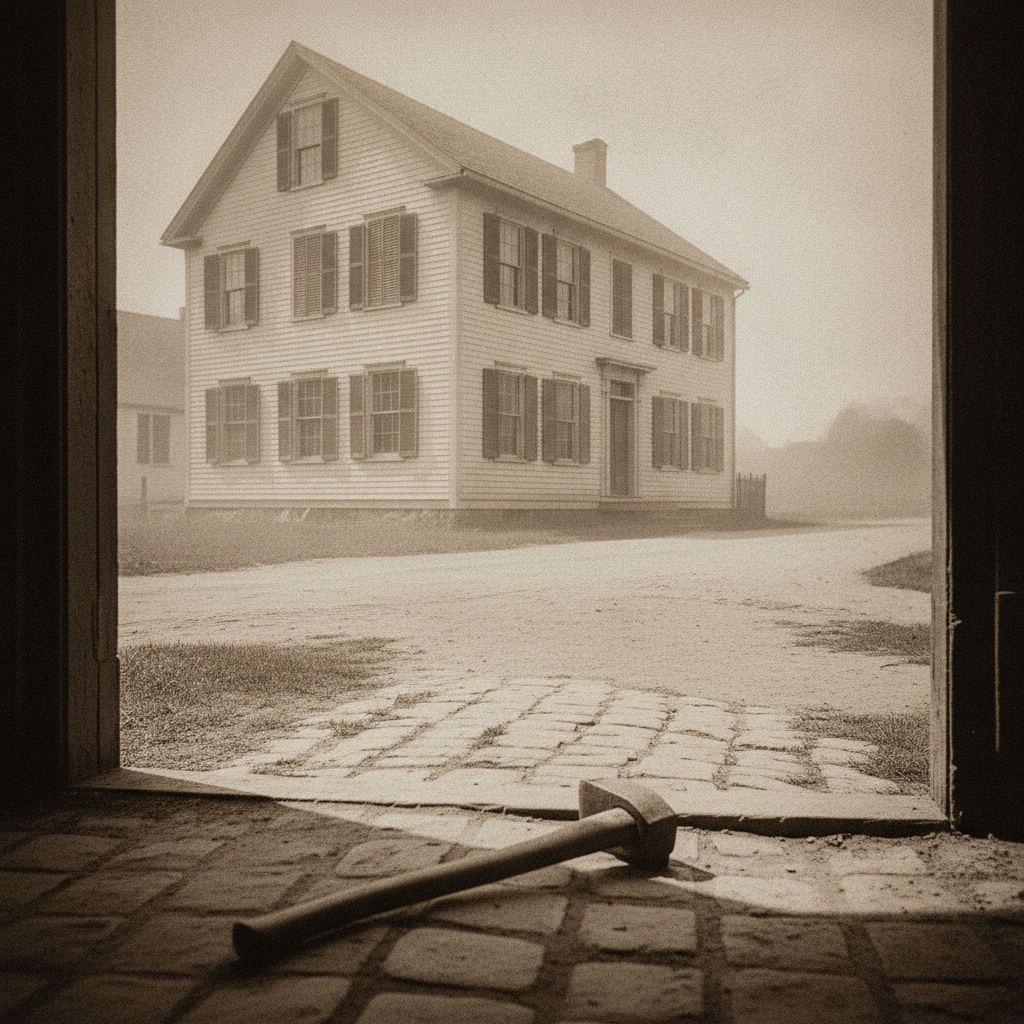
Lizzie Borden and the Fall River Murders: Two Bodies, One Morning, and No Answer
On the morning of Thursday, 4 August 1892, Abby Borden went upstairs to make a bed.
She was 64 years old. She had been married to Andrew Borden for 27 years. The bed was in the guest room, because a relative had come to stay the night before.
Abby never came back down.
About an hour and a half later, her husband Andrew came home from his morning walk to the bank and the post office. He was 69. He lay down on the sofa in the sitting room to rest.
By 11:10 that morning, both of them were dead.
The house stood at 92 Second Street in Fall River, a mill town in the state of Massachusetts, in the northeast of the United States, about 80 km south of Boston. It was a narrow, two-storey wooden house, close to the street and close to the neighbours.
This is the case of Lizzie Borden. Here it is in one sentence: two people were hacked to death in a small house in broad daylight, with other people inside or near it; the daughter of the house was charged and found not guilty; and no one else was ever charged. More than 130 years later, it is still not known for certain who killed them.
The people in the house
Andrew Borden was one of the richest men in Fall River. He owned property, sat on the boards of banks and mills, and was worth around 300,000 dollars, a very large fortune at the time.
He was also known for being careful with money. The house had no indoor plumbing upstairs, even though he could easily have afforded a grander home on the hill where the wealthy families of the town lived.
He had 2 daughters from his first marriage. Their mother died in 1863. Emma, the elder, was 41 in 1892. Lizzie, the younger, was 32. Neither was married. Both still lived at home.
Abby was their stepmother. Andrew married her in 1865, when Lizzie was a small child.
The household also had a live-in maid, a 25-year-old woman who had come from Ireland. She slept in a small room on the third floor, under the roof.
At the trial, the maid said that the 2 sisters rarely ate meals with their father and stepmother. Inside the house, some doors between the rooms were kept locked.
There had been a quarrel over money. A few years earlier, Andrew had bought a house for Abby's sister. The daughters were angry. To even things out, he gave them a house of their own. Lizzie stopped calling Abby "mother" and started calling her "Mrs. Borden".
The week before
In late July and early August 1892, the summer was very hot.
Emma was away, visiting friends in a town about 25 km away. Lizzie had also been away for a while, and had come back.
In the first days of August, Andrew, Abby and the maid were violently sick. Lizzie said later that she had felt unwell too. Abby was frightened. She crossed the street to the family doctor and told him she thought they had been poisoned. The doctor thought it was bad food - most likely meat kept too long in the heat.
According to a local druggist, on the day before the murders a woman he identified as Lizzie came into his shop and tried to buy prussic acid, a deadly poison. She said she wanted it to clean a fur cape. He refused to sell it without a prescription. Lizzie denied it had been her.
That same day, Andrew's brother-in-law from his first marriage arrived for a visit. He was the uncle of Emma and Lizzie. He slept in the guest room.
Thursday, 4 August
The day can be rebuilt almost minute by minute, from the testimony given later in court.
The family had breakfast early. The uncle left the house at about 8:45 to go and see relatives across town. He said he would be back for lunch.
A little after 9:00, Andrew left for town.
Abby went upstairs to make the bed in the guest room. The maid was sent outside to wash the windows.
Lizzie came down to the kitchen at some point that morning. She said later that she ate nothing for breakfast.
At about 10:30, Andrew came home. The front door was locked from the inside with 3 locks. The maid came to let him in. She struggled with the lock and said a word of annoyance.
Then she heard laughter from the top of the stairs. She said it was Lizzie, who was standing on the upstairs landing.
This detail became one of the most important in the whole case. From the landing, a person could see into the guest room. Abby's body was lying on the floor of that room. If Abby was already dead at that moment, the prosecution would later argue, then Lizzie had been standing within a few metres of her.
Lizzie came downstairs. She told her father that Abby had gone out. She said a note had come asking Abby to visit a sick friend.
Andrew sat down on the sofa in the sitting room. The maid finished the windows in the dining room. Then, at around 10:55, feeling unwell from the illness of the past days, she went up to her room on the third floor to lie down.
At about 11:10, she heard Lizzie calling up to her from the bottom of the back stairs:
"Come down quick! Father's dead! Somebody came in and killed him!"
What the police found
Andrew Borden was lying on the sofa, still dressed, with his feet on the floor. He had been struck about 10 or 11 times in the head and face with a sharp, heavy blade. One eye had been cut in half. The blood was still fresh. He seemed to have been asleep when the first blow landed.
Lizzie sent the maid across the street for the doctor. A neighbour came over. Someone asked where Abby was.
Lizzie said she thought she had heard Abby come in.
The maid and the neighbour went upstairs. Halfway up, at eye level with the floor of the guest room, the neighbour saw Abby lying face down between the bed and the dressing table.
Abby had been struck about 18 or 19 times in the back of the head. The first blow seems to have hit her while she was facing the person who killed her.
The doctors noticed something at once. Andrew's blood was still flowing. Abby's blood was dark and had set. Her body was colder.
Abby had been killed first - at least an hour, and possibly more, before her husband.
That fact is at the centre of the mystery. For an hour or more, the killer was either inside the house, or came and went twice, while Lizzie, the maid and then Andrew were all there.
Where was Lizzie?
The first police officers began asking questions within minutes.
Lizzie told them that while her father lay on the sofa, she had gone out to the barn behind the house. She said she went up to the loft to look for pieces of metal to make weights for fishing lines. She said she was there for about 20 minutes, maybe half an hour. She said that when she came back to the house, she found her father dead.
A police officer went up to the barn loft that same afternoon. He said later that the floor was covered with a thick layer of undisturbed dust. He saw no footprints. To test it, he pressed his own hand into the dust, and the mark was clear. In his view, no one had been up there that morning.
The defence later brought witnesses who said that several boys from the neighbourhood had climbed into the loft soon after the murders, before the officer arrived. That claim cast doubt on what the officer saw.
Lizzie's own accounts did not stay the same. To different people that day she said she heard a groan, that she heard nothing, that she was in the barn, that she was in the yard, that she was eating pears under a tree.
Several people who saw her in the first hour noticed something else. She was calm. She did not cry. And they saw no blood on her - not on her hair, her face, her hands or her dress.
To kill 2 people with that many blows would almost certainly have left blood on the killer.
The search of the house
In the basement, the police found 4 tools with blades: 2 axes, a claw hatchet, and the head of a small hatchet whose wooden handle had been broken off.
That broken hatchet head interested them most. The break in the wood looked fresh. The blade was covered with a layer of ash, as if it had been rubbed in, while the other tools were dusty in a different way.
The stomachs of both victims were removed during the autopsy and sent to a chemistry professor at Harvard University, to test for poison. He found none. He also tested the hatchets and axes for blood. He found no blood on them.
The note that Lizzie said had called Abby away was never found. No one ever came forward to say they had written it. No sick friend was ever identified, even after the newspapers asked the writer to come forward.
The police also found a pail in the basement with rags soaked in blood. Lizzie told them it was from her monthly period. The police did not test it.
A doctor who lived nearby said that on his way down Second Street that morning, he had seen a strange man near the house. The newspapers made much of this "wild-eyed man". He was never found.
The uncle who had slept in the guest room was questioned closely. His account of his morning was detailed and precise. A crowd in the street jeered at him. But his alibi was confirmed. He had been across town with relatives when the killings took place.
The maid was questioned too. She had no motive and no blood on her, and most of her morning was accounted for by what she was doing outside.
The burned dress
On the Sunday morning after the murders, 3 days later, Lizzie's close friend was staying in the house.
The friend walked into the kitchen. She saw Lizzie at the stove, holding a light blue dress. Lizzie said she was going to burn it, because it was old and stained with paint. She tore it and put it in the fire.
The friend told her: "I wouldn't let anybody see me do that, Lizzie."
The next day, the friend told the police.
Was it the dress Lizzie had worn on the morning of the murders? That was never proved. The dress Lizzie handed to the police as the one she had worn that morning showed no blood. Some people who saw her that morning said she had been wearing a light blue dress. Others described it differently.
The inquest and the arrest
Within a week, a closed hearing was held. Lizzie was questioned for 3 days, without her own lawyer present. Her doctor had been giving her a sedative to help her sleep.
Her answers were confused. She gave different accounts of where she was when her father came home - reading in the kitchen, ironing in the dining room, coming down the stairs.
On 11 August 1892, one week after the murders, Lizzie Borden was arrested and charged with the murder of her father. She was held in jail.
A few weeks later, at another hearing, the judge said that he found her "probably guilty". On 2 December 1892, a grand jury formally charged her with both murders.
From the first day, the case divided the country. Many people simply could not believe that a respectable church-going woman from a good family could have done such a thing.
The trial
The trial opened on 5 June 1893 in New Bedford, a port town about 25 km east of Fall River. It lasted about 2 weeks. Reporters came from all over the United States.
She was defended by a team that included a former governor of Massachusetts.
Before the trial began, the defence won 2 important battles. The judges ruled that Lizzie's testimony at the closed hearing could not be used, because she had not been properly warned or allowed a lawyer. And they ruled that the druggist's story about the poison could not be heard, because it was too far removed from the way the victims actually died.
The prosecution's case was built on 3 points: Lizzie had a reason to want them dead, an inheritance and her hatred of her stepmother; she had the opportunity, because she was in the house; and she burned a dress afterwards.
But the prosecution had no witness to the killings. It had no blood on Lizzie. It had no proof that the broken hatchet was the weapon. Even the police officers could not agree on it. One said the broken handle had been found next to the head. Another said it had not.
The skulls of Andrew and Abby were brought into the courtroom to show how the wounds matched the blade. When they were shown, Lizzie fainted.
The maid testified for hours. Her account of the laughter on the stairs did not change.
Then a peddler who sold ice cream from a cart testified for the defence. He said that at around the time of Andrew's murder, he had driven past the house and seen a woman walking from the barn towards the house. That supported Lizzie's story about the barn.
A few days before the trial opened, another killing shocked Fall River. A young woman was hacked to death with an axe on a farm in the town. The newspapers immediately compared it to the Borden murders. A farm worker was later convicted of that crime. He was shown not to have been in the area in August 1892, so he could not have killed the Bordens.
The verdict
At the end of the trial, the judge gave the jury his instructions. He spoke at length about the weakness of circumstantial evidence. He reminded them that her calm behaviour was not evidence of guilt. Many observers felt his words leaned openly towards the defence.
The jury of 12 men went out on 20 June 1893. Newspapers at the time said they agreed on the first vote, in about 40 minutes. Later accounts say about an hour and a half.
Not guilty.
Lizzie Borden walked out of the court a free woman. The law said she was innocent, and the law has never said anything else.
Where it stands
No one else was ever charged with the murders of Andrew and Abby Borden. The case was never reopened.
**This is where the documented record ends: 2 murders, 1 person tried and acquitted, and no proof against anyone else.**
Several things that might have answered the question were never found, or never examined. The real weapon was never proved. The bloody rags in the pail were never tested. The dress that was burned was never seen by the police. The note to Abby was never found, and neither was its writer. Modern forensic methods, such as testing for blood traces or DNA, did not exist in 1892.
After the trial, Lizzie and Emma inherited their father's fortune. They bought a large house on the hill, the part of Fall River where the rich families lived. Lizzie began to call herself Lizbeth.
The town never accepted her. Many people crossed the street when they saw her. In 1905, after a quarrel, Emma moved out, and the 2 sisters never saw each other again.
Lizzie Borden died on 1 June 1927, aged 66. Emma died 9 days later. Both were buried in the family plot, next to their father and stepmother.
The house at 92 Second Street still stands. Today it is a museum and a guest house.
The theories
Every person ever named in this case has been dead for decades. These are theories, put forward by writers and researchers, not findings of any court.
**Lizzie did it, as the prosecution said.** For: she was in the house the whole time, her stories changed, and she burned a dress. The problem: no blood was ever found on her, and a jury acquitted her.
**Lizzie did it during some kind of mental blackout.** A writer who grew up in Fall River proposed this in a book in 1967. The problem: there is no medical record to support it.
**The maid was involved, or helped hide the evidence.** A crime novelist proposed this in the 1980s and 1990s. The problem: she had no motive, and a story of a later confession has never been confirmed.
**An outsider came in and hid in the house.** The problem: he would have had to wait at least an hour between the 2 killings, inside a small house, without being seen or heard.
The house is 130 years older now. The question is the same one the jury faced: if not Lizzie Borden, then who?