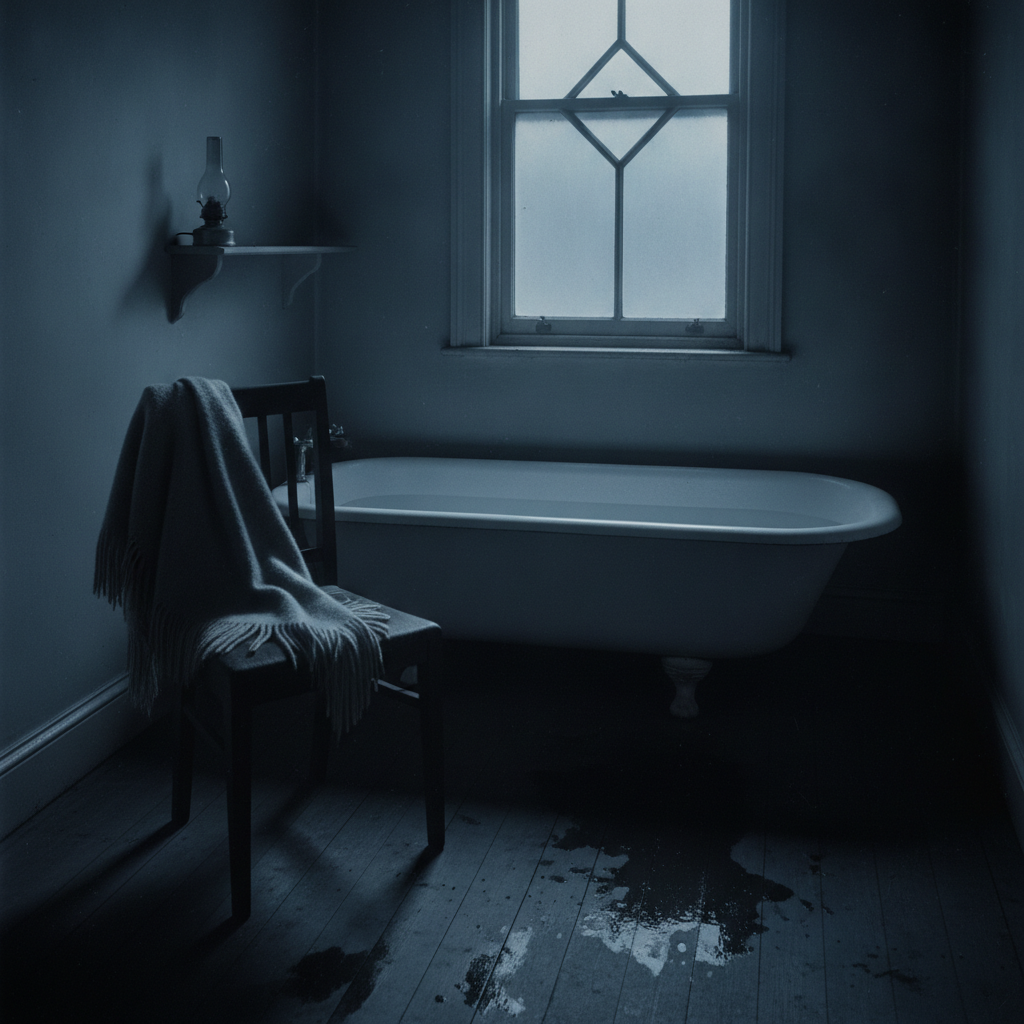
Three Baths, Three Accidents, One Newspaper Item
Before the First World War, England was full of cheap boarding houses.
A man and a woman could arrive in the afternoon, take a furnished room for a few shillings a week, and be gone a month later. Nobody asked to see papers. Nobody wrote down a name and checked whether it was real.
For a woman on her own with a little money, marriage was not only a matter of the heart. It was the only financial protection the law really offered her. Her husband managed what she owned. A will written in his favour was an ordinary thing to sign.
Between 1912 and 1914, three women in three different towns married a man, moved with him into rented rooms, signed a will or an insurance policy in his favour, and within weeks were found dead in a bath.
Each death was examined on its own. Each was ruled an accident. Three doctors, three inquests, three certificates saying the same thing: a woman drowned while bathing.
Nobody connected the three, because there seemed to be nothing to connect. A woman who drowns in her own bath is a household tragedy, not a crime. And the husband had used a different name each time.
This is the story of how the pattern was finally noticed, by a father reading a Sunday newspaper. And of the problem the police faced the moment they believed it: how do you prove that a healthy adult was drowned in a bath, in a small room, with a man standing beside her, when there is not one mark on the body?
The first bath
July 1912, Herne Bay. A small seaside town in the south-east of England, about 100 km east of London.
A couple had taken a house there. They had married two years earlier in another town, under a surname that was not his, and had separated within days when he vanished with her money. In the spring of 1912 he came back. She took him back.
The house had no bathroom. He walked into a local shop and bought a steel bath. He argued over the price and got it down.
Then he took his wife to a doctor. He explained that she suffered from fits. She had never had a fit in her life. A few days later he brought her to the doctor again.
On 8 July the two of them signed wills. Everything she owned went to him. Everything he owned, which was nothing at all, went to her. Her inheritance from her father was worth about 2,500 pounds, enough to keep a working family for many years.
Five days later she was dead.
He told the inquest he had gone out for a walk and to buy fish for breakfast. His own words: "I returned about eight o'clock. On looking into the bathroom I saw her in the bath. Her head was right down in the water, submerged."
The doctor who had been told about her fits signed the certificate without hesitation. The inquest ruled misadventure: a seizure in the bath.
He collected the money.
Then he carried the bath back to the shop where he had bought it, and got his money back for that too.
The second bath
December 1913, Blackpool. A holiday town on the north-west coast, about 400 km from Herne Bay.
He had married again in November, this time under his own name. The bride was 25, the daughter of a fruit grower. Her father had not liked him and had said so plainly. They married anyway.
Before the wedding he had taken her to a doctor as well, saying she suffered from bad headaches. After the wedding a life insurance policy for 500 pounds was taken out on her, and a will was drawn up in his favour.
In Blackpool the couple went from house to house looking for lodgings. He turned down rooms that were perfectly good, for one reason: the building had no bath.
Eventually a boarding house took them in. It had a bath.
On the evening of 12 December she went upstairs to bathe. Her husband was elsewhere in the house.
She was found in the water, dead.
The inquest heard about the headaches and about the visit to the doctor. The verdict was accidental drowning. He collected the insurance money and left the town within days.
Two towns, 400 km apart, 17 months apart, two different surnames. No police force in England had any reason to put the two files side by side.
The third bath
December 1914. The country was four months into a war and the newspapers had room for little else.
A woman of 38, a clergyman's daughter who worked as a companion and housekeeper, met a man through a matrimonial advertisement. On 17 December they married in London. He gave his name as John Lloyd.
The day before the wedding, a life insurance policy for 700 pounds was taken out on her.
The couple took rooms in a boarding house in Highgate, in north London. Before agreeing to the rooms, he asked the landlady one question: was there a bath in the house?
There was.
On the afternoon of 18 December, one day after the wedding, the new wife was taken to a solicitor, where she signed a will leaving her husband everything she had. Then they went to a bank and her savings were withdrawn.
That evening she went up to bathe.
The landlady, in the room below, described afterwards exactly what she heard. Splashing. Then a sound like wet hands slapping against the sides of the bath. Then a sigh.
Then nothing at all.
And then, from the sitting room downstairs, the sound of the harmonium being played.
A few minutes later the front doorbell rang. The husband was standing on the step with food for supper in his hands. He said he had gone out and forgotten his key.
He went upstairs, and came back down shouting that his wife was in the bath and would not answer him.
The inquest recorded another accident. He had been married to her for one day. He was the beneficiary of a will, an insurance policy of 700 pounds, and an emptied bank account.
A father reading a newspaper
A few days later, in a village far from London, a man opened a Sunday paper and read a short item about a bride who had drowned in her bath the day after her wedding.
He was the father of the young woman who had died in Blackpool a year earlier.
He read it again. The bath. The new marriage. The insurance. He had stood at his own daughter's inquest and heard almost the same words.
The owner of the Blackpool boarding house read the same item and reached the same conclusion.
On 3 January 1915 a letter reached the police, with the newspaper cuttings inside it.
That letter is the whole reason this case exists. Without it there would have been three accidents in three separate filing cabinets, and a man free to marry again.
The detective who counted the coincidences
Scotland Yard in January 1915 was thin on men; most of the young ones were in France. The letter was given to Detective Inspector Arthur Neil.
Neil began by going to the house in Highgate and looking at the bath itself.
It was small. He stood in the room and tried to picture how a grown woman lying in that bath could get her head under the water and keep it there, by accident, without making any noise the landlady would have recognised as a struggle.
He could not do it.
Then he began collecting paper, and the paper was worse than the bath. A will signed hours before the death. A bank account emptied the same day. A life insurance policy bought the day before the wedding. A husband who had asked about the bath before he agreed to take the rooms.
He sent for the Blackpool file. It held the same shapes in the same order: a doctor told in advance about an illness, an insurance policy, a will, a bath, an accident, a fast departure.
Neil then had to answer the simplest question in police work: who is this man?
The marriage certificates gave him several names. The names led to other marriages. Some of those wives were alive. One had been married, robbed within days, and abandoned. And behind all of them, in 1912, in a seaside town in Kent, stood a third dead wife in a third bath.
Neil now had a pattern. What he did not have was a single piece of evidence that any of the three women had been killed.
He also had a problem of time. The husband was waiting for the insurance money from the Highgate death, and the moment he had it he would disappear.
So Neil went to the office of the solicitor who would hand over the money, and waited.
On 1 February 1915 a man walked in to collect. He was arrested on the spot. He was not charged with murder, because there was nothing yet to charge him with. He was charged with making a false entry in a marriage register.
He denied everything, and kept denying it.
What the pathologist could not find
Three bodies were exhumed that winter, and the examinations were given to the Home Office pathologist, the most famous medical witness in England.
He looked for what any pathologist would look for. Heart disease that might explain a sudden collapse. A stroke. Poison. Bruises on the arms, the neck, the shoulders, the kind of marks left when one person holds another under water.
He found none of it.
The women had been healthy. There was no poison. There were no injuries of a struggle, beyond one small bruise above an elbow that could have come from anything.
This was the heart of the case, and it cut both ways.
Drowning leaves almost nothing behind. A pathologist cannot look at a drowned body and say whether the water came in by accident or because someone put the head under. The absence of marks was consistent with murder. It was equally consistent with three ordinary accidents.
So the pathologist worked backwards from the bath.
His conclusion was this. A woman bathing in a small tub sits with her knees bent and her feet towards the narrow end. If someone takes hold of her ankles and pulls them sharply upwards, her head slides under the water before she can brace herself. Water rushes into the nose and throat at once. The sudden shock of cold water in the airway can stop the heart, or knock a person unconscious in a moment.
There is no struggle because there is no time for one. And there are no marks because no one has touched her above the ankles.
It was a theory. It explained everything. It proved nothing.
The experiment that nearly killed a witness
Neil decided to test it.
He found a professional swimmer, a woman of roughly the same build as the dead women, and had a bath filled. A doctor was present.
First he tried the obvious method. He pushed her head under the water while she sat in the bath. She fought him hard, water went everywhere, and it was clear that anyone doing this to a living person would leave marks on her and noise in the house.
Then he took hold of her ankles and pulled them sharply upward.
She went under without a sound. She lost consciousness almost instantly.
It took Neil and the doctor more than half an hour to bring her back. When she could finally speak, she said she remembered nothing except the rush of water.
The police had proved the method existed. They had very nearly killed their own witness to do it.
Nine days at the Old Bailey
The trial opened on 22 June 1915 in London.
He was charged with one murder only: the death in the bath in 1912. English law tried one murder at a time.
And this was the prosecution's difficulty. Taken by itself, that death was a closed case with an accident verdict, a doctor who had been told about fits, no witness and no wound. On its own it would have collapsed in an afternoon.
So the prosecution asked the judge for something unusual. They asked to tell the jury about the other two deaths, not as crimes he was on trial for, but as proof that the 1912 death was not an accident.
The defence, led by the most celebrated defence barrister in England, fought it. His argument was simple and strong: a jury told that a man's other two wives had also drowned will convict him of anything.
The judge allowed the evidence. He allowed it as evidence of what the court called system: a repeated method, used three times, too exact to be chance.
The trial ran nine days. The prosecution called 130 witnesses and produced 264 exhibits. Among the exhibits, carried into the courtroom, were the baths themselves.
The accused did not give evidence. He passed a note to his own barrister saying that he would not go into the witness box.
On 1 July 1915 the jury went out and came back 20 minutes later with a verdict of guilty.
The appeal was dismissed. He was hanged at a prison in Kent on 13 August 1915, still denying the murders.
What the case left behind
The law changed with it.
The ruling that a pattern of similar crimes can be shown to a jury, to prove that a single death was not an accident, became one of the most quoted principles in English criminal law. It is still argued over in courtrooms today, because it is powerful and dangerous at the same time.
The pathologist who had found nothing on the three bodies came out of the case as a national figure, the man whose word could hang a defendant.
That reputation is now the part historians are least comfortable with. In the decades since, medical writers have gone back over his work in other cases and found a man who stated opinions with far more certainty than his evidence allowed.
Conclusions and Open Questions
**He was convicted on a pattern, not on a wound.** Three near-identical deaths, three insurance arrangements, three wills, three false names, one method. The problem: not one of the three bodies carried a mark that proved a hand had touched it. Strip away the other two deaths and there is no case at all. That is exactly what the defence said at the time, and it is still the honest description of the evidence.
**The drowning method was demonstrated, not observed.** The experiment with the swimmer showed that a sharp pull on the ankles can render a person unconscious in seconds and leave no mark. The problem: showing that something can happen is not the same as showing that it did. Nobody saw any of the three deaths.
**The number of victims is unknown.** He went through at least seven marriages under false names. Some of those women were robbed and abandoned rather than killed. Three died in baths. The problem: he moved constantly, under names that were invented, in an era with no national records to cross-check. Whether the list of dead wives stops at three is something the police of 1915 could not establish, and no one has established since.
**Why the deaths were ruled accidents three times.** In each case a doctor had been told in advance that the woman was ill, and in each case the doctor was the one who certified the death. The problem: that was a system failure, not bad luck, and the case was a large part of the reason inquest and certification practice was tightened afterwards.
What remains is the narrowness of it. The three deaths were not uncovered by forensic science, or by police intelligence, or by a confession.
They were uncovered because a grieving father in a village opened a newspaper, recognised the shape of his daughter's death in a stranger's, and took the trouble to write a letter.