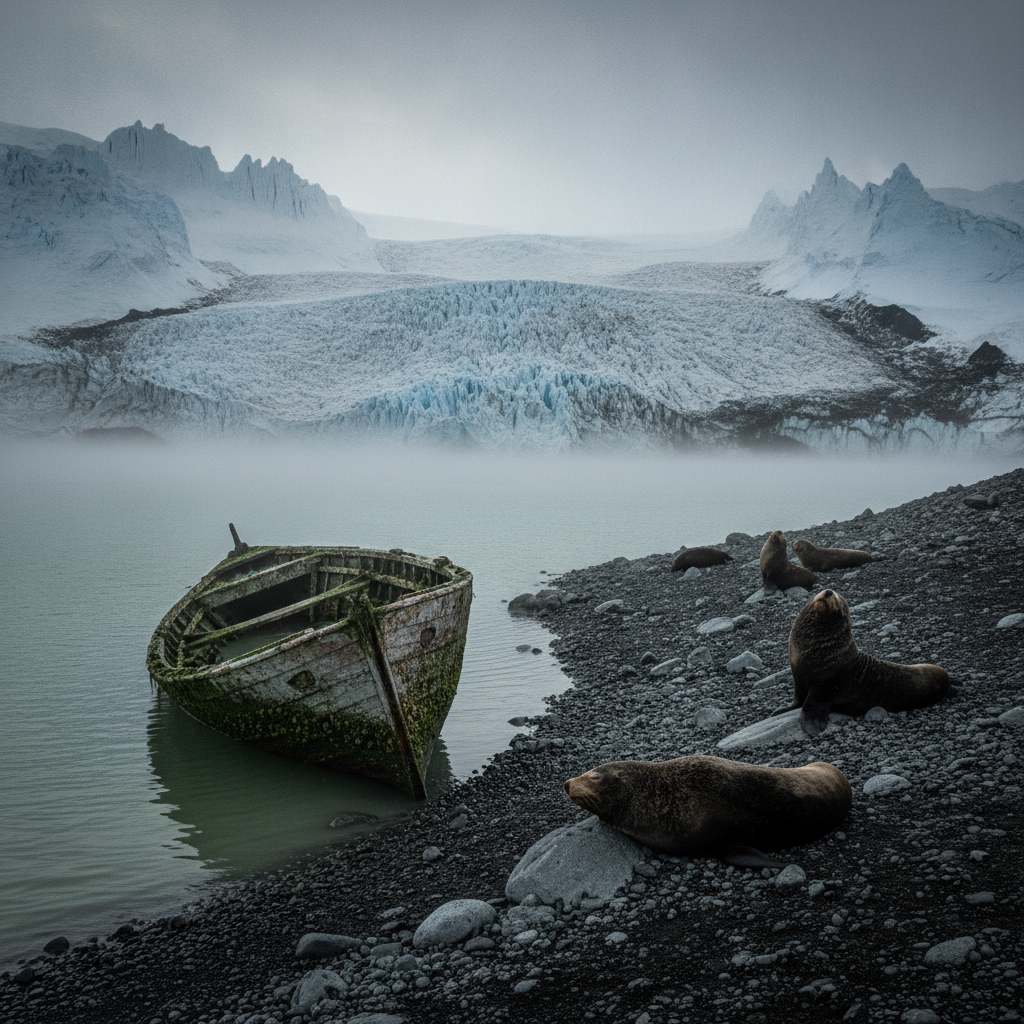
The Boat in the Lagoon: 45 Minutes on the Loneliest Island on Earth
On 2 April 1964 a helicopter dropped a small party of men onto a ledge of black rock at the end of the world.
They had 45 minutes. The wind had been above 90 km/h for three days and would rise again. Below them the sea broke white against ice cliffs. Around them, elephant seals the size of cars lifted their heads and roared at the strangers.
Within a few minutes of landing, one of the men looked down into a shallow lagoon and saw a boat.
It was made of wood, about 6 m long, an open boat of the kind carried on the deck of a ship. It was half full of water and sitting low, but it was not smashed. It had no name on it. No number. No flag, no port of registry, no marking of any kind.
About 90 m away, up on the rock, lay a pair of oars. Near them were pieces of wood, a metal drum of the type that holds 200 litres of fuel, and a flattened copper tank of the sort used to keep a lifeboat afloat.
There were no people. There were no bodies. There was no shelter, no fireplace, no tin, no scrap of clothing. Nothing that said anyone had stayed.
Here is the mystery in one sentence: a ship's boat, in usable condition, was found on the most isolated island on the planet, and to this day nobody has established which ship it came from, how it got there, or what happened to whoever was in it.
Where this is
The island is called Bouvet. It belongs to Norway, and it sits alone in the Southern Ocean, about 1,600 km north of the coast of Antarctica and about 2,600 km south-west of South Africa.
It is the most remote island on Earth. Draw a circle around it with a radius of 1,600 km and the circle contains no other land at all.
The island itself is small, about 49 km2, and roughly 93 per cent of it is under ice. The coast is a wall. Cliffs rise almost vertically out of the water, in places to nearly 500 m, and the surf hits them without a harbour or a beach to break it.
For most of recorded history there was simply nowhere to land.
The ledge that was not there before
That changed in the 1950s.
Aerial photographs taken in January 1955 show the north-west coast as sheer cliff. Photographs taken by an American icebreaker on 1 January 1958 show something new: a flat shelf of rock at the foot of the cliffs, roughly 370 m long and 180 m wide, formed by a massive collapse of the mountainside.
The Norwegians named it Nyrøysa, meaning the new heap.
It is the only place on the whole island where a person can stand on level ground. Everything that has happened on Bouvet since 1958, including the discovery of the boat, has happened on that one shelf.
Three days of waiting
In the southern autumn of 1964, two ships met off the island: a South African supply vessel and a British ice patrol ship. The purpose was a scientific survey, a look at the new ledge and whether a weather station could ever stand on it.
They waited three days for the wind to drop below 50 knots, about 90 km/h. On 2 April it finally did, and the helicopter went in.
What the shore party found is described in their reports and has never been in dispute. The boat in the lagoon. The oars on the rock. The drum, the wood, the copper tank.
What they did not do, and later regretted, was examine any of it closely. They had less than an hour, a survey to complete, rock samples to collect, and large aggressive seals between them and most of the ground. Nobody photographed the boat in detail. Nobody looked under the floorboards. Nobody wrote down the exact construction, which might have identified the country that built it.
They went back up into the helicopter and the weather closed in again.
When they came back, it was gone
A biological survey landed on the same ledge in 1966.
Those scientists went to the lagoon and studied it properly. They recorded that it was shallow, thick with algae, fed by meltwater from the cliffs above, and made alkaline by seal droppings.
They did not record a boat.
Two years, and the sea or the weather had taken it. Whatever the wood could have told anyone, it took with it.
**From this point on there is no physical evidence at all. Everything that follows is reasoning about an object nobody can examine any more.**
What the men on the ledge thought
The first idea was the obvious one: survivors.
A ship goes down somewhere to the west. The crew get a boat away. Current and wind carry them east, and by extraordinary luck they strike the only piece of level shore on the only island for 1,600 km in any direction.
The men who had actually stood there did not believe it, for one reason. If people had come ashore alive on Bouvet, they would have had nowhere to go. They would have stayed on that shelf, and there would have been a camp on it, and remains. There was neither.
The second idea was a boat with nobody in it at all: a derelict, lost from some ship far away, drifting for months or years until it washed up.
That has a problem too. The 1966 team noted something specific about that coast. Almost nothing washes up there. The exposed western side of the island was practically clean of the drifted seaweed and debris that collect on almost any shore in the world.
And a boat that had crossed thousands of kilometres of the roughest sea on Earth as a derelict would not arrive upright and intact, with its oars laid out on the rock 90 m away.
Oars do not carry themselves out of a boat and lie down side by side. Somebody put them there.
The quiet answer
The explanation most researchers now consider likeliest has nothing to do with shipwreck.
In the late 1950s the Soviet Union was running large Antarctic expeditions, with icebreakers and whaling fleets working in exactly these waters. Their operations were not published in detail at the time.
There is one documented trace of a Soviet presence on the island. A Soviet researcher published bird observations made on Bouvet in an Antarctic expedition bulletin in 1964, which means Soviet personnel had been ashore.
From there the reasoning is simple. A landing party goes in with two boats. Something goes wrong, either an accident or a sudden change in the weather, which on Bouvet takes minutes. The party is taken off by other means, or comes back with fewer people than it can crew two boats with. One boat is left where it lies, along with a fuel drum and a spare buoyancy tank, and nothing is ever said about it publicly.
A version of this story circulates in more detail, with a named vessel, a landing party trapped by the weather for three days in November 1958, and a helicopter taking them off. That account rests on a single source and has not been confirmed from Soviet archives.
Conclusions and Open Questions
**A boat with no marks is itself a fact.** Every ship's boat carries the name or number of its parent vessel, usually cut or painted in more than one place. The problem: this one carried nothing. That points to a boat deliberately stripped, or to one whose markings were removed by weather and sea, and there is no longer any object to examine to tell the two apart.
**The oars are the strongest clue and the least discussed.** They were on dry rock, roughly 90 m from the water, as a pair. The problem: that means at least one person got out of that boat alive and walked. Nothing else on the ledge supports the idea that anyone stayed.
**The absence of remains cuts against the survivors theory.** There was no camp, no fire, no clothing, no bones. The problem: 45 minutes with seals on the ground is not a search. A small camp or a body in a crevice could have been missed entirely, and no one has ever searched that ledge specifically for one.
**The Soviet explanation fits, but it is not proved.** It accounts for the unmarked boat, the fuel drum, the absence of any distress report and the silence afterwards. The problem: not one Soviet document has been produced that says a boat was left on Bouvet. The theory rests on opportunity and on the habits of the era, not on a record.
There is one more thing worth stating plainly, because it is easy to miss.
No ship was ever reported missing in that part of the ocean in a way that matches this boat. Nobody came looking. No family, no owner, no insurer ever asked what had become of a vessel that might explain it.
Whoever left that boat in the lagoon either got home safely and never mentioned it, or was never counted as lost in the first place.