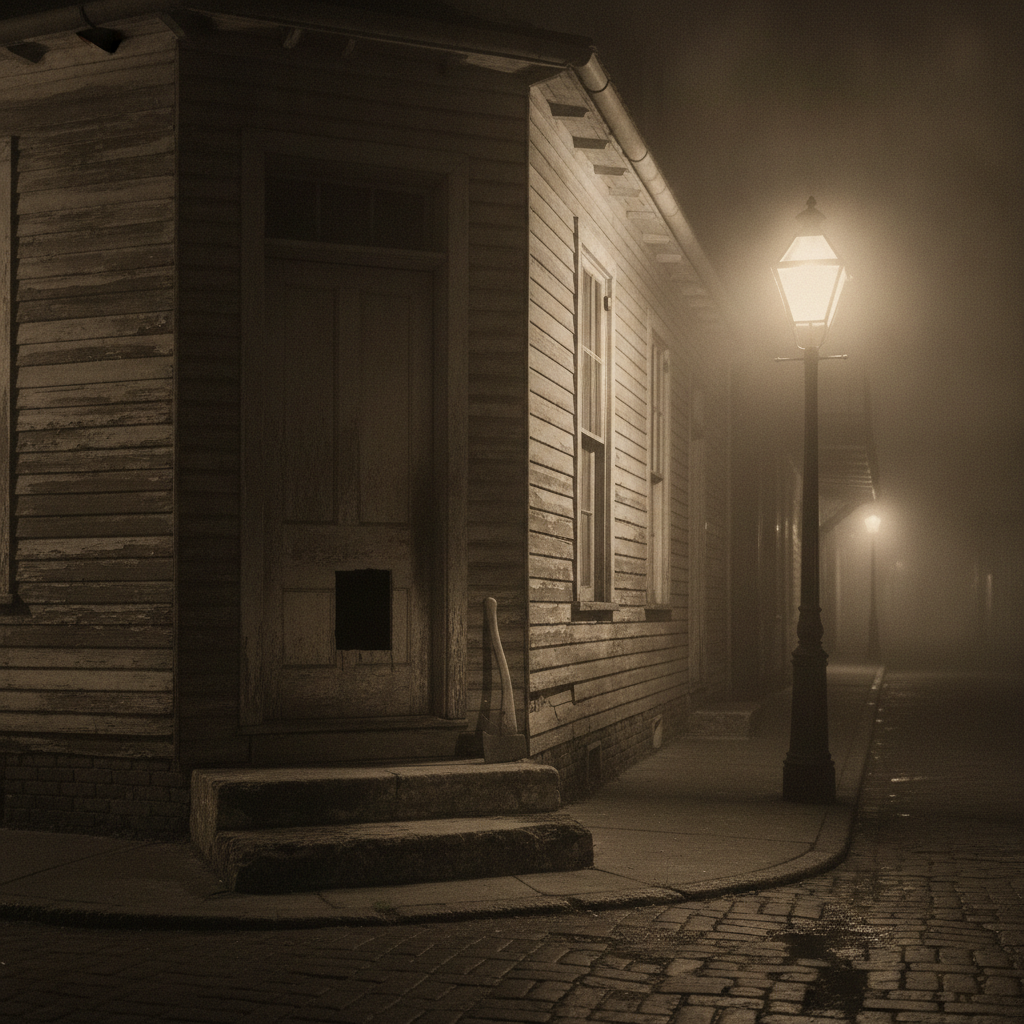
The Axeman of New Orleans: 2 Years of Night Attacks, a Letter About Jazz, and No Killer Ever Named
In 1918, New Orleans was a port city of nearly 400,000 people on the Mississippi River, in the south of the United States.
Many of its corner grocery shops were run by Italian immigrants. The family usually lived in rooms behind the shop or above it. The shop closed late, the family went to bed, and a wooden back door was the only thing between them and the night.
Between May 1918 and October 1919, someone came through those back doors.
The method was almost always the same. A panel at the bottom of the back door was cut out with a chisel. Through the hole, the intruder reached the bolt and opened the door. Inside, he picked up an axe or a hatchet that belonged to the household. Then he went to the bedroom and struck the sleepers on the head.
Often he left the weapon behind. Often he took nothing, even when money and valuables lay in plain sight.
The newspapers named him the Axeman of New Orleans.
This is what is known for certain. In about 18 months, at least 8 homes were attacked in this way. At least 6 people died. Others survived with fractured skulls and could not remember a thing. Several innocent people were arrested, and 2 of them were convicted in court, one of them sentenced to death. The real attacker was never identified.
The first night
On the night of 23 May 1918, Joseph Maggio and his wife Catherine were asleep in the rooms attached to their grocery, on a street corner in the uptown part of the city.
Early in the morning, Joseph's brothers, who lived in the other half of the building, heard groaning through the wall. They went in.
Catherine was dead. Her throat had been cut so deeply that her head was almost separated from her body. Joseph was still alive, barely. He died within minutes.
Both had been struck on the head with an axe and cut with a straight razor.
The police found that a panel of the back door had been chiseled out. The axe was found inside the house. The razor turned up later on a neighbouring lawn, covered in blood.
Valuables in the rooms had not been touched. Robbery did not look like the motive.
On the pavement near the house, someone had written a line in chalk: "Mrs. Maggio will sit up tonight just like Mrs. Toney." Nobody could explain it for certain. Some investigators connected it to the wife of an Italian grocer who had been killed in her home in 1912. That connection was never proven.
The wrong suspect, the first time
The razor belonged to Andrew Maggio, one of Joseph's brothers. He was a barber, and he had brought the razor home from his shop.
For the chief of police, this was enough. Andrew was arrested.
He admitted he had been drinking that night. But he said he had seen nothing, and he described a man he had noticed lurking near the building. The detectives questioned him again and again. They could not break his story, and they had nothing else against him.
Within days he was released.
This would become the pattern of the whole case. The investigators looked for the attacker inside the victim's own circle - a brother, a partner, a neighbour - because that is where killers usually are. In this case, again and again, it led nowhere.
A month later, a second grocery
On the morning of 28 June 1918, a bakery delivery driver came to the grocery of Louis Besumer, in another part of the city. The door was locked, which was unusual. He knocked. Inside he found Besumer covered in blood.
Besumer had been struck above the right temple. In the back rooms lay Harriet Lowe, the woman who lived with him, with a deep wound above her left ear.
The weapon was a hatchet that belonged to Besumer himself. It was found in the bathroom. Again, a panel had been cut out of the back door.
Both survived the night.
The police arrested a 41-year-old Black man who had once worked for Besumer. There was no evidence against him, and he was released.
Then the investigation turned in a strange direction. It was wartime. Besumer was a newcomer with a foreign background, and suspicion fell on him as a possible German spy. He was arrested. 2 days later he was released.
In August 1918 Harriet Lowe underwent surgery for her wounds. Before she died, she told the authorities that Besumer himself had attacked her. On the strength of this, Besumer was charged with murder.
He spent 9 months in jail. At his trial, on 1 May 1919, the jury deliberated for about 10 minutes and acquitted him.
August 1918: a city in panic
In the same summer, the attacks came quickly.
On 5 August 1918, Anna Schneider, 28 years old and 8 months pregnant, was found in her bed, beaten about the face and head. Her husband had come home shortly after midnight and found her. She survived, with no memory of what happened. 2 days later she gave birth to a healthy daughter. A few dollars were missing from her husband's wallet. A man with a criminal record was arrested, and released for lack of evidence.
On 10 August 1918, 2 sisters, Pauline and Mary Bruno, woke to noises from the room of their elderly uncle, Joseph Romano. They saw a man running away: heavy-set, dark-skinned, in a dark suit and a slouched hat. Their uncle had 2 wounds on his head. He walked to the ambulance by himself. He died in hospital.
The panel of the back door had been chiseled out. A bloody axe lay in the yard. The room had been turned over, but nothing had been taken.
Now the newspapers made the connection, and so did the police: the same man was behind all of it.
The city panicked. People reported strangers in their yards. Axes and chisels were "found" everywhere. Men sat up at night with loaded shotguns and took turns guarding their families.
A retired detective, who had once specialised in crime inside the Italian community, told the press that he believed the killer was the same man behind a series of attacks on Italian grocers around 1910 and 1911. He described someone who led a normal life by day and turned into a killer at night.
**That claim, about earlier attacks, was never proven. Modern researchers who went back to the old newspapers found the early reports unreliable, and some of those attacks may not belong to this series at all.**
And then, in the autumn of 1918, the attacks stopped.
March 1919: a child
They started again across the river.
In the early hours of 10 March 1919, in Gretna, a small town on the other bank of the Mississippi, facing New Orleans, a grocer named Charles Cortimiglia was asleep with his wife Rosie and their 2-year-old daughter Mary.
A neighbour, the elderly grocer Iorlando Jordano, heard screaming and ran over. He found Charles on the floor, bleeding. Rosie was sitting in the doorway with a deep head wound, holding her daughter.
Mary was dead. She had been killed by a single blow to the back of the neck.
Charles and Rosie both had fractured skulls. The axe was found on the back porch. A panel of the back door had been chiseled out. Nothing had been taken.
The head of the New Orleans police, Superintendent Frank Mooney, said publicly that this was the work of the same attacker. In his words, it was a degenerate who gloated over blood.
The Gretna police did not agree.
The Gretna police and the Jordanos
The Gretna police did not believe that a serial killer had come to their small town. They looked for a local reason.
They found one next door. The Jordanos also ran a grocery, and they were business rivals of the Cortimiglias. There had been a quarrel between the 2 families.
Rosie was held in jail as a material witness. She was badly injured, and she could not read or write English. The morning after she was jailed, she signed a statement accusing Iorlando Jordano, then 68 or 69 years old, and his son Frank, 17 or 18. The sources give both ages.
There were problems with this from the beginning. Iorlando was in poor health. Frank was over 1.80 metres tall and weighed over 90 kilograms - far too big to crawl through the small panel cut out of the door. And Charles, the husband, said his wife was wrong. He said the Jordanos had not attacked them.
The police arrested both men anyway.
At the trial, the case rested on Rosie's word. On 26 May 1919 the jury found both guilty. Frank was convicted of first-degree murder and sentenced to death by hanging. Iorlando was sentenced to life in prison.
According to the reports of the trial, Frank told the judge that he could hang him if he wanted, but begged him to set his father free, because his father was as innocent as he was.
After the trial, Charles divorced Rosie.
A letter from "Hell"
Between the Gretna attack and the Jordano trial, on 14 March 1919, the city's main newspaper, The Times-Picayune, published a letter it had received.
It was dated "Hell, March 13, 1919" and signed "The Axeman".
The writer said he was not a human being but a spirit, a demon, invisible to the police. He mocked the investigators. And he announced that at 12:15 in the morning of the coming Tuesday, 19 March, he would pass over New Orleans.
He offered a deal. Anyone who had a jazz band playing in their home at that moment would be spared. Everyone else would "get the axe".
That night, New Orleans played jazz. The dance halls were packed. Bands played in hundreds of private homes. A song called "The Mysterious Axman's Jazz" was published soon after.
No one was attacked that night.
**Nobody knows who wrote the letter.** It may have been the killer. It may have been a prankster, a journalist, or someone who wanted the attention. A historian who published a book about the case in 2017 argued that the letter-writer was probably not the attacker at all.
Summer and autumn 1919: the last attacks
On 10 August 1919, a grocer named Steve Boca woke in his bedroom to find a figure standing over him with an axe. He was struck on the head. He managed to get out and stagger to a neighbour's house, where he collapsed. He survived, and remembered nothing about the attacker. The panel of his back door had been chiseled out.
On 2 September 1919, a pharmacist named William Carson heard someone breaking in. He fired several shots. The intruder ran, leaving a broken door and an axe.
On 3 September 1919, Sarah Laumann, 19, who lived alone, was found unconscious in her bed by neighbours who broke in when she did not answer. She had a severe head wound and had lost several teeth. A bloody axe lay on the front lawn. This time the intruder had come in through a window. She recovered, with no memory of the attack.
On 27 October 1919, Mike Pepitone, a grocer, was attacked in his bedroom. His wife Esther heard a noise and reached the bedroom door in time to see a man running away. She could describe him only as "large". Mike had been struck on the head. Blood covered the walls of the room, including a picture of the Virgin Mary that hung there. He died, and left his wife and 6 children.
Sources disagree about the weapon in this last case. Most say an axe. At least one account of the time speaks of an iron bar.
After Mike Pepitone, the attacks in New Orleans stopped. They never resumed.
The Jordanos are freed
In December 1920, Rosie Cortimiglia walked into the offices of The Times-Picayune.
She had been ill with smallpox. She told the journalists that she had lied. She said she had accused the Jordanos out of jealousy and spite. According to the newspaper, she said a saint had come to her in a dream and told her to tell the truth. In some accounts she also said that a jailer had threatened her with prison if she did not name the Jordanos.
Her testimony had been the only real evidence. The prosecutor asked the court to drop the charges. The judge agreed, and Iorlando and Frank Jordano walked out of jail.
Frank had spent more than a year and a half behind bars, under a death sentence, for a murder he did not commit.
Why it was never solved
Looking back, the reasons are visible.
There was almost no forensic science. Fingerprints were known, but they were not collected and compared at these scenes in any organised way. Blood could not be matched to a person.
The survivors were struck while asleep, in the dark. Almost none of them remembered anything. The few descriptions - "dark-skinned and heavy-set", "large" - fit thousands of men.
The attacks crossed police boundaries. New Orleans and Gretna had different police forces, and they disagreed openly about whether the attacks were even connected.
The investigators chased the people closest to each victim: a brother, a partner, the neighbours. Every one of those leads collapsed, and 3 of them sent innocent people to jail.
And the panic buried the evidence. Every axe found in a yard, every shadow, every rumour was reported. The few real clues drowned among thousands of false ones.
**Everyone who was ever charged in the Axeman attacks was later acquitted or freed. The case was never solved.** It is not even certain how many attacks belong to it. Depending on which cases are counted, the number of dead ranges from 6 to more than 10.
The suspects on the record
**A man shot dead in Los Angeles.** The best-known theory begins in December 1921, in Los Angeles, on the other side of the United States. Esther Pepitone, the widow of the last victim, had moved there and remarried. She shot dead a man who used several names: Joseph Mumfre, Leon Manfre, Frank "Doc" Mumphrey. A crime writer later presented him as the Axeman, and an American scholar has also named him as the main suspect. The evidence: he had a criminal record and was in New Orleans at the time of the attacks. The shooting itself was reported in the press. The problem: the details change from one account to the next, starting with his name and the date. In some versions she said he was involved in the disappearance of her second husband, not that he had killed her first one. Apart from her own words, nothing connects him to any of the attacks. The 2017 book argues that he was not the Axeman, and its publisher says it shows that the real attacker went on killing after he left New Orleans.
**A Mafia vendetta.** Most of the victims were Italian grocers, and the police first thought of extortion by Italian criminal gangs. The problem: those gangs usually sent threats and demanded money first. They did not attack sleeping women and children like this. In most cases nothing was taken and no demand was ever found.
**A killer driven by something other than money.** 2 British crime writers suggested a man with a sadistic motive, who was after the women and struck the men only when they were in his way. The problem: the victims include men attacked alone, like Joseph Romano. The theory rests on interpretation, not on evidence.
**Not one attacker at all.** It is possible that the newspapers and the police joined several unrelated crimes - a family quarrel here, a robbery there - into one legend. The problem: the chiseled door panel and the household axe repeat too many times to be a coincidence.
More than 100 years later, the Axeman of New Orleans has no name. Everyone who was ever suspected is long dead, and no evidence survives that could change that.