The Postcard with the Rising Sun: the Camden Town Murder, London 1907
On the evening of Thursday, 12 September 1907, a railway worker climbed the stairs of a rooming house at 29 St Paul's Road, Camden Town, in north London.
He lived there with the woman he called his wife. Her name was Emily Dimmock. Everyone around her called her Phyllis.
She was in her early twenties. That day she had not turned up to meet his mother at the station, as the two women had arranged.
The door of their rooms was locked. He got hold of a key and went in.
The front room looked as if someone had searched it. Drawers had been pulled open. The door to the bedroom was locked as well, and he forced it.
Emily Dimmock lay on the bed, naked. Her throat had been cut from ear to ear, so deeply that the cut almost reached the spine. The sheets were soaked in blood.
There was no sign of a fight. She had been killed in her sleep.
What this case is
This is the Camden Town Murder, one of the most famous crimes of Edwardian London.
A young woman was killed in her own bed, sometime before dawn. The police found a man who had lied about knowing her. He was tried for murder and acquitted.
Nobody else was ever charged. More than 115 years later, nobody knows who cut Emily Dimmock's throat.
Who she was
Emily Dimmock came from a working-class family. As a teenager she worked as a servant in other people's houses.
Later she began to earn money as a prostitute. She met men in the pubs of Camden Town and sometimes took them home.
In 1907 she lived with a cook who worked on the railway. Most sources say he cooked in the dining cars of the Midland Railway, one source calls him a fireman. His job meant he spent many nights away on the trains.
The couple were not married, but they lived as husband and wife. In the summer of 1907 they rented 2 rooms in a house in St Paul's Road. The landlady lived in the same house. The street is called Agar Grove today.
According to the detailed accounts of the case, her partner did not know that she still brought men to the rooms while he was away.
The last week
In late August and early September 1907, Emily met a ship's cook in a pub called the Rising Sun. He was on shore leave. He spent several nights with her in the rooms in St Paul's Road.
That man later became an important witness. The police checked him carefully. He had an alibi for the night of the murder and was cleared.
He told the police about two pieces of paper.
The first was a letter. It came on the morning of Wednesday, 11 September, the last day of her life. He saw it. As he remembered it, the letter said: "Will you meet me at the Eagle, Camden Town, 8:30 tonight, Wednesday?" It was signed "Bert". The Eagle was another pub nearby.
Emily read it and burned it in the fireplace.
The second was a postcard, in the same handwriting. She showed it to him. It said: "Phyllis darling, if it pleases you meet me at 8:15 p.m. at the..." and then, in place of a word, there was a small drawing of a rising sun. It was signed "Alice".
The drawing was a joke. It meant the Rising Sun pub.
The last evening
On the evening of 11 September, Emily went out to the pubs of Camden Town, as she often did.
Witnesses saw her that night with a man. Barmaids and regular customers later described him as neatly dressed but not well off. The newspapers called him "shabby-genteel".
From here on, the accounts of that night split. The prosecution would later say she spent the evening with one particular man and left with him. Other witnesses said that after midnight they saw her with a different man.
**What is certain is only this: at some point that night Emily Dimmock went home, went to bed, and was killed while she slept.**
The police doctor examined the body. He placed the time of death in the early morning hours. Sources give slightly different windows, from between 3 and 4 a.m. to between 3 and 6 a.m.
A man in the street
At about 5 a.m. on 12 September, a carman walking along St Paul's Road saw a man come out of a house. A carman drove a horse and cart for a living.
He did not see the man's face clearly. It was still dark, and the light was poor. He noticed one thing: the man walked in an odd way, with a jerky movement of the shoulders.
This was the only person anyone saw near the house at the time of the killing. Whether he even came out of number 29 was never proved.
The scene
The detectives who arrived that evening found several strange details.
The bedroom showed no struggle. She had been attacked in her sleep, with a very sharp blade. The weapon was never found.
In the front room, according to one detailed account, the remains of a supper for 2 were still on the table.
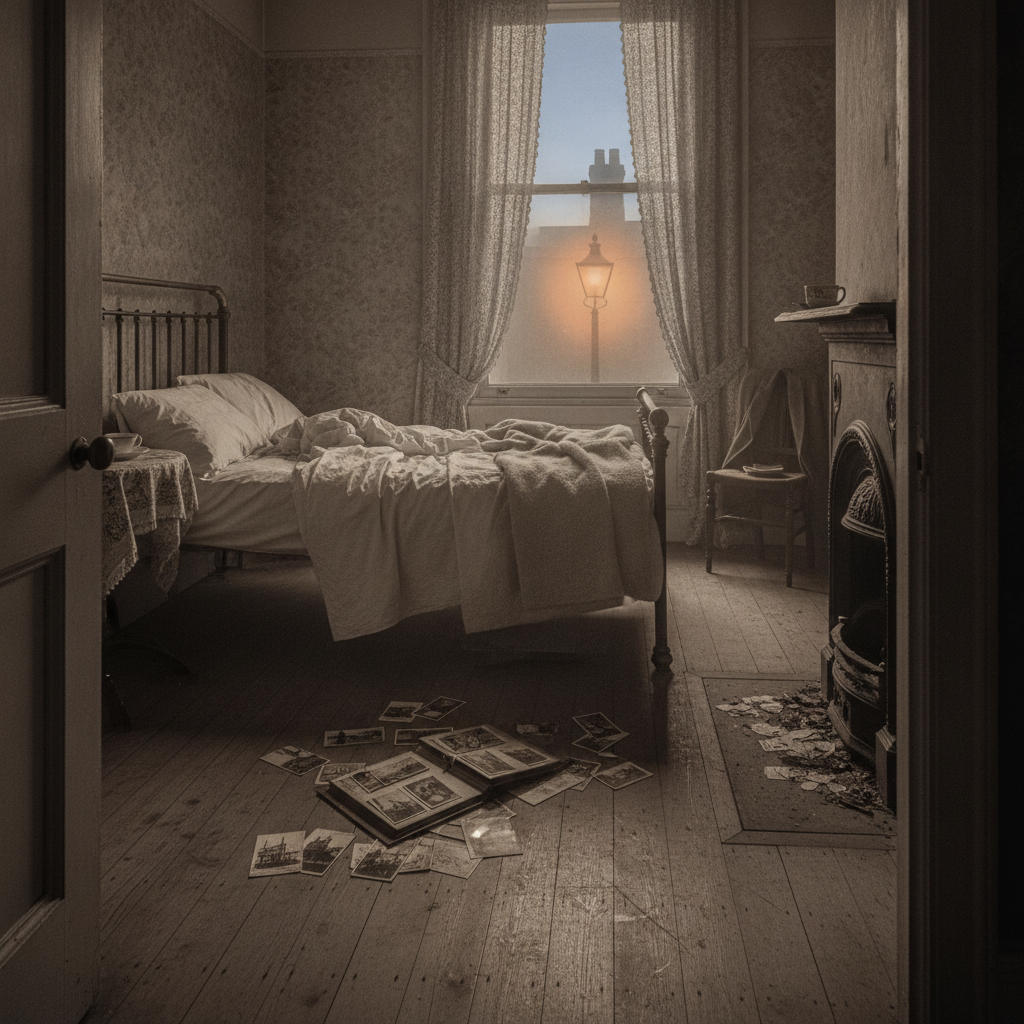
Emily had collected picture postcards, as many people did in those years. Her album lay open, and some cards had been pulled out of it.
The detectives drew a conclusion from this. The killer had been looking for something. Probably something with his own handwriting on it.
Some small things were also gone. One account lists her partner's watch and cigarette case and Emily's purse. Other sources say that very little was taken, and that the motive was unclear.
In the fireplace, the police found the burned remains of a letter. They matched what the ship's cook described.
The partner is cleared
The first person the police checked was her partner. In a murder in a bedroom, the partner is always checked first.
He had a strong alibi. On the night of the murder he was working on his train, far from London. The police confirmed it, and he was quickly cleared.
The ship's cook was also cleared. The police were left with no suspect.
The postcard turns up
The letter signed "Bert" had been burned. But the postcard with the rising sun had not been found in the room.
The detectives thought the killer had found it and taken it.
They were wrong. About 2 weeks after the murder, her partner was packing up the rooms so he could move out. Under the paper lining of a drawer he found the postcard. Emily had hidden it there.
The police now had a sample of the handwriting of the man who had arranged to meet her.
They gave the postcard to the newspapers. Copies were printed across London with the question: who wrote this?
On 29 September, the popular Sunday paper the News of the World offered a reward of 100 pounds for information about the writer.
The woman who knew the handwriting
In another part of London, a young woman looked at the postcard in the paper and knew the handwriting at once.
She had once been the girlfriend of a young artist named Robert Wood. He worked as a designer at a London glass-decorating firm. Some sources call him an engraver, others a commercial artist.
She also knew his little sketches. He often drew small pictures in his letters.
Before she went to anyone, Robert Wood came to see her.
According to her later evidence, he admitted that he had written the card. He said he had met a woman in the Rising Sun who called herself Phyllis, and that she had asked him to write a postcard for her.
Then he asked her for a favour. If anyone asked, she should say that on the evenings of the week of the murder he had been with her.
He did more. According to the trial evidence, he asked his foreman at work not to tell anyone that the handwriting was his. He said his father was ill, and that a scandal would harm him.
He also asked a friend, who had seen him in a pub with a woman on the night of 11 September, to leave that woman out of anything he said.
The arrest
The young woman kept quiet for a few days. Then she told a friend. The friend knew a journalist.
The journalist contacted Scotland Yard. A meeting was arranged at Piccadilly. A detective inspector came to it.
On 4 October 1907, the inspector arrested Robert Wood.
At first Robert Wood told the police the same story he had prepared: that on the night of the murder he had been at home with his sick father.
Then the alibi fell apart. The young woman told the police everything, including that he had asked her to lie for him.
He changed his account. Yes, he knew Phyllis. Yes, he had written the postcard. Yes, he had been with her in the pub on the evening of 11 September. But he had left her that night and gone home. He had not killed her.
He was charged with murder.
Why he was a serious suspect
From the police's point of view, the case against Robert Wood looked strong.
He had known the victim. He had written the postcard that arranged a meeting. He had been seen drinking with her on the last evening of her life.
He had lied to the police. He had asked a former girlfriend to lie for him. He had asked his foreman and a friend to keep quiet.
The carman said that the man in the street had a peculiar walk. Robert Wood, said the prosecution, walked in a similar way.
And in the handwriting there was the drawing of the rising sun. Robert Wood was an artist.
Why the case was weak
But every link had a gap.
Nobody had seen him go into the house that night. Nobody had seen him come out.
The carman admitted in court that the light was poor and that he could not be sure who the man was.
No weapon was ever tied to him. None of the missing things was ever found in his possession.
And there was no motive. Nobody could explain why a young man with a steady job would cut the throat of a woman he hardly knew.
The trial
The trial opened at the Old Bailey, the central criminal court in London, on 12 December 1907. That was exactly 3 months after the body was found.
The prosecution was led by one of the most senior Crown lawyers in the country.
The defence was led by Edward Marshall Hall, the most famous defence barrister of his time. Robert Wood's employers believed in him and helped pay for his defence.
The courtroom was packed. Crowds stood outside in the cold every day.
The witnesses
The prosecution called the people from the pubs. A barmaid and several customers said they had seen Robert Wood with Phyllis on several evenings.
The carman described the man with the jerky walk. Under cross-examination by the defence, he admitted that the street was dark, that he had not seen the man's face, and that he could not swear it was the accused.
The former girlfriend gave her evidence. She told the court how Robert Wood had asked her to give him a false alibi.
The defence answered this point directly. The alibi he had asked her for covered the evening, not the hours before dawn when the murder happened. A man who had killed someone at 4 a.m., the defence argued, would have asked for an alibi for 4 a.m.
The defence also brought witnesses who said that after midnight they had seen Emily Dimmock with another man, not with Robert Wood.
Why had he lied? The defence gave a simple answer. He was a respectable young man with a sick father and a good job. He was terrified of being publicly connected with a prostitute and a murder. He lied out of panic, not guilt.
The accused speaks
Then Robert Wood went into the witness box himself.
In those years this was still fairly new. A law of 1898 had allowed accused people in England to give evidence in their own defence. Many lawyers thought it was dangerous.
His barrister asked him the first question: "Robert Wood, did you kill Emily Dimmock?"
Robert Wood did not answer. The barrister had to ask again.
Then he said: "I mean, it's ridiculous."
It was a poor start. Under cross-examination by the prosecution, he was vague and sometimes seemed almost bored. Many people in the court thought he was hurting his own case.
The verdict
In his closing speech, the defence barrister went through the evidence link by link and showed that each one could be read in another way. According to accounts of the trial, it was so powerful that one of the jurors fainted.
Then the judge summed up the case for the jury. Many people had expected him to lean towards a conviction. He did the opposite.
He told the jury that the evidence was entirely circumstantial. The prosecution, he said, had not brought the case close enough to the accused.
The jury went out at 7:45 p.m. on 18 December 1907. They came back 15 minutes later.
The verdict was not guilty.
Outside the Old Bailey, the crowd cheered. In London theatres, performances were stopped so that the verdict could be announced from the stage.
The former girlfriend whose evidence had led to the arrest had to be taken out of the building secretly. Part of the crowd saw her as a traitor.
Where the case stands
With the acquittal, the investigation reached a dead end.
The police had built their whole case on one man. When the jury rejected it, there was no second suspect to turn to.
**Here is where what we know ends. After December 1907, no new evidence was ever found, and nobody else was ever charged with the murder of Emily Dimmock.**
What was missing is clear.
The weapon was never found. The missing small items, if anything was taken at all, never turned up. Fingerprints played no part in the evidence at the trial, although Scotland Yard had started using them only a few years earlier. Blood typing and DNA did not exist yet.
The only witness who saw a man near the house at the right time could not describe his face.
The man who wrote the letter signed "Bert" was never proved to be the man who killed her. Robert Wood admitted writing the postcard. The letter itself had been burned.
As for Robert Wood, he left the public eye. Accounts of his later life differ. One says he changed his name and moved to Australia. Another says he stayed in England, married and had children. Neither has been firmly confirmed.
Everyone connected to the case died long ago.
The painter
The case left one strange mark on English art.
In 1908 and 1909, a well-known London painter who lived and worked in Camden Town made a series of paintings, drawings and etchings with the title "The Camden Town Murder". Each one shows a clothed man and a naked woman in a small, dark room.
The pictures are not a record of the crime. But they kept the name of the case alive for more than a century.
The suspects and theories
These are the theories on the documented record. None of them has been proved.
**Robert Wood did it after all.** The evidence: he knew her, he arranged to meet her, he lied and asked others to lie. The prosecution put this case to the jury in 1907. The problem: a jury heard all the evidence and acquitted him in 15 minutes. Nothing new has been found since. In law he is innocent, and he must be treated as innocent.
**A client she brought home that night.** The evidence: she often brought men back. Witnesses said they saw her after midnight with a man who was not Robert Wood. The supper for 2 and the searched postcard album suggest that someone she knew, or had just met, was in the room. The problem: nobody ever identified this man.
**Her partner slipped back from his train.** Some later writers have asked whether he could have left his train secretly during the night. The problem: the police checked his alibi at the time and accepted it. No evidence has ever supported this idea.
**The painter.** Some writers have tried to link the Camden Town painter to the murder, because of his paintings and because he lived nearby. The problem: there is no evidence placing him in the house, and nothing connected him to the victim. Most historians reject the idea.
What remains is a young woman killed in her sleep, a postcard with a drawing of a rising sun, and a man in the dark street with a jerky walk, whose face nobody saw.