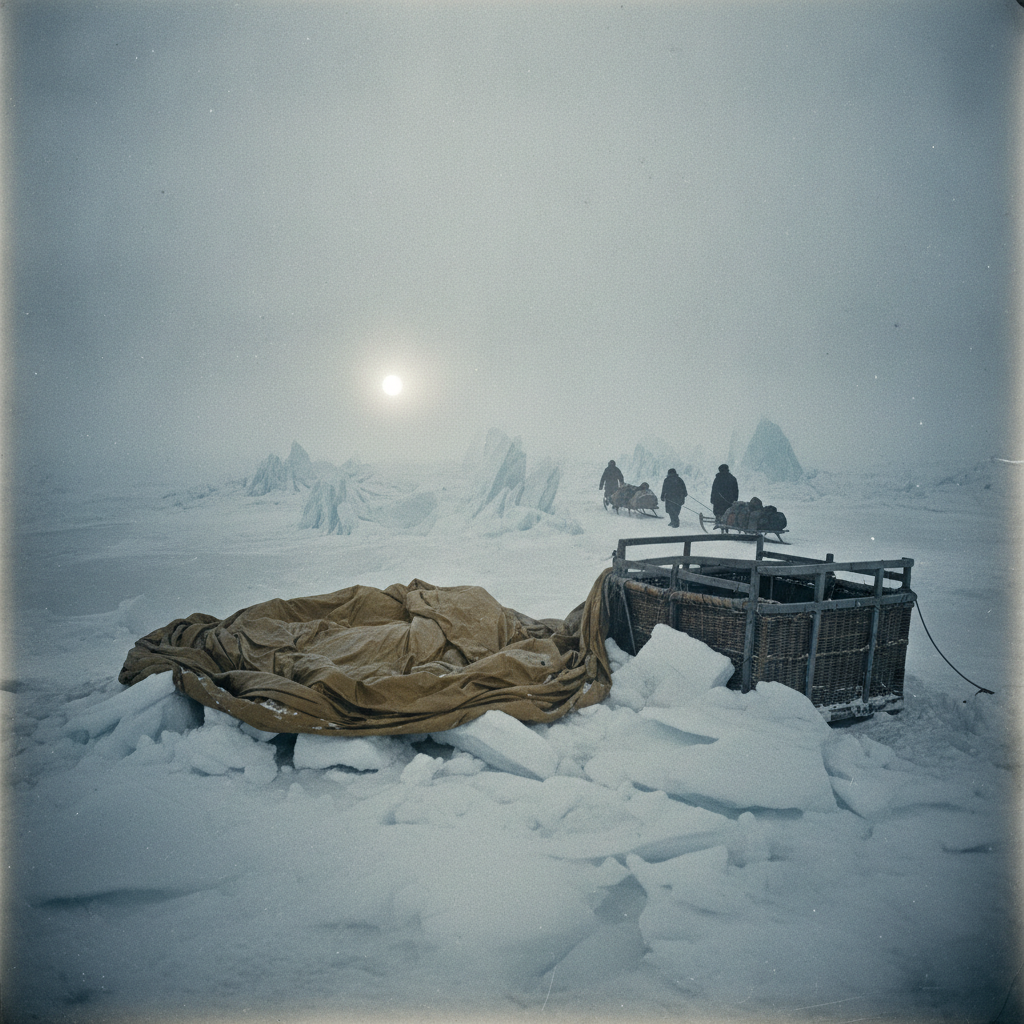
Andrée's Balloon: Three Men Flew Toward the North Pole and Were Found 33 Years Later
On the morning of 11 July 1897, three men climbed into a wicker basket on a cold, rocky shore in the far north.
Above them hung a huge balloon of varnished silk, 20.5 metres across, filled with hydrogen. After weeks of waiting, the wind had finally turned. It was blowing toward the North Pole.
The ropes were cut. The balloon rose, dipped toward the sea, rose again, and drifted north. The people on the shore watched it grow smaller until it was gone.
Nobody saw the three men alive again.
This is the story of Andrée's Balloon, a Swedish attempt to reach the North Pole by air. The balloon came down on the ice after about 2 days. The men walked for almost 3 months and died on a frozen island. Their bodies were found by chance 33 years later. We know where they died. We still do not know what killed them.
A plan that sounded modern
In the 1890s, nobody had reached the North Pole.
Andrée was a 42-year-old Swedish engineer who worked at the national patent office. He had an idea. Why walk across the ice, when you could fly over it?
His balloon was named the Eagle. Andrée believed he could steer it. Long, heavy ropes would hang from the basket and drag along the ground. Their friction would slow the balloon, and small sails would let it turn across the wind.
The king of Sweden gave money. So did the industrialist whose fortune later created the Nobel Prize.
The launch site was a small island in the northwest of Svalbard, a group of Norwegian islands in the Arctic Ocean. From there, the Pole was about 1,100 km away.
The first try, and a warning
The first attempt came in the summer of 1896. All summer the wind blew from the north, the wrong direction. The balloon never left the ground.
But that summer produced a serious warning. A meteorologist on the team measured the balloon every day. It was leaking. It lost about 68 kg of lifting power a day, through millions of tiny holes along the stitched seams.
By his calculation, the balloon could stay up for about 17 days, not the 30 days the plan promised. He refused to go again unless it was fixed.
Andrée did not cancel. He replaced the meteorologist with a 27-year-old engineer, a strong athlete. The third man was Nils Strindberg, a young physicist and the expedition's photographer.
A few minutes that ruined everything
On 11 July 1897, the trouble started almost at once.
As the balloon left its shed, it sank toward the water and the drag ropes caught. The ropes were attached with new screw fittings, designed to come apart in an emergency. They came apart. About 530 kg of rope fell into the sea.
At the same moment, the men threw 210 kg of sand overboard to keep the basket out of the water.
Within minutes the balloon was 740 kg lighter. It shot up higher than planned. Without the drag ropes, nothing could steer it. The Eagle was now an ordinary balloon, going wherever the wind went.
Messages that said all was well
The men carried homing pigeons. Only 1 was ever recovered, shot by the crew of a Norwegian ship. Its note was dated 13 July. It said that all was well on board.
It was not. Andrée's own diary tells a different story. Fog and ice made the balloon heavy. For 41 hours it kept dropping and bouncing along the frozen surface.
On 14 July, after about 2 days in the air, the men let the gas out and landed on the pack ice, a little short of 83 degrees north. They were still about 780 km from the Pole. Nobody was hurt.
Walking on ice that moves
They had rifles, sleds, a tent and a small folding boat. They had 767 kg of food, mostly canned meat and condensed milk.
What they did not have was fur clothing. They wore wool and oilskins. For the rest of their lives, they would be wet.
They loaded more than 200 kg onto each sled. The sleds broke. They cut the load to about 130 kg each, and on 22 July they set out toward a supply depot on islands far to the southeast.
Pack ice is not land. It floats, and the wind and the currents push it. All day the men pulled their sleds south. Again and again, the ice had carried them back.
The surface was brutal. There were ridges of broken ice as high as a two-storey building, and channels of open water between the floes. Sometimes they crawled on hands and knees, hauling the sleds. They shot polar bears and seals and ate the meat, often half cooked.
On 4 August they turned toward a second depot, on small islands north of Svalbard. They expected 6 to 7 weeks of walking. The ice carried them away from that goal too.
Giving up the walk
By 12 September, they accepted the truth. They could not walk out.
They chose a large, thick floe and built a hut on it, with walls of snow hardened with water. The plan was to spend the winter there, drifting.
The floe drifted fast toward the south. Then, on 2 October, the ice began to crack, right under the hut. The floe was being crushed against the shore of an island.
That island was White Island, at the far eastern edge of Svalbard. It is almost entirely covered by a glacier, and in most years it is ringed by ice and fog. Ships rarely get close.
Over the next few days, the men carried their supplies ashore. By 5 October they were on solid ground for the first time in almost 3 months.
The last words
Strindberg's diary ends on 7 October. His last readable word is "Moving".
Andrée wrote one more entry, on 8 October. He wrote that it felt good to sleep on firm land, after weeks of hearing the ice crack beneath them. He wrote that they would need to collect driftwood and whale bones.
**This is where the written record ends. From here on, nobody knows for certain what happened to the three men, or in what order they died.**
33 years of silence
In Sweden, people waited. Searches found no trace. The three men became national heroes, and then a sad legend.
In the summer of 1930, the weather around White Island was unusually warm, and the ice pulled back. A Norwegian sealing ship carrying a scientific team managed to land there.
In early August, two sealers went looking for fresh water. Near a small stream, they saw something sticking out of the snow. It was the expedition's boat, still full of equipment.
They found two bodies. One lay near the camp, half sitting against a rock, with a rifle beside him. That was Andrée. His diary had been wrapped with care, with clothing, hay and balloon cloth around it.
The second body was Strindberg's. It was wedged into a crack in the rocks and covered with stones. Someone had buried him. So he died first.
On 5 September, a second ship, carrying journalists, reached the island. They found the third man's body in what was left of the tent. They also found a metal box with rolls of exposed film.
A photographer in Stockholm, the capital of Sweden, saved 93 pictures from the soaked film.
On 5 October 1930, exactly 33 years after the men stepped onto White Island, the bodies arrived in Stockholm. Huge crowds filled the streets. Then the bodies were cremated, without a full autopsy.
That decision is the main reason the question is still open. We know where the men died, roughly when, and that food, rifles and fuel lay all around them. We do not know what actually killed them.
Conclusions and Open Questions
None of the explanations explains everything.
**A disease from undercooked polar bear meat.** In 1952 a doctor argued that the men caught a parasitic worm from bear meat. Larvae of that worm were found in bear remains from the camp, and the diaries mention diarrhoea and pain. The problem: the diaries never mention fever, the main symptom. This disease rarely kills. Other explorers lived on bear meat in the same region for more than a year without harm.
**Gas from the stove.** A well-known Arctic explorer argued that a faulty kerosene stove filled the tent with carbon monoxide. The problem: the stove was found with fuel still in it, and it was probably standing outside the tent.
**Cold, exhaustion and despair.** A Swedish museum researcher who studied the expedition for decades argued there was no single cause. After 3 months wet and cold, losing their hut was the final blow. In his view, the surprise is not that they died, but that they lasted so long. The problem: it explains why they were weak, but not why all 3 died within days of reaching land.
**A polar bear, and then morphine.** A Swedish doctor who spent years on the case examined the 1930 medical reports and the surviving clothing. She found tears in Strindberg's clothing that may have been made by a bear's claws. In her view, a bear killed him first. The third man died later in the tent. Andrée, alone, may have taken morphine from the medical kit. Nearly empty morphine bottles were found at the site. The problem: a torn piece of cloth after 33 years in the ice is not proof. Without the bodies, nothing can be tested.
Other suggestions include lead from the food cans, botulism and scurvy. Each has some support, and each has a weakness.
What remains open is simple to state. Three men, with food and rifles, reached solid ground after 3 months on the ice. Within days, all 3 were dead. Andrée had time to wrap his diary with care. What happened in those few days is still unknown.