Twelve Years, 52 Victims and a Blood Test That Lied: How Andrei Chikatilo Was Caught
In the Rostov region of southern Russia, in the early 1980s, people began to talk about the forest strips.
These were narrow belts of trees, planted between the fields to break the wind. They ran beside the railway lines and the roads for kilometres. A person walking from a small station to a village often had to pass through one.
Between 1978 and 1990, bodies kept turning up in those strips, and in the parks, orchards and fields nearby. Boys and girls. Young women. Many of them had been travelling alone. Many had last been seen at a bus stop or a railway station.
All of them had been killed with a knife, with a violence that shocked even experienced detectives.
This is the story of Andrei Chikatilo, the man later called the Rostov Ripper, and of the 12-year hunt that finally caught him. In 1992 he was convicted of 52 murders. Along the way, the investigation sent an innocent man to the firing squad, pushed vulnerable men into false confessions, and held the real killer in a cell for 3 months - and then let him go.
A quiet man with a briefcase
Andrei Chikatilo was born on 16 October 1936 in a village in Ukraine, which was then part of the Soviet Union. He served in the army from 1957 to 1960. In 1961 he took a job as a communications engineer near Rostov-on-Don, the main city of the region.
In 1963 he married. He and his wife had 2 children. In 1970 he earned a degree in Russian literature by correspondence, and from 1971 he worked as a teacher.
His teaching career ended badly. He left one school after complaints from pupils. In March 1981 he left teaching altogether, after further complaints that he had molested children.
He became a supply clerk at a factory. The job sent him travelling all over the region and beyond, by train and by bus.
For a man like him it was the perfect cover. A middle-aged official with a briefcase, waiting on a platform, was the most ordinary sight in the Soviet Union.
The first murder, and the wrong man
The first killing that would later be proven against him took place on 22 December 1978, in Shakhty, a mining town in the Rostov region.
Yelena Zakotnova was 9 years old. She was walking home from an ice rink when a man spoke to her.
Her body was found 2 days later, on 24 December, under a bridge over the Grushevka River.
The police found a suspect quickly. Aleksandr Kravchenko was a labourer who already had a previous conviction. He was arrested and questioned. He confessed - under pressure, as he later said - and then took the confession back.
He was convicted anyway and sentenced to death. In December 1980 the Supreme Court reduced the sentence to 15 years in prison.
But the girl's relatives kept pressing. Kravchenko was tried again and convicted again. In July 1983 he was executed by firing squad.
He had not killed Yelena Zakotnova. Andrei Chikatilo had. It would take until 1992 for a court to say so.
The pattern appears
In September 1981, Larisa Tkachenko, 17 years old, disappeared while waiting for a bus back to her boarding school. She was found dead.
On 12 June 1982, Lyubov Biryuk, 13 years old, was taken while walking home from a shopping trip in the village of Donskoi. Her death became the first in the series that the police tied to a single manhunt.
Through 1982 more bodies were found. The method was the same each time.
The victim was approached in a public place - a station, a bus stop, a train. Something was offered or promised. The victim was then led on foot into woodland or open ground, away from any witness. And there the knife was used.
In January 1983, 4 murders were tentatively linked to one killer. Moscow sent a team of police investigators to Rostov. At the start it numbered about 10 people.
In March 1983, a forensic analyst named Viktor Burakov was appointed to lead the hunt. On 6 September 1983 the Soviet prosecutor's office formally linked 6 murders to one man.
The wrong suspects
What followed was the darkest part of the investigation.
There was no witness and no name. So the police went looking among the people they considered likely.
From September 1983, several young men with intellectual disabilities were brought in and questioned for long periods. Some of them confessed. Their confessions did not fit the facts. And while they were in custody, the killings went on.
The police also went after gay men and known sex offenders. The pressure was so heavy that 3 gay men and 1 convicted sex offender took their own lives.
Viktor Burakov had become sceptical of confessions. He had seen too many of them produced by long interrogations, only to fall apart when they were checked.
As a side effect, the enormous sweep solved more than 1,000 unrelated crimes. It did not solve the one it was meant to solve.
September 1984: the killer in a cell
Then, on 13 September 1984, the investigation came within one step of the answer.
2 undercover detectives were watching the crowds in Rostov. They noticed a middle-aged man who kept approaching young women and trying to start conversations with them. They followed him to the central market, and there they arrested him.
It was Andrei Chikatilo.
In his briefcase they found a knife, a length of rope and a jar of Vaseline.
He was held while investigators checked him against the murders. The key test was blood.
At the scenes of 6 killings from 1984, the murderer had left semen. The laboratory had classified it as blood group AB. Andrei Chikatilo's blood was group A.
The result did not match. Investigators largely set him aside as a suspect.
He was not released at once. He was held on an unrelated theft charge, convicted, expelled from the Communist Party and sentenced to 1 year. On 12 December 1984, after 3 months in custody, he walked free.
Shortly before, on 8 October 1984, the prosecutors had formally joined 23 murders into one case, and dropped the charges against the men who had confessed earlier.
**On the day he walked out, nobody on the investigation knew that the killer had just been released.**
The hunt grows
In November 1985, a special prosecutor was assigned to take charge of the whole case. By then the team had grown to 15 prosecutors and 29 detectives.
That same year, Viktor Burakov turned to a psychiatrist, Alexandr Bukhanovsky. He asked him to describe the man they were looking for.
Bukhanovsky wrote a profile 65 pages long. Some accounts describe it as the first psychological profile ever used in a Soviet criminal investigation.
It described a man aged between 45 and 50. Reclusive. Impotent. Sadistic. Of ordinary intelligence. And with a job that made him travel on a schedule.
Every point fitted Andrei Chikatilo. But nobody connected the profile to the clerk who had been arrested at the market.
The supply clerk's work took him far from home, and the killings went with him. The records of the case include victims lured off trains far from the region: one in Tashkent, in Central Asia, and another in Leningrad, the city known today as St. Petersburg.
In 1988 an official circular reached investigators. It said that in rare cases a man's blood group could differ from the group found in his semen and saliva. Nobody, at that point, went back to the clerk from 1984.
October 1990: the trap at the stations
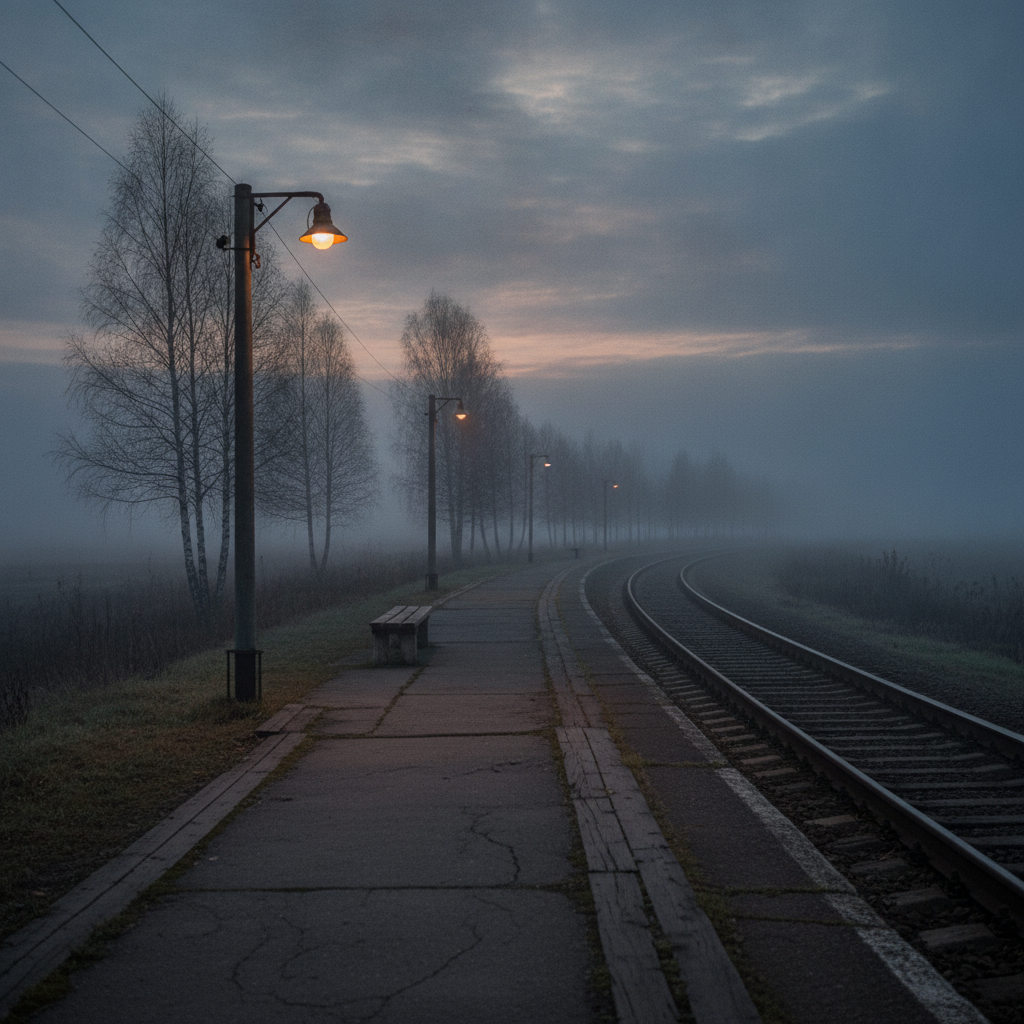
By 1990 the investigators were sure of one thing at least. The killer moved by rail, and many victims had been taken from small stations on the same routes.
On 27 October 1990 the police launched a new operation. They put 360 men into the railway stations of the Rostov region.
At the large stations, uniformed officers stood openly on the platforms. At the 3 smallest stations on the key line, where there seemed little reason to post anyone at all, they placed undercover officers instead.
The idea was simple. A killer who saw police at the big stations would move to the small ones. And there, someone would be watching.
6 November 1990: the last victim
On 6 November 1990, Svetlana Korostik, 22 years old, was killed in the woods near a small station called Donleskhoz.
That same day, an undercover officer at the station stopped a man. Several details about him seemed wrong to the officer. But he had no body and no report of a crime, so he had no grounds for an arrest.
He did what the operation required. He checked the man's papers and wrote down his name.
The name was Andrei Chikatilo.
On 13 November 1990, Svetlana Korostik's body was found near the station. She was the 38th death linked to the manhunt.
The investigators went through the names collected at that station. One of them belonged to a man who had been arrested in 1984 with a knife and a rope in his briefcase.
The arrest
From 14 November 1990 he was kept under surveillance.
On 20 November 1990 he was arrested in Novocherkassk, a city in the region. He had a wound on one finger. The medical examiners concluded that it was a human bite.
On 21 November his blood was tested again. It was group A, exactly as in 1984. This time, a sample of his semen was taken as well. It came back as group AB - the same as the samples from the crime scenes.
For days he denied everything. The law allowed the investigators to hold him for 10 days before they had to charge him or let him go.
The confession
On 29 November 1990, with the deadline close, Viktor Burakov made an unusual decision. He allowed the psychiatrist Alexandr Bukhanovsky to speak with the prisoner.
Bukhanovsky sat with him and read to him from the profile he had written 5 years earlier.
Andrei Chikatilo began to cry. Then he began to confess.
The charges were filed the same day, before the 10 days ran out. On 30 November 1990 he was formally charged with 36 murders.
He admitted 36 of the 38 killings the police had linked to him, and denied the other 2. Over the following days he confessed to about 20 more, which the police had never connected to the case at all.
In December 1990 he led investigators out into the countryside. He showed them the body of Aleksey Khobotov, and the remains of other victims.
In the end he confessed to 56 murders.
The trial
On 20 August 1991 he was sent to the Serbsky Institute in Moscow, the country's central psychiatric centre, for a 60-day evaluation. On 18 October 1991 the psychiatrists concluded that he had a personality disorder with sadistic features, and that he was fit to stand trial.
The trial opened on 14 April 1992, in the regional court in Rostov. He was charged with 53 murders and 5 sexual assaults.
He sat inside an iron cage. It had been built to protect him from the families of the victims, who were in the courtroom.
His behaviour in court was wild. He shouted over the judge. He called the court a farce. He sang socialist anthems. At times he exposed himself. The judge repeatedly reprimanded him, and at times the court went on without him.
On 21 April he stopped answering questions. On 13 May he withdrew his confessions to 6 of the killings. He also claimed 4 more victims who were not on the charge sheet.
In July, psychiatric experts from the Serbsky Institute told the court that his behaviour was calculated: an attempt to be declared insane.
On 14 October 1992 the court found him guilty of 52 of the 53 murders and of all 5 sexual assaults. On 15 October 1992 he was sentenced to death.
In the summer of 1993 the Supreme Court heard his appeal. It ruled that 9 of the 52 murders were not sufficiently proven. It upheld the other 43, and it upheld the death sentence.
On 4 January 1994, the president of Russia rejected his plea for clemency.
On 14 February 1994, in the prison at Novocherkassk, Andrei Chikatilo was executed with a single shot. He was 57 years old. He was buried in an unmarked grave in the prison cemetery.
What remains open
The case was solved. 2 things in it were never fully settled.
The first is the blood test of 1984. At the trial, a serology expert testified that Chikatilo was a rare case of what she called "paradoxical secretion": a man whose semen showed a different group from his blood. Other serology and DNA experts rejected this. One said the likelier cause was faulty Soviet laboratory chemicals that gave a false reading. The sources do not agree, and the question was never resolved.
The second is Aleksandr Kravchenko. He was executed in 1983 for the murder of Yelena Zakotnova, the murder that opened the series. Amnesty International recorded that a man had been wrongly tried and executed for Chikatilo's first killing.
The men who confessed under pressure and the 4 men who took their own lives were also harmed by the hunt. Kravchenko was the only one the state put to death.