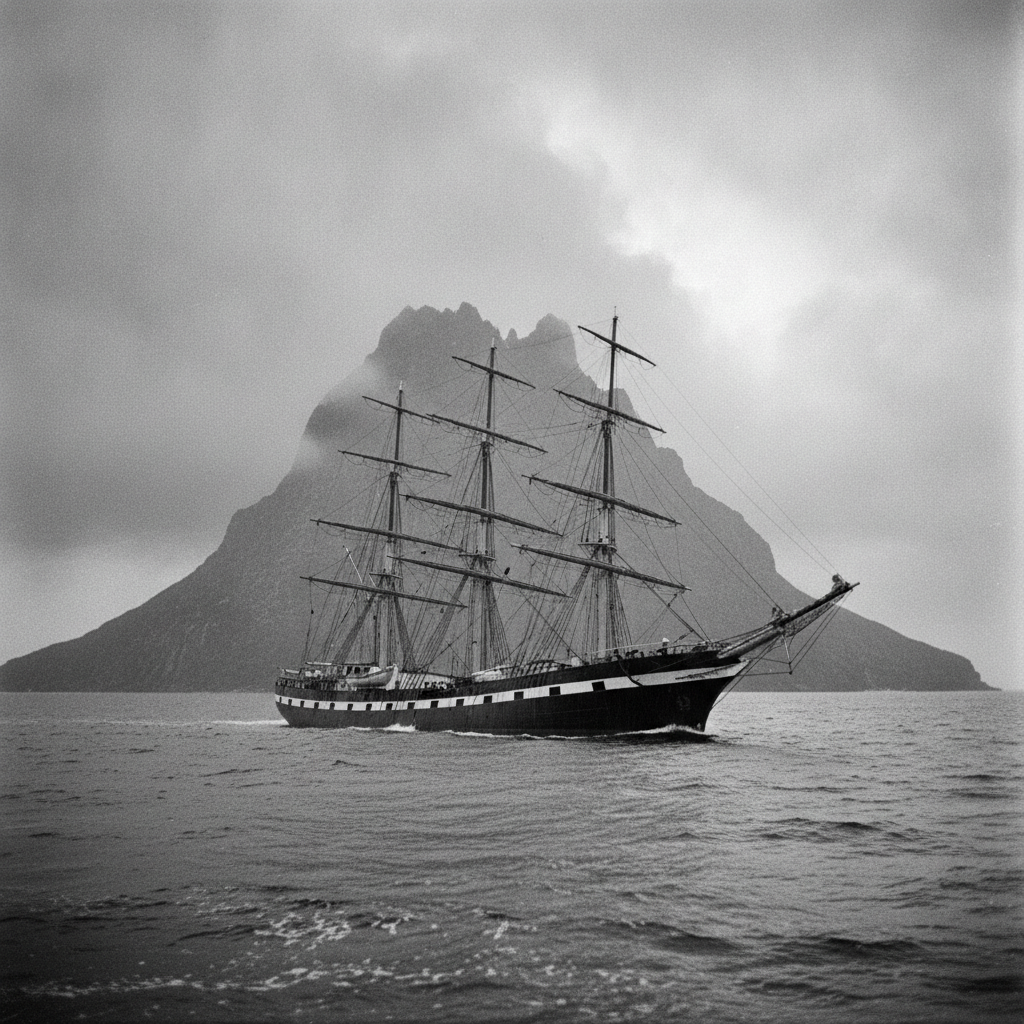
København: The World's Largest Sailing Ship Vanished With 60 Young Sailors Aboard
It is the evening of 22 December 1928, in the middle of the South Atlantic Ocean.
A Norwegian cargo steamer is crossing an empty stretch of sea. Its radio operator picks up a signal from a sailing ship somewhere nearby.
The message is short. All is well on board.
The sailing ship is the København, the largest sailing ship in the world. On board are about 60 people. Most of them are teenage boys training to become ships' officers. They are 8 days out of port, heading for Australia, and getting ready to celebrate Christmas at sea.
That same night, the Norwegian operator tries to call the ship again. There is no answer.
Nobody ever heard from the København again.
This is the story of the København, a Danish training ship that disappeared with everyone on board. No wreck was ever confirmed. No body was ever identified. No lifeboat was ever proven to be hers. Nearly 100 years later, nobody knows where she sank, when, or why.
A giant built to teach
The ship was built in 1921 at a shipyard in Scotland, for a large Danish shipping company that traded with Asia.
She was enormous. She was about 130 metres long and had 5 masts, each about 60 metres tall from the keel. When all her sails were set, they covered more than 4,600 square metres. That is more than half a football pitch of canvas.
The company used her as a floating school. Every voyage carried a small crew of experienced sailors and several dozen cadets, boys in their teens who wanted to become officers. They learned to climb the rigging, handle the sails, steer, and find their position by the sun and the stars.
Between 1921 and 1928 she made 9 long voyages. She went around the world twice and visited almost every continent.
The last voyage
On 21 September 1928, the København left a small port in northern Denmark. She was carrying chalk and bags of cement to Argentina.
She arrived in Buenos Aires, the capital of Argentina, on 17 November. The cargo was unloaded.
The plan was to sail on to Australia and pick up a cargo there for the trip home. But in Buenos Aires the company could not find anything to carry to Australia.
So she left empty. That detail would matter later.
On 14 December 1928, the København sailed out of Buenos Aires. Her course would take her east across the South Atlantic, south of Africa, and across the Indian Ocean to Australia. The trip was expected to take about 45 days.
On 22 December, 8 days out, came the radio contact with the Norwegian steamer. Everything, the message said, was fine.
After that, silence.
Why nobody worried at first
At first, the silence did not alarm anyone.
The captain was known for rarely using the radio.
The ship was due in Australia around the end of January 1929. The end of January passed. Then most of February.
In February, the shipping company began asking questions through Lloyd's of London, the insurance market that kept track of ships around the world. Nobody had seen her.
In early April the company raised a formal alarm. The British navy agreed to help.
By then the ship had been silent for more than 3 months.
The search
In April 1929 the company sent one of its own motor ships south to search. The idea was to check the lonely islands along the route, where survivors might have come ashore.
Another ship was sent to search small islands deep in the southern Indian Ocean. These are cold, windswept places, thousands of kilometres from any city. If a lifeboat had drifted there, the boys could still be alive, living off seals and seabirds.
More ships were hired later, from Australia and from South Africa. The search went on for months, across 2 oceans. It was officially ended on 9 September 1929.
It found nothing. Not a plank, not a lifeboat, not a life ring with the ship's name on it.
On 1 January 1930, Lloyd's of London officially listed the København as missing.
A ship near the island
There is one report that people still argue about.
It comes from Tristan da Cunha, a tiny volcanic island in the middle of the South Atlantic, about 2,800 kilometres from South Africa.
When the searchers reached the island, an English clergyman living there told them what he had seen on 21 January 1929.
He said a large ship with 5 masts appeared, coming from the south. It had a black hull with a white band along it. The front masts were broken. The ship was carrying almost no sail. Its stern sat very low in the water, as if it was flooding.
He said the sea was too rough for the islanders to launch their boats. "We could do nothing but watch her," he said. He was sure the ship was in distress. He watched her drift toward the reefs at the edge of the island, and then he lost sight of her.
The accounts of his report do not agree on the details. One version says the ship came within about 400 metres of the shore. Another says it stayed about 5 kilometres out. One says it drifted west, another says east.
Islanders later said they found boxes and pieces of timber on the reefs. But nothing that washed ashore could be linked to the København.
**This is where the documented trail ends. The radio message of 22 December is the last thing known for certain. Everything after it, including the ship at the island, is a report that nobody could confirm.**
The rumours that followed
For years afterwards, new stories kept appearing.
Fishermen in Chile said they saw a five-masted ghost ship. In 1930, sailors on an Argentine freighter reported a five-masted ship in a storm.
In 1934, a Finnish captain said he had seen wreckage with the ship's name on it in the sea south of Australia, but could not bring it aboard.
That same year, a large American newspaper reported that a diary written by one of the cadets had been found in a bottle on a remote island in the far South Atlantic. The diary said icebergs had wrecked the ship, and the crew had left in lifeboats.
It was a fake. It later emerged that a Danish journalist had made it up, copying passages from a Spanish novel.
In 1935, 7 skeletons and the remains of a lifeboat were reported half buried in the sand on the coast of south-west Africa. Some newspapers linked them to the København. No one ever proved it.
For the families, every new story opened the wound again. In 1934, a British newspaper quoted parents of the lost cadets. "We know our boys are dead," they said, "but it is terrible not to know how and why and where the tragedy happened."
Divers at the island
Around 2011 and 2012, 2 divers who live on Tristan da Cunha explored the sea floor off the island's coast. They found the remains of a large old sailing ship. There were 2 big anchors, an iron bowsprit, and a capstan, the drum sailors used to haul in the anchor chain.
It sounds like an answer. But so far, there is no proof that this wreck is the København. The waters around the island have wrecked other ships over the centuries,.
So here is what we know. The ship left Buenos Aires empty on 14 December 1928. She reported that all was well 8 days later. Then she vanished with about 60 people. Everything else, the ship seen from the island, the skeletons in Africa, the wreck on the sea floor, remains unconfirmed.
Conclusions and Open Questions
There are several explanations. None of them is proven.
**Maybe she hit an iceberg.** This is the explanation repeated most often in Danish and British accounts. Her route ran far south, into waters where icebergs drift, and in the dark or in fog a lookout might not see one until it was too late. The problem: a sinking like that usually leaves something floating. The search found nothing at all.
**Maybe she capsized in a storm.** She was sailing empty, with no cargo in the hold. Large sailing ships rely on the weight of cargo or ballast low down to stay upright. The problem: she had tanks that could be filled with water as ballast, and an experienced captain knew the danger of sailing empty. There is no surviving record of how much ballast she carried on this trip.
**Maybe she was the ship seen at Tristan da Cunha.** The description fits: 5 masts, a black hull, a white band. If so, she survived some disaster, drifted for a month with broken masts, and finally went down near the island. The problem: the sighting came 4 weeks after the last radio message, the versions of the report contradict each other, and nothing found on the island was proven to be hers. The wreck the divers found has not been identified.
**Maybe some of the crew reached land in a lifeboat.** The skeletons found in south-west Africa in 1935 made some people believe this. The problem: nobody showed that the boat or the bones had anything to do with the København. And the diary that seemed to support this story turned out to be a hoax.
Even the most basic number is disputed. Danish sources speak of 59 or 60 people aboard, 45 of them cadets. Some English-language accounts give higher figures, up to 75. The difference has never been explained.
Questions remain. Why was there no distress call, when the ship had a radio? Did she sink on the night of 22 December, or a month later beside a lonely island? And is the wreck off Tristan da Cunha her grave, or some other ship's?
Until someone can put a name to that wreck, the largest sailing ship of her time remains missing, together with every person who was aboard.