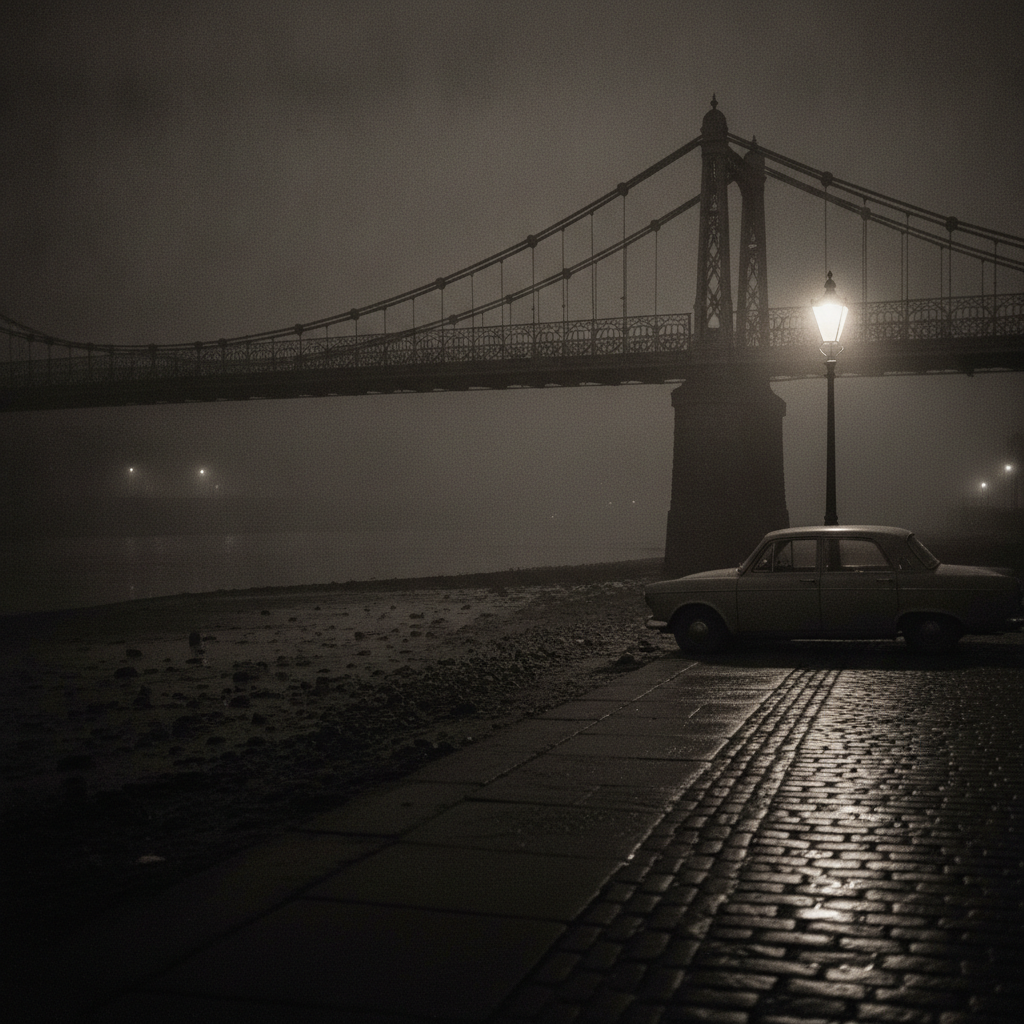
Jack the Stripper: 6 women, one year by the Thames, and a killer Scotland Yard never charged
In the winter of 1964, the women who worked the night streets of west London were afraid of the river.
The river is the Thames. Where it bends through the districts of Hammersmith and Chiswick, about 7 km west of central London, its banks were lined with boatyards, pubs, small factories and long stretches of mud that the tide covers and uncovers twice a day.
Between February 1964 and February 1965, the bodies of 6 women were found in this part of London. Some lay on the mud of the riverbank. Others lay in alleys, a car park, a quiet residential street. All of them were naked.
All 6 were young. All 6 earned their living as prostitutes. Most of them had been strangled or suffocated.
The newspapers gave the unknown killer a name borrowed from the most famous unsolved murders in British history. They called him Jack the Stripper.
Here is the mystery in one sentence: Scotland Yard ran one of the biggest manhunts of its time, questioned thousands of men, came within reach of a factory yard where the killer had hidden at least one body - and still never charged anyone.
The killings stopped in 1965. The killer was never named in a court. More than 60 years later, nobody knows for certain who he was.
This is the story of those 12 months, of the investigation that followed them, and of why it failed.
Before the series began
Some investigators believe the killer started earlier than 1964. Two older deaths are often added to the list, though police at the time did not link them for certain.
On 17 June 1959, at 5:10 in the morning, the body of a 21-year-old woman was found at Duke's Meadows, a riverside park in Chiswick. Her name was Elizabeth Figg. Her dress had been torn open at the waist. The marks on her neck showed she had been strangled by hand.
Her underwear, her shoes and her handbag were missing. They were never found. Detectives later wondered whether she had been undressed inside a car, and whether those things simply stayed in the car when her body was dumped.
Four years later, on 8 November 1963, workmen were clearing a rubbish tip on Townmead Road in Mortlake, also beside the Thames. A shovel struck a buried body and accidentally cut off the head.
The dead woman was Gwynneth Rees, 22, from Wales. She had disappeared 6 weeks earlier, on 29 September 1963. She was naked except for one stocking on her right leg.
The sources disagree about how she died. One account says the cause could not be determined. Another says she had been strangled with a ligature and that several of her teeth were missing. That detail - missing teeth - would come up again.
Neither case was solved. At the time, they were 2 sad deaths among many in a big city. That changed in 1964.
The first body on the foreshore
On 2 February 1964, the body of a woman was found on the Thames foreshore, the muddy strip uncovered at low tide, below Linden House, close to Hammersmith Bridge.
She was Hannah Tailford, 30, born in the north of England. She had disappeared in January.
She was naked. Several of her teeth were missing. Her underwear had been forced into her mouth.
Here again the record is not clean. The pathologist's findings, as summarised in the sources, point to strangulation, while the official cause of death recorded in some summaries is drowning. What is certain is that someone had stripped her and left her at the river.
Two months later, on 8 April 1964, a second body was found on the foreshore, at Corney Reach in Chiswick, not far from where Hannah Tailford had been found.
She was Irene Lockwood, 25. She had last been seen on 7 April, the night before. She was pregnant. The recorded cause of death was drowning.
Two naked women, both working on the street, found on the same stretch of river within 9 weeks. The police now began to talk openly of a link. They also looked back at Elizabeth Figg in 1959.
A confession that collapsed
At the end of April 1964, the investigation seemed to be over before it had properly begun.
A 57-year-old man who worked as a caretaker at a lawn tennis club in Holland Park walked into a police station. On 27 April he confessed to killing Irene Lockwood.
He was charged and sent for trial. But in court he withdrew the confession. His account contained details that did not match the facts, and there was no other evidence against him.
On 23 June 1964 a jury found him not guilty. He was acquitted, and under the law he was innocent of the crime. Any account of this case must say so plainly.
By then, it no longer mattered to the investigation. Because while he was in custody, the killer had struck again.
The paint on the bodies
On 24 April 1964, while the caretaker was still being questioned, a woman's body was found in an alley behind a house on Boston Manor Road in Brentford, a short distance west of Chiswick.
She was Helen Barthelemy, 22. She had disappeared 2 days earlier, on 22 April. She had been strangled.
This time the scientists at the police laboratory found something new. On her skin were tiny flecks of paint.
It was not the kind of paint found on a woman's clothes by chance. Detectives began to suspect that the killer worked at, or had access to, a place where paint was sprayed, and that the body had lain there before it was dumped.
On 14 July 1964, a fourth body was found in the open, outside a house on Berrymede Road, a quiet residential street in Chiswick.
She was Mary Fleming, 30. She had been missing since 11 July. Residents told police they had heard a car reversing in the street shortly before she was found.
She too had been strangled. And on her body, again, were spots of paint.
Now there was a pattern. Each woman had disappeared at night. Each was found days later, naked, dumped as if from a vehicle. And the paint linked at least 2 of them to the same unknown place.
A grey car in Kensington
On the night of 23 October 1964, a 21-year-old woman named Frances Brown got into a client's car. A friend who worked with her watched it happen.
The friend later gave the police a description of the man and of the car. She believed the car was a Ford Zephyr or Zodiac, grey in colour - large, common family saloons of the time.
Frances Brown did not come back. On 25 November 1964, more than a month later, her body was found in a car park on Hornton Street in Kensington, a little east of Hammersmith. She had been strangled.
She had a public past. In 1963 she had appeared as a defence witness at a famous London trial connected with the Profumo affair, a political sex scandal that had shaken the British government. One writer has noted that Hannah Tailford was also loosely connected to the same circles. Whether that link meant anything has never been shown.
For the investigators, the car was the first real description they had. But London was full of grey Ford saloons. Without a number plate, it led nowhere.
The detective from Scotland Yard
By the end of 1964 the case had been placed in the hands of one of Scotland Yard's best-known detectives, Chief Superintendent John Du Rose.
He took over a team that had already been working for months, and he made the scale of the manhunt clear.
According to the most cited account, almost 7,000 men were questioned in the course of the inquiry. Other sources give a lower figure of about 1,700 potential suspects. The sources disagree, and both figures appear in the record.
The investigators now had 3 kinds of clues. The bodies themselves, stripped and dumped. The description of a grey car. And the paint.
The paint was the strongest lead. If they could find the place where it came from, they believed, they would find the man.
The last victim
On 16 February 1965, the body of a woman was found near a storage shed behind the Heron Trading Estate, an industrial estate in Acton, a neighbouring district of west London.
She was Bridget O'Hara, 27, known as Bridie. She had been missing for 5 weeks, since 11 January 1965.
She had died of asphyxiation. On her body, again, were flecks of industrial paint.
But the pathologist noticed something more. Her body showed signs of having been kept in a warm place for some time after death, before it was left outside.
That meant the killer had somewhere to hide a body for weeks. A building nobody entered. Somewhere warm.
The transformer
The scientists compared the paint from Bridie O'Hara with the paint found on the earlier victims. They matched.
The search now focused on the Heron Trading Estate itself. Officers went through it building by building.
In the spring of 1965 they found what they were looking for. Behind one of the buildings stood an electrical transformer, hidden from view. Under it was paint of the same kind found on the bodies. Facing it was a workshop where paint was sprayed.
A transformer gives off heat. The space around it would stay warm all winter. Detectives believed this was where the killer had kept Bridie O'Hara's body.
It was the closest the investigation ever came to the killer himself. He had been here. He knew this yard. He had access to it at night.
The bluff
John Du Rose now did something unusual. He went to the press.
At a series of news conferences he announced that the police had narrowed the list of suspects to 20 men. Then to 10. Then to 3.
According to later accounts, this was not true. It was a bluff. The aim was to frighten the killer - to make him believe the police were about to knock on his door, and to stop him from killing again.
Whether because of the bluff or not, no more bodies were found. Bridie O'Hara was the last.
**This is where the documented investigation stops. The police never arrested the man they were looking for, and no court ever heard the case.**
The security guard
The detectives had one man in mind.
He was a Scottish security guard who worked at the Heron Trading Estate. His job gave him access to the yard where the transformer stood, at the hours when the estate was empty.
He became a suspect after Bridie O'Hara's murder. Shortly after the police connected the paint to his workplace, he killed himself in his garage with car exhaust fumes.
He left a note. It said that he could not stand it any longer, and that he would be found in the garage - to save the police the trouble of looking for him.
He never confessed. He was never charged. He died without any court weighing the evidence.
In 1970, in a television interview with the BBC, John Du Rose said that his chief suspect had killed himself before he could be questioned. He did not give the man's name. He called him only "Big John". Later researchers identified "Big John" as the security guard.
A review of the case by Scotland Yard in 2006 and 2007 described the circumstantial evidence against him as "very strong".
And yet there is a serious problem. Later research found evidence that on the night Bridie O'Hara disappeared, the security guard was in Scotland, hundreds of kilometres away. Scotland Yard has suggested that his work records may have been falsified - but that, too, has never been proven.
Where the case stands
The case was never solved. No one was ever charged with the murders of the 6 women of 1964 and 1965. The 2 earlier deaths were never formally linked to them.
The physical evidence gathered at the time - the paint samples, the clothing, the material from the bodies - is believed to have been destroyed or lost. That means modern DNA testing, which has solved other old murders in Britain, cannot be used here.
The main suspects named over the years are all dead. Without the evidence, and without a living person who can be questioned, the case is very unlikely ever to be closed.
The suspects and theories
Every name below has been proposed by someone on the record. None was ever convicted of these murders. Each is a theory, not a fact.
**The Scottish security guard.** Proposed by John Du Rose himself, and supported by Scotland Yard's later review. The evidence: his access to the estate, the timing of his suicide, the note. The problem: research places him in Scotland on the night Bridie O'Hara vanished.
**A famous boxer.** A former British light-heavyweight boxing champion was named as the killer by one writer in 1972, and again in 2001 by the son of a London gangster. He was found shot dead in his car in July 1965, apparently by his own hand, a few months after the last murder. The evidence: the timing of his death, and stories passed on second-hand. The problem: there is no solid evidence at all, and the police said he was never a suspect.
**A senior detective.** In a book published in 2002, two authors accused a well-known Flying Squad superintendent. He died in 1970. The problem: the claim rests on no published evidence.
**A child killer from Wales.** In 1921, as a teenager, a young man from Abertillery in Wales murdered 2 young girls. He was too young to be hanged. He was released in 1941, and by 1947 he was living in Fulham, close to Hammersmith. He died in Hammersmith in 1971. A book in 2011 and a BBC documentary, Dark Son, broadcast in January 2019, proposed him as the killer. The evidence: he was a proven killer, living in the right area at the right time. The problem: nothing connects him directly to any of the women.
Six women - Hannah Tailford, Irene Lockwood, Helen Barthelemy, Mary Fleming, Frances Brown and Bridie O'Hara - and perhaps 2 more before them. Their killer stood in a factory yard in Acton, beside a warm transformer, in the winter of 1965. The police got within a few metres of where he had been.
They never got any closer.