The Lesley Molseed Case: 31 Years, the Wrong Man, and a Strip of Tape
On Sunday, 5 October 1975, around lunchtime, a mother in a council estate in northern England sent her daughter to the corner shop.
The girl was 11. Her name was Lesley Molseed.
She was small for her age. She had been born with a heart problem, and at the age of 3 she had gone through open-heart surgery. She was frail, and her family watched over her.
The errand was a simple one. A loaf of bread and a can of air freshener. The shop was a few minutes' walk away. She wore a blue raincoat and carried £1 in change.
She was seen walking along a narrow footpath between the houses, close to home.
That was the last time anyone who knew her saw her alive.
When she did not come back, her parents went looking. By about 3 in the afternoon they had called the police.
The estate is called Turf Hill. It is on the edge of Rochdale, a town in England about 16 km north of the city of Manchester.
Three days on the moor
For 3 days the police and neighbours searched the streets, the waste ground and the fields around the estate.
On the morning of Wednesday, 8 October, at about 8 o'clock, a driver pulled into a lay-by on a road that crosses the moors to the east of the town.
He saw something on the slope above the road. It was Lesley.
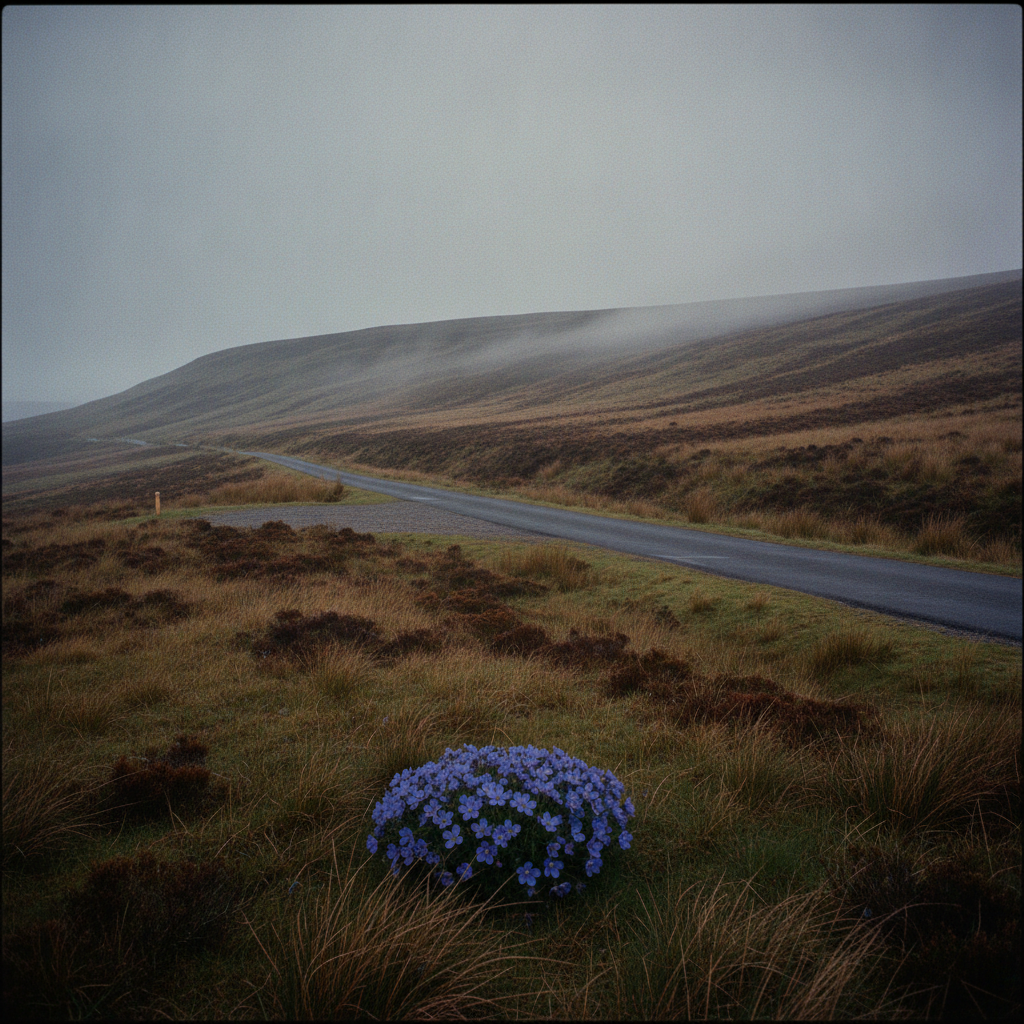
She lay face down on the hillside, about 9 metres above the road. The place is Rishworth Moor, over the county border in West Yorkshire, a short drive from her home.
She had been stabbed 12 times. One of the wounds had reached her heart. She had no wounds on her hands or arms, the kind people get when they try to fight back. Her pound was gone.
There was one more finding. On her clothing the scientists found traces of semen. The man who killed her had also attacked her sexually.
This is what the case is about, in one sentence: a little girl was murdered on a hillside, the police convicted a man who could not possibly have done it, and it took 31 years to find the man who did.
Because the body was found in West Yorkshire, the murder belonged to the West Yorkshire police. A senior detective took charge.
The forensic teams collected everything they could from the hillside and from her clothes. The list came to 379 small items. Among them were foreign fibres, and traces of dried wallpaper paste.
The most important item was the semen. In 1975 there was no DNA testing. But a scientist could still look at the stains under a microscope and see whether they contained sperm.
He looked. He wrote in his notebook that sperm heads were clearly present.
That note is the centre of this whole story. Remember it.
A suspect nobody had to look far for
In the weeks after the murder the police took statements from hundreds of people on the estate.
Among them were 4 local girls and young women. They said that a man had exposed himself to them in the area the day before Lesley disappeared.
They named a local man. His name was Stefan Kiszko.
He was 23. He worked as a clerk in a tax office. He lived with his mother, not far from Lesley's home. His father, who had come to England from Eastern Europe, had died some years earlier.
He was a large, clumsy man, and slow in the way he spoke and understood things. Later, doctors and psychologists described him as having the mind of a child. The sources do not agree on the exact age they gave.
He had a medical condition. His body did not produce enough male hormone, and he was being treated with hormone injections.
He also had an odd hobby. He wrote down the registration numbers of cars that he thought had annoyed him. To the detectives, a man who wrote down car numbers and owned a car looked like a man who could drive a girl up to the moor.
In his car they found a bag of sweets and some adult magazines.
On 21 December 1975, 11 weeks after the murder, the police arrested him.
He was questioned over 3 days. No lawyer was present. His mother was not allowed to sit with him.
At the end, he confessed.
Years later he explained why. He believed that if he told them what they wanted to hear, they would let him go home to his mother for Christmas. Then, he thought, everything would be sorted out.
It was not sorted out. On 24 December 1975, Christmas Eve, he was charged with murder.
What the police knew and did not say
After the arrest, the police took a sample from him to compare with the stains on Lesley's clothes.
Here is the problem the investigation now faced.
The sample from the suspect contained no sperm at all. His condition had left him unable to produce any.
The stains on Lesley's clothing were full of sperm.
In other words, the scientific evidence said plainly that the semen on the girl could not have come from the man who had confessed.
There was a second fact. According to medical records, the suspect had broken his ankle some months before the murder. The killer had carried or led a girl up a steep slope.
Neither fact was given to his defence. Neither fact was heard by the jury.
The trial
The trial began on 7 July 1976, at the crown court in Leeds.
The prosecution relied on the confession and on the 4 witnesses who said he had exposed himself.
His own defence team made a choice that hurt him badly. Alongside the claim that he was innocent, they also argued that if he had done it, he was not fully responsible for his actions because of his mental state. He had never agreed to that line. To a jury it sounded as if even his own side thought he might be guilty.
On 21 July 1976, after 5 hours and 35 minutes, the jury convicted him by a majority of 10 to 2. He was sentenced to life in prison.
At about the same time, something happened a few kilometres away that nobody connected to the case.
On 3 July 1976, 4 days before the trial began, a young man from the same area abducted a 9-year-old girl and indecently assaulted her. He pleaded guilty and was fined £25. 2 years later he was fined again, this time for indecently assaulting a 7-year-old boy.
Nobody looked at him in connection with Lesley. He had a record of attacks on children and he came from her estate. But the case was closed. The police already had their man.
In prison, the man convicted of killing a child was a target.
He was attacked by other prisoners again and again. In one attack, in 1977, he needed 17 stitches. He was moved into segregation for his own protection.
In 1978 he appealed. The Court of Appeal found no grounds at all to question the verdict.
From about 1979 his mind began to break. He developed schizophrenia. He came to believe strange things about the world and about himself.
He always said he had not killed Lesley.
A mother who would not stop
Outside, one person never accepted the verdict. His mother.
She had no money and no connections. In 1984 she wrote to a legal charity. In about 1987 she was put in touch with a solicitor who agreed to look at the file.
The solicitor read it and found things that did not add up. Together, they prepared a petition to the Home Secretary, the government minister responsible for the police and prisons.
It worked. In 1991 the case was reopened.
The second investigation
The West Yorkshire police gave the review to a detective superintendent who had not been part of the original inquiry.
His instructions were to look at everything again, from the beginning, without assuming anything.
He went back to the original laboratory records from 1975.
There, in the scientist's own notebook, was the line about the sperm heads. It had been there the whole time.
The new team asked a different forensic scientist to look again at the original microscope slides. The slides had been kept. He confirmed it: sperm heads, clearly visible.
Then the doctors examined the prisoner. His condition was confirmed. He was, and had always been, unable to produce sperm.
The investigators also went back to the 4 witnesses. Now grown women, they admitted that the story of the man exposing himself had been made up. According to the court records, they said they had done it "for a laugh".
Cleared
On 17 February 1992, the case came before the Court of Appeal in London.
The most senior judge in England, the Lord Chief Justice, heard it with 2 other judges. He said that the man had been shown to be unable to produce sperm, and so could not have been the murderer.
The conviction was quashed. After 16 years in prison, Stefan Kiszko was free.
He was never really free. He was sent to a psychiatric hospital for treatment, and left it in March 1992. He lived with his mother and went out very little.
He died of a heart attack in December 1993, less than 2 years after he was cleared. He was 41. Most accounts give December 1993; one gives October.
His mother died in May 1994.
In 1994 the senior detective from the original investigation and the forensic scientist were charged with perverting the course of justice. The charge was that they had held back the evidence that would have cleared him.
In 1995 a magistrate stopped the case. He ruled that so much time had passed that a fair trial was no longer possible.
So no court ever decided whether the 2 men were guilty. In law, they remain innocent of that charge. The detective died in 2007.
Back to the beginning
After 1992 the police had a terrible position. They knew who had not killed Lesley. They did not know who had.
The case was now 17 years old.
Here the story nearly ends for good. In October 1985, 10 years after the murder, Lesley's clothes had been destroyed. That was normal practice at the time for a solved case.
But one thing had survived.
In 1975, the scientists had pressed strips of sticky tape against her clothing to lift off fibres and stains. Those tape strips had been filed away in the laboratory. Nobody had thrown them out.
On the tape, there were still a few sperm heads.
In 1999, using the new DNA techniques, scientists managed to build a full genetic profile of Lesley's killer from those tiny traces. They ran it through the national DNA database.
No match.
The killer was out there, and he had not been in trouble with the police since the database began. The profile sat in the system, waiting.
It waited 6 years.
On 1 October 2005, a man was arrested in the Rochdale area over an allegation of a sexual attack. He was not charged. But as with every arrest by then, a swab was taken from the inside of his cheek, and his DNA went into the database.
It came back as a direct hit against the profile from Lesley's underwear.
The man was 53. He was a taxi driver who also sold comic books. He had grown up on the Turf Hill estate, the same estate as Lesley, and still lived only a few kilometres away.
He was the young man who had been fined in 1976 and 1978 for attacking children.
On 5 November 2006 the police arrested him for the murder of Lesley Molseed.
The second trial
His trial began on 22 October 2007, at the crown court in Bradford.
He denied everything.
His defence argued that the DNA sample might have been contaminated. The tape had been stored for decades. Samples from different cases had been handled in the same laboratory.
A forensic scientist told the jury that the chance of the semen coming from someone other than the accused was about 1 in a billion.
On 12 November 2007, 32 years after Lesley died, the jury found him guilty. This time the verdict was unanimous.
He was sentenced to life in prison, with a minimum of 30 years before he can even be considered for release. That makes him at least 83 years old before any hearing.
In July 2008 he tried to appeal. The Court of Appeal refused. One of the judges called the grounds of the appeal "entirely speculative".
**This is where the documented case ends: a named man is convicted, his appeal is refused, and he has never admitted the murder or explained what happened on the moor that Sunday.**
What the records do not contain is his own account. How he met Lesley on the footpath, why she went with him, what happened in the car, and why he chose that hillside. Only he knows, and he has never said.
Conclusions and Open Questions
The case is solved in court. But it leaves more questions than most solved cases.
**How could the evidence be hidden for 16 years?**
The evidence: the scientist's own notebook recorded the sperm in 1975. The sample from the suspect showed none. Both facts sat in the files from before the trial.
The problem: the 2 men accused of holding it back were never tried, so there is no ruling on what they knew, when, and why. One view, argued by the defence campaigners, is that the investigators simply decided they had the right man and ignored anything that pointed elsewhere. Another view is that the significance of the difference was not understood at the time. No court ever tested either.
**Why did nobody look at the man fined in 1976?**
The evidence: 4 days before the murder trial began, a man from the same estate abducted and assaulted a 9-year-old girl, and within days he had pleaded guilty. 2 years later he was convicted again.
The problem: in 1975 and 1976 there was no national computer linking crimes, and different police forces kept their own paper files. Lesley was taken from Greater Manchester and found in West Yorkshire. The earlier offences were handled locally. Once a man had confessed and been convicted, nobody was searching any more. Whether better records would have caught him in 1976 is something nobody can prove.
**Why did the confession work?**
The evidence: a frightened man with limited understanding, 3 days of questioning, no lawyer, and a wish to go home for Christmas.
The problem: in 1975 the rules on questioning suspects in England were much weaker. New rules came in 1984, partly because of cases like this one. They require a lawyer to be offered, and special care with vulnerable people. The case is still taught to police officers as an example of a false confession.
**Did the killer attack anyone else?**
The evidence: he had convictions for attacks on 2 children before 1979, and an arrest for another alleged sexual attack in 2005 that did not lead to a charge.
The problem: the police have never publicly linked him to any other killing. Any suggestion that he did more is guesswork, and the record does not support it.
**What would have happened without the tape?**
This may be the strangest question of all. The clothes were destroyed in 1985. If a laboratory worker had tidied the files and thrown out a few strips of old tape, there would have been no DNA in 1999, no match in 2006, and Lesley's killer would still be unnamed.
The first investigation had the answer in a notebook and did not use it. The second investigation had nothing but a few specks on a strip of tape, and used it to end the case.