The Beautiful Cigar Girl: Who Killed Mary Rogers in 1841?
On Sunday morning, 25 July 1841, at about 10 o'clock, a young woman knocked on the door of a lodger's room in her mother's house in New York.
Her name was Mary Rogers. She was about 21 years old. The lodger was Daniel Payne, a cork cutter who rented a room in the house. He was also her fiancé.
She told him she was going to spend the day with her aunt and her cousins, on the other side of the city.
According to later accounts, he answered that he would come for her in the evening and walk her home.
She went out into the street. It was a hot summer Sunday.
Nobody who knew her ever saw her alive again.
That evening a heavy thunderstorm broke over the city. He did not go to fetch her. Her mother, by her own account, was relieved that her daughter was not out in the storm.
On Monday the weather cleared. Mary did not come home.
In the evening Payne went to the aunt's house. The aunt told him that Mary had never arrived. She had not been there on Sunday at all.
Who she was
To understand why this case shook a whole country, you have to know who Mary Rogers was.
She was born around 1820 in a small town in Connecticut, in the north-east of the United States. No birth record survives, so the exact year is not certain. Her father died when she was young. Her mother moved with her to New York and opened a boarding house: a house where people rent a room and eat at a shared table. It stood at 126 Nassau Street, in the heart of Manhattan, the oldest part of the city.
As a teenager Mary took a job behind the counter of a tobacco shop on Broadway, the city's main street. The owner paid her well, and he had a reason. She was very beautiful, and men came into the shop just to look at her. Writers, journalists and politicians bought their cigars there.
The newspapers gave her a nickname: "the Beautiful Cigar Girl." A customer even published a poem about her in a newspaper.
So when she vanished, the city already knew her face.
The first disappearance
There is one more detail, and it matters for everything that came later. This was not the first time Mary Rogers had disappeared.
The sources disagree about when it happened. Most say it was in October 1838. A New York newspaper reported then that the cigar girl had vanished from home, and that her mother had found a note that sounded like a farewell before suicide. The next day another paper reported that it was all a false alarm: she had simply been visiting a friend in Brooklyn, across the river.
An account written in 1910 by a police historian places a similar disappearance in early 1841, and says she was gone for 6 days and came back without explaining where she had been.
Either way, the episode left a mark. Some newspapers suggested that the shop owner had staged the whole thing to get publicity for his shop. Others hinted that there was a man involved. Nothing was ever proven.
After this, Mary left the shop and went back to help her mother run the boarding house. A few months later her engagement to Daniel Payne was announced.
The body in the river
Now back to July 1841.
For 2 days Payne searched for her. He went from one end of the city to the other. After 2 days he placed a notice in a newspaper asking for information about a missing young woman.
On Wednesday, 28 July 1841, men in a small boat on the Hudson River saw something floating in the water. The Hudson is the wide river that separates New York from the state of New Jersey.
They were opposite Hoboken, a town on the New Jersey side, a short ferry ride from Manhattan. In 1841 Hoboken was a place where New Yorkers went on Sundays to get out of the city: there were riverside lawns, taverns, and a cave with a spring of fresh water that was a popular attraction.
The thing in the water was about 180 metres from the shore, not far from that cave. The men rowed out to it. It was the body of a young woman.
The sources disagree on how many men there were and who they were: 2 day-trippers, 3 men in a rowboat, or fishermen setting their nets. All agree on the place and the date.
They towed the body to the shore and laid it on the bank. It lay there in the summer heat for about an hour before the coroner arrived. A crowd gathered.
A former lodger of the boarding house, who had once courted Mary, had come over from New York when he heard of the find. He looked at the clothes and the body and said it was her. The police questioned him too, and let him go. Nothing connected him to the death.
What the coroner found
The coroner of Hoboken was a doctor. He examined the body on the spot and then more closely.
This is what his report and the press accounts of it say.
There were dark bruises on both sides of her neck, in the shape of fingers.
A strip of cloth was tied very tightly around her neck, so tight that it had sunk into the flesh. The sources disagree about what it was: one says a piece of lace trimming, another says a strip torn from her underskirt. One account says the coroner noted that it was tied in a sailor's knot.
There were marks on her wrists, as if they had been tied.
Her dress was torn. The coroner concluded that she had been sexually assaulted before she died.
Her light gloves were still on her hands. Her bonnet hung around her neck by its ribbons.
His conclusion was murder by strangulation.
An account written in 1910 adds that a rope was tied around her waist with a heavy stone at the other end, as if someone had tried to sink her. The earlier sources do not mention this, so it is not certain.
Not everyone was happy with the examination. A reporter for a small-town newspaper in New York State wrote about the "slovenly manner" of the Hoboken coroner. The body had lain in the heat, the crowd had pressed around it, and evidence that might have been there was lost in the first hours.
A city with no detectives
At this point the reader needs to know one thing about New York in 1841: it had no real police force.
The city had about 320,000 people. To keep order it had a night watch made up of part-time men, 100 city marshals, 31 constables and 51 police officers. There was no detective department. Nobody's job was to solve murders.
And the body had been found in another state. Hoboken was in New Jersey, not New York.
The newspapers soon turned on the authorities. Every day they printed new rumours and new accusations that nothing was being done.
About a week after the body was found, the authorities issued a proclamation. They offered a reward for information, and a promise: any accomplice who helped convict the killer would not be prosecuted, as long as he was not the killer himself. The governor of New York announced a reward of 750 dollars.
The first suspect
The first person the investigators looked at was the fiancé.
Daniel Payne was the last known person to see her. Rumours spread that the couple had been quarrelling, and that she had threatened to break off the engagement.
He was questioned. He gave an account of where he had been on Sunday and Monday, and people confirmed it. He was released. He was never charged with anything.
The letter about the gang
Then a letter arrived.
The day after the reward was announced, the coroner received an anonymous letter. The writer said he was a young man from Hoboken.
He wrote that on that Sunday he had seen a young woman matching Mary's description in a riverside park in Hoboken, with 6 rough-looking men who had come from a boat. He also described a second boat, with 3 well-dressed men in it. One of them, he wrote, asked whether the men had used violence on the woman. Then that boat went back to New York.
The letter was printed in the newspapers. The writer was never identified.
Soon after, 2 men who had been on the shore that day came forward. They said they had seen a woman who looked like Mary with a group of rough men. But they could not say for certain that it was her.
This became the most popular theory in the city: that Mary Rogers had been attacked by one of the street gangs that roamed the riverside on Sundays. The fear of gangs, and of the new immigrants who were blamed for them, filled the newspapers for weeks.
A woman at the inn
A few weeks after the murder, a stagecoach driver came forward. He said that on that Sunday he had seen a young woman matching Mary's description get off near Hoboken with a tall, dark, well-dressed man. He said they went to a roadside inn near the cave.
The inn was run by a widow. When the investigators came to her, she said she remembered the couple. A man fitting that description had come in with a young woman. They had a drink, then went out toward the woods behind the inn.
Not long after, she said, she heard a woman scream from the woods. She thought nothing of it at the time. Screams and shouts from the woods were common there on a Sunday.
The investigators accepted her account. Some writers later noted that she had not told any of this in the first weeks after the murder, when the newspapers were full of the case.
The thicket
Then came the most important find in the whole case.
Not far from the inn there was a dense thicket of bushes. Some boys were playing there. They were the sons of the widow who ran the inn.
The sources disagree on the date: early September 1841, or 25 September 1841, about 2 months after the murder.
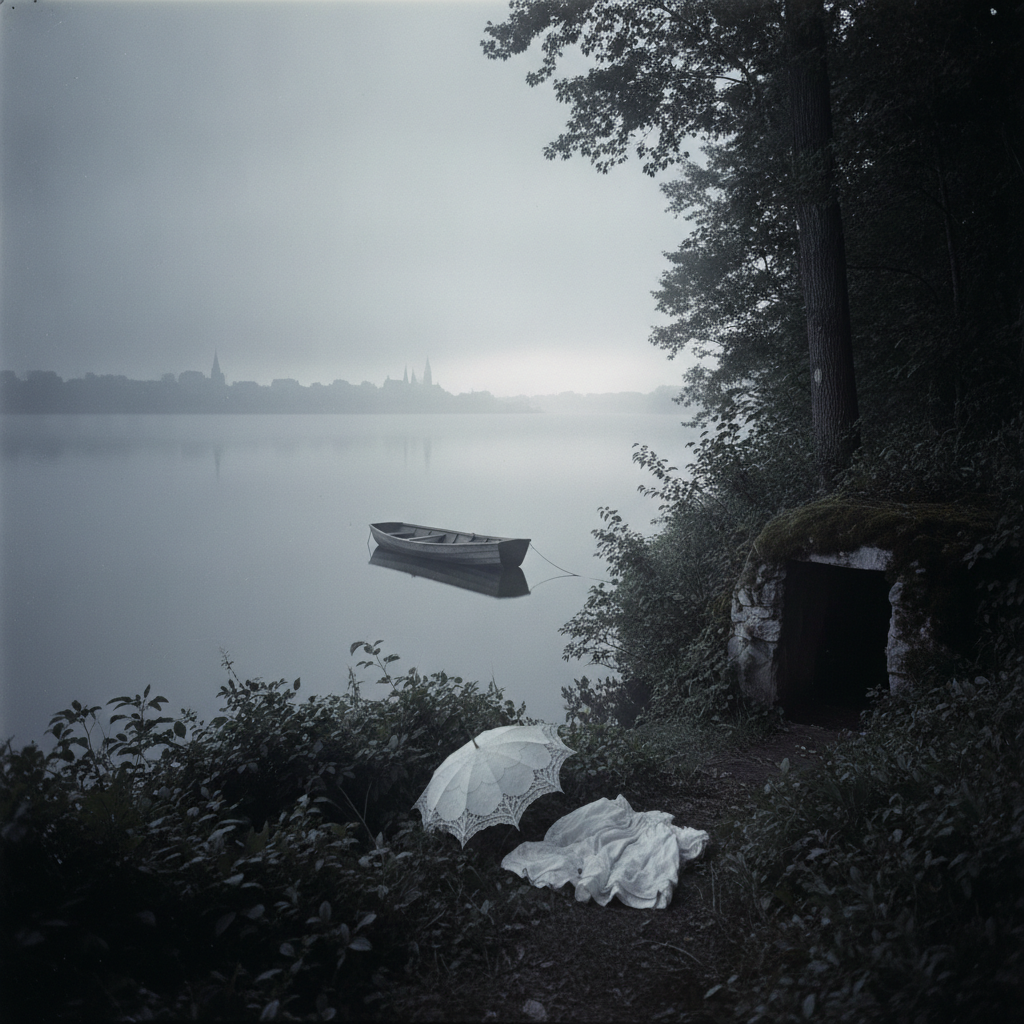
Inside the thicket the boys found women's clothing: a white petticoat, a silk scarf, a parasol, and a linen handkerchief embroidered with the letters "M. R."
The things were identified as the clothes Mary had worn when she left home.
The ground in the thicket was torn up. The bushes were broken and trampled, as if there had been a struggle. A broad track led from the thicket toward the river, as if something heavy had been dragged.
People started calling it "the murder thicket."
But there was a problem with the find. The things had been lying out in the open for 2 months, through summer heat and storms, in a place full of Sunday visitors. Some observers wondered why nobody had seen them before. Others asked whether someone had placed them there later.
The widow also said she had found 2 of Mary's gloves in her yard. The police rejected that at once: Mary's gloves were still on her hands when her body came out of the river.
The fiancé on the bench
Daniel Payne never recovered from her death.
On 7 October 1841, about 10 weeks after she disappeared, he crossed over to Hoboken. He visited the thicket. He went from tavern to tavern, drinking. He bought a bottle of laudanum, a medicine made from opium that was sold freely at the time.
He was found dying on a bench near the cave, a few hundred metres from where her body had been brought ashore. He died there.
In his pocket was a note. It began: "To the World - Here I am on the very spot." It went on to ask God to forgive him for his "misspent time."
The inquest into Mary's death had not yet finished.
People read the note in 2 opposite ways. Some saw it as a confession. Others saw only a man destroyed by grief, who had come to die at the place where the woman he loved had died. The note does not say which. He was never charged, he never stood trial, and the law and this magazine regard him as innocent.
A story in Paris
In 1842, the case reached a writer who was then living in Philadelphia, about 130 kilometres from New York.
Edgar Allan Poe had remembered the cigar girl from the newspapers. He wrote a story called "The Mystery of Marie Rogêt." He moved the whole thing to Paris, renamed the people, and kept almost every other detail of the real case. His fictional detective, Dupin, sits in his room, reads the newspaper reports, and takes apart the theories one by one.
The story came out in 3 parts, in 1842 and 1843. In his introduction Poe claimed that his story was a careful analysis of the real murder in New York.
But the detective never names a killer. And the real police paid no attention to the story.
The deathbed confession
Then, in the autumn of 1842, a new explanation appeared.
The widow who ran the inn was accidentally shot by one of her own sons. One source gives the date as 6 November 1842. She died about 10 days later.
Before she died, while she was delirious with fever, she said something new. According to the reports, she said that Mary Rogers had come to her inn that Sunday with a young doctor, to have an abortion. At that time an abortion was dangerous and done in secret. She said Mary died during the operation. Her sons, she said, then took the body to the river, threw it in, and scattered the clothes in the thicket.
A New York newspaper printed this under the message that the mystery was "at last explained."
The 2 eldest sons were arrested and charged with helping to hide the body. The charges were soon dropped. There was no physical evidence, there were no other witnesses, and the only source was the words of a dying woman in a fever.
The police did not believe her. The young doctor was never identified.
Here is where what we know ends
**And that is where the documented trail stops. Nobody was ever convicted, and nobody knows who killed Mary Rogers, or even for certain how she died.**
The case was never solved. Several things make it impossible to solve today.
The examination of the body was hurried and done in the open, in the heat, in front of a crowd.
The crime crossed a state border, and no single authority owned it.
The clothes in the thicket were found 2 months late, by the sons of the woman who would later confess.
And every witness who came forward did so after reading the newspapers, which had already told the whole city what to look for.
What the case changed
The murder of Mary Rogers did not find its killer. But it changed the city.
In 1845 the state of New York passed a law that made it a crime for a woman to seek an abortion. Mary Rogers was cited as one of the reasons for it. In the same year the city passed a police reform law and set up a modern, full-time police force, in place of the old night watch.
Poe also returned to his story. In a later version he added small hints pointing toward the abortion explanation.
The suspects and the theories
All the people involved died long ago. These are the theories as they stand in the documented record.
**The gang.** The anonymous letter and the 2 men on the shore described a woman with a group of rough men. This was the theory most newspapers believed in 1841. The problem: the letter writer was never found, and the 2 men could not say it was her.
**The fiancé.** He was the last person to see her, there were rumours of a quarrel, and his last note said "here I am on the very spot." The problem: his account of his movements was confirmed, and the note can be read as grief just as easily as guilt. He was never charged.
**A failed abortion.** In August 1841 a newspaper editor already suggested it. The innkeeper said it on her deathbed, and Poe later hinted at it. The problem: the coroner found bruises from fingers on her neck and a cloth tied tight around it. That does not fit a death on an operating table, unless the body was made to look like a murder afterwards. And the confession came from a woman in a fever.
**The unknown man.** The coachman and the innkeeper both described a tall, dark, well-dressed man. The problem: he was never identified, and their accounts came weeks after the murder.
**The shop owner.** He died in Paris in 1881, and he said that Mary's ghost haunted him. In 1887, in a court fight over his money, a lawyer claimed that he had paid Poe 5,000 dollars to write the story and turn suspicion away from himself. The problem: nothing was ever produced to support that claim. It was said by a lawyer in a fight over an inheritance, 46 years after the murder.
185 years later, the Beautiful Cigar Girl is still where Poe left her: in a story with a detective, and no killer.