A Letter, a Storm and a Cut Throat: the Peasenhall Murder
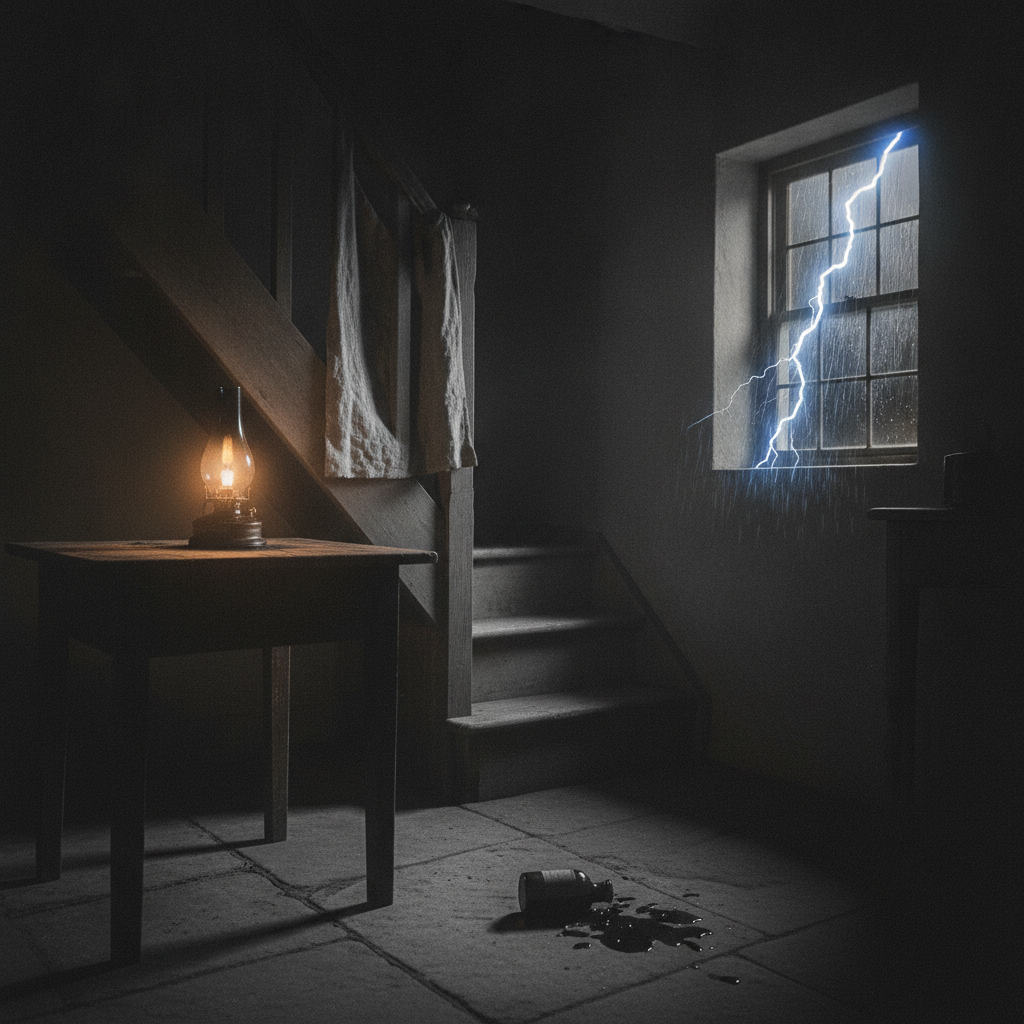
On the evening of Saturday 31 May 1902, Rose Harsent was alone in the kitchen of the house where she worked.
This is the story of the Peasenhall murder. Before morning, Rose would be dead, with her throat cut. A local chapel choirmaster was tried twice for killing her, and both times the jury could not agree. More than 120 years later, nobody knows for certain who killed her.
Rose was 22. She was a live-in servant to an elderly couple in Peasenhall, a village in the county of Suffolk in eastern England, about 16 km from the North Sea coast. Around 700 people lived there, in about 180 houses.
The house was called Providence House. Rose slept in a small room at the top, reached by a narrow back staircase that came down into the kitchen.
On Sundays she sang in the choir of a Methodist chapel in the next village. During the week she also cleaned another chapel in Peasenhall.
That afternoon the post had brought her a letter. It had no signature.
At about 10 that night her mistress spoke to her for the last time. Then the old couple went up to bed.
Later that night a heavy thunderstorm broke over the village. One account puts its start at about 11:30. It went on for hours.
Some time in the dark, the mistress heard a sound from downstairs. In court it was described as a stifled scream and then a thud. She wanted to go down and look. Her husband stopped her. The storm was loud, and they stayed in bed.
Sunday morning
At 8:40 the next morning, Rose's father walked up to the house. He was bringing her clean linen and milk.
The house was quiet. He went into the kitchen.
His daughter was lying on the floor at the foot of the back stairs. Her head was against the bottom step and her feet pointed towards the door. She was wearing only her nightdress. She was cold.
There was a great deal of blood. The room smelled strongly of paraffin and of burning.
The front of her nightdress had burned away. Parts of her body were charred. Next to her lay a burned newspaper and a burned tablecloth. On the floor were the pieces of a broken glass bottle.
Her father covered her with a rug and went for help.
The village constable came. He had probably never dealt with a murder before. He sent for a senior officer from a town 11 km away. In the meantime, people came and went through the kitchen. Nobody sealed the room.
The local doctor looked at the body. At first he thought it could be an accident, or even suicide: a fall on the stairs with an oil lamp, perhaps.
Her body was carried to the village pub and locked in a barn behind it.
What the doctor found
The post-mortem examination, made a couple of days later, ended the idea of an accident.
Rose had a stab wound in the chest. Her throat had been cut, in two places. She had a bruise on her face and jaw. There were cuts on her hands, the kind a person gets when trying to fight off a knife.
None of these wounds could have been self-inflicted. Someone had killed her with a knife and then tried to burn the body.
There was one more finding. Rose was about 6 months pregnant.
The sources do not agree on when she died. One account says she had been dead about 4 hours when she was examined. Another says the doctor put the time of death between 2 and 4 in the morning. The letter by her bed, as we will see, named midnight.
The bottle and the letter
The pieces of glass told the police something.
It was a small medicine bottle. It had once held camphorated oil, a common household remedy. Now it smelled of paraffin. Whoever brought it had used it to carry the fuel for the fire.
The bottle still had its chemist's label. It showed that the village doctor had supplied it the previous February, for the children of a local man: William Gardiner.
Among the pieces lay a spent match and a small scrap of blue woollen cloth. The constable and the doctor collected everything and sent it to the government analysts in London.
Upstairs, in Rose's room, the bed had not been slept in. There was a dent in it, as if someone had sat on the edge.
Next to the bed was the letter that had arrived that afternoon. Its envelope carried 2 postmarks, from Peasenhall and from a nearby small town.
It began: "DR, I will try and see you tonight at 12 o'clock at your place." It asked her to put a light in her window at 10 o'clock as a signal, and said the writer would come round to the back.
So someone had arranged to visit Rose at midnight, by the back way into the kitchen.
One detail puzzled people then and still does. The envelope was addressed "Peasenhall near Saxmundham", the way someone from outside the area would write it. A man who lived in the village would hardly need to.
In a chest of drawers the police found about 20 more letters, from her family and from local men. 2 of them were from William Gardiner.
There were also some crude verses. A 20-year-old neighbour, who lived in another part of the same building, admitted that he had written them. He said Rose had asked him to.
The rumour from the year before
To understand why the police went straight to one man, we have to go back a year.
William Gardiner was 35. He was a foreman carpenter at the village's largest employer, a works that made seed drills for farmers. He was married and had 6 children. He lived in a small semi-detached cottage on the main street, in sight of Providence House. The police measured the distance between the two houses: about 190 metres.
He was also a pillar of his church. He was choirmaster of the chapel where Rose sang, and superintendent of its Sunday school.
In May 1901, a year before the murder, 2 young wheelwrights saw Gardiner and Rose go into the chapel that Rose cleaned. The 2 young men stayed outside and listened. They later claimed they heard a conversation of a sexual nature. They said Rose mentioned a passage she had read in the Bible about "what they were doing".
Another member of that congregation said that he too had seen Gardiner behave improperly, and wrote to him suggesting Rose sit somewhere else.
The story went round the village. It reached Gardiner's wife.
His church held an inquiry. It found nothing it could prove. The minister told Gardiner he had been indiscreet and should be more careful. Gardiner, for his part, threatened to sue the 2 young men for spreading lies.
His wife called the whole story rubbish.
Now, a year later, Rose was dead and pregnant, a bottle from his home lay next to her body, and 2 letters from him were in her drawer.
The arrest
On Tuesday 3 June 1902, 2 days after the body was found, the police arrested William Gardiner.
He denied everything. He said he knew nothing about the murder. He said he had not written the midnight letter.
The police collected what they could.
A neighbour said that at about 10 on the Saturday night, before the storm, he had stood outside with Gardiner, talking about the storm that was coming. From the spot where Gardiner stood, the prosecution would argue, a man could see the high gable window of Providence House. A light was burning in it. That was the hour, and the signal, named in the letter.
A gamekeeper said he had walked through the village at about 5 on the Sunday morning, after the rain. He said he saw footprints in the wet ground running from Gardiner's cottage to Providence House, and back again. He thought they had been made by shoes with rubber soles. The police found that Gardiner owned a pair of rubber-soled shoes.
The police took Gardiner's pocket knife. It looked as if it had recently been scraped clean. In the hinge, the analysts found traces of recent blood. They could say only that it was the blood of a mammal. In 1902 there was no way to tell whether it was human, let alone whose.
There was also a fire. A witness said that at about 7:30 on the Sunday morning Gardiner went into his back yard, where a fire was burning in his wash-house. The prosecution suggested he was burning something. Another account of that morning has him asleep until about 8:30. The two versions were never fully reconciled.
And there was the handwriting. At the hearing before the trial, an expert told the court that the writing on the letter and envelope matched business letters Gardiner admitted writing.
On 2 July 1902, Gardiner was formally sent for trial.
The alibi
Gardiner's defence had its own witnesses.
When the storm broke, the defence said, Gardiner and his wife went next door to their neighbour and sat with her through the worst of it.
The neighbour confirmed this in court. She said Gardiner was in her house from about midnight until about 1:30, when it was already getting light.
After that, the couple went home. Gardiner's wife said she was unwell and awake for much of the night. A neighbour said she heard her through the thin wall, going back to bed at about 4.
If these women told the truth, Gardiner was sitting in his neighbour's house at the exact hour named in the midnight letter.
The defence also attacked each piece of evidence. Only 1 man had seen the footprints, and nobody checked them before they were walked over. Rubber-soled shoes were not rare. Traces of animal blood on a working man's knife proved very little. And not all the handwriting experts agreed that Gardiner wrote the letter.
As for the bottle, how it came to be in that kitchen was never proved.
Two trials, no verdict
Gardiner spent about 5 months in prison waiting for his trial.
The first trial opened in November 1902 at the court in Ipswich, the main town of Suffolk. It lasted 3 days.
The jury went out and could not agree. It was reported that 11 jurors wanted to find him guilty and 1 refused.
At that time, English law required all 12 jurors to agree. One person holding out was enough to block a verdict. The judge ordered a new trial.
The second trial began on 20 January 1903, before a different judge and a new jury. The same 2 lawyers faced each other again.
Again the jury could not agree. This time, it was reported, the split was the other way round: 11 for not guilty and 1 for guilty.
A third trial was possible. The prosecution decided against it. Instead it filed a formal notice, known by its Latin name "nolle prosequi", stating that it would not continue the case.
That meant Gardiner walked free. But he was never declared not guilty either. He is one of very few people in English history who were tried for murder with no verdict ever returned.
Decades later, English law changed to allow majority verdicts. Under today's rules, the first jury's 11 to 1 vote could have convicted him.
Where the case stands
**Here the documented record ends. Nobody was ever convicted of killing Rose Harsent, and no new evidence has come to light since 1903.**
William Gardiner left the village with his family and moved to south London. He died in 1941. He never admitted anything.
In law he must be treated as innocent. He was accused, tried twice, and never convicted. Everyone involved in the case has been dead for many decades.
Why was it never solved? Part of the answer is the scene itself. Nobody protected the kitchen in the first hours. Science in 1902 could not tell human blood from animal blood, and had no DNA. Nobody could test who was the father of Rose's unborn child.
A modern British crime writer who studied the case argued that with today's methods it would probably have been solved within about 24 hours.
The suspects and the theories
**Theory 1: William Gardiner.** This was the prosecution's case. He was the father of the child, wrote the letter to arrange a midnight meeting, and killed her to save his name and his marriage. The evidence: the rumour of 1901, the bottle with his children's label, his letters in her drawer, the expert who matched his handwriting, the footprints and the knife. The problem: 2 witnesses gave him an alibi for midnight. The experts disagreed. Much of the rest rests on single witnesses. Two juries could not convict him.
**Theory 2: Gardiner's wife.** In a 2005 BBC television documentary, a British writer who re-examined the case concluded that the killer was probably Gardiner's wife, acting out of jealousy. He suggested she would have confessed if her husband had been convicted. The evidence: she knew the rumours, she was awake that night, and the bottle came from her home. The problem: there is no direct evidence against her. She was never charged. The crime writer mentioned above found the idea unconvincing: if her husband had gone to prison, she and her 6 children could have lost their home.
**Theory 3: another man.** The same crime writer believes Gardiner was innocent. He thinks Rose had another lover, who was the father and the killer. He also pointed out that from Gardiner's cottage there was only a narrow angle of view to Rose's window, which would make the signal light hard to see. The evidence: Rose had other admirers, as the letters and verses in her room show. The odd address on the envelope suggests someone from outside the village. The problem: no such man was ever identified.
Three questions remain open. Who wrote the midnight letter? Who was the father of the child? And how did a medicine bottle from the Gardiner home end up on that kitchen floor?